
The Hybrid Human-AI Workforce: How Agencies Should Actually Structure It in 2026
The Hybrid Human-AI Workforce: How Agencies Should Actually Structure It in 2026. A hybrid human-AI workforce means AI agents handle repeatable, data-heavy execution — research, drafting, routing, reporting — while people own the brief, the judgment calls, and anything that touches client trust or real risk. The adoption numbers you’ll see cited get thrown around loosely — 79% “adopted” per PwC sounds nothing like 40% “in production” per IDC — and that’s because adopted, deployed, and scaled are three different questions, worth knowing before you benchmark your own agency against any single statistic.
Table of Contents
Why AI-Agent “Adoption” Numbers Are All Over the Map
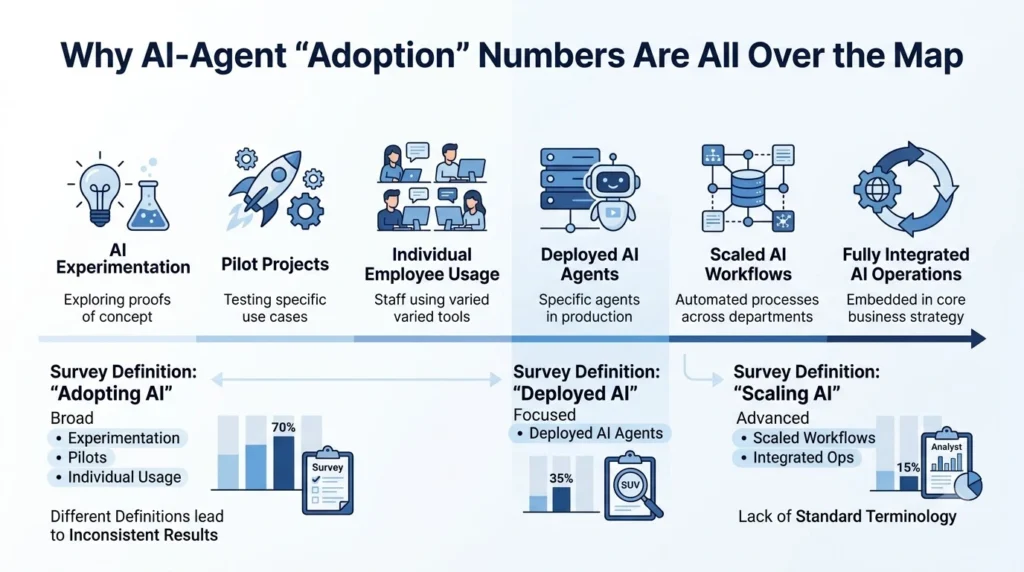
Start with the two most-cited 2026 figures, because the gap between them tells you almost everything. PwC’s survey of 308 US executives found 79% reporting AI-agent adoption at their company, with 66% of adopters seeing measurable productivity gains — but that same survey found 68% admitting half or fewer of their employees actually interact with an agent day to day. “Adopted” in that survey covers any pilot, proof of concept, or single-team experiment happening anywhere in the building — a much lower bar than it sounds. The Hybrid Human-AI Workforce: How Agencies Should Actually Structure It in 2026
KPMG’s Q1 2026 AI Pulse Survey asked a tighter question and got a correspondingly different answer: 62% of organizations were either scaling or actively deploying agents, with another 30% piloting. Even within KPMG’s own survey series, the wording moves the number — a slightly different question in the following quarter produced a noticeably different percentage from a comparable sample, and researchers tracking this across publishers have found that swapping “adopted” for “deployed to date” can shift a headline figure by roughly 60 percentage points on its own. None of these numbers are wrong. They’re answering different questions, and treating them as interchangeable is the single most common mistake in AI-adoption reporting right now.
Here’s a genuinely new data point worth building into your planning: KPMG’s follow-up survey, released in June 2026, found that while 66% of organizations now have AI monitoring dashboards and 61% have approval processes in place, only 26% report full, real-time visibility into what their AI systems actually cost to operate. Deployment is outpacing cost governance almost everywhere — a pattern worth remembering the moment you start pricing a platform for your own agency.
On the UK side, the Agency Performance Pulse 2025 found a third of independent agencies had seen productivity gains from AI automation, with 23% citing AI adoption as their leading opportunity — but the survey covered only 89 agencies and explicitly describes itself as directional, not statistically representative of the UK’s roughly 8,000 independent agencies. There’s no reliable public benchmark yet for “hybrid human-AI agency adoption” specifically. What exists are three genuinely different things worth keeping separate in your own head: individual employees using an AI tool, an AI agent deployed inside one business function, and a formally redesigned hybrid workforce with documented roles, quality gates, and governance. Most agencies citing “AI adoption” right now are somewhere in the first two.
The Operating Model: Risk-Tiered Autonomy
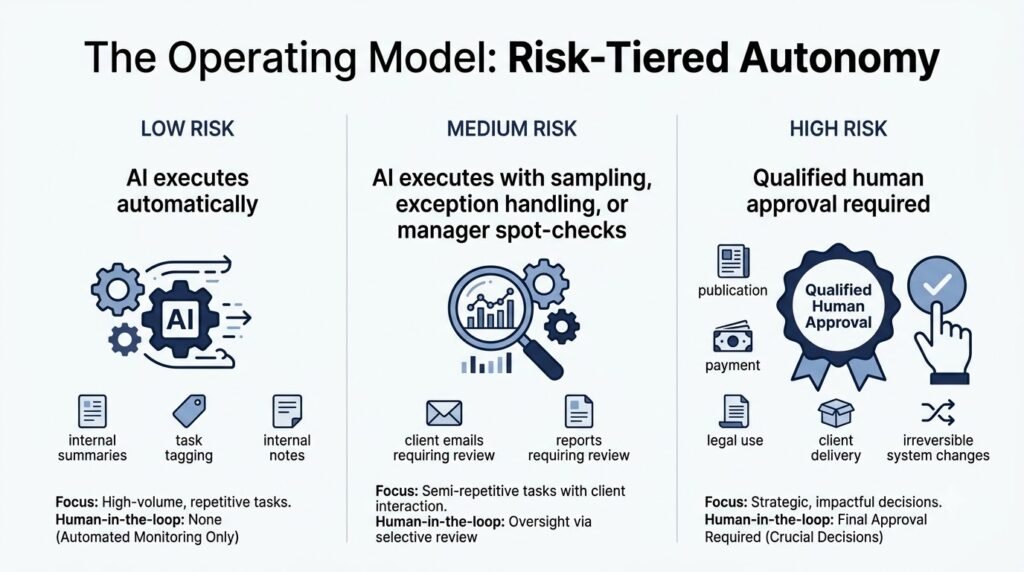
The practical framework underneath all of this is simpler than the adoption statistics make it look. Not every workflow needs the same level of human oversight:
- Low risk — AI executes automatically. Tagging an internal task, generating a first-pass summary, drafting an internal note nobody’s relying on for a decision.
- Medium risk — AI executes, but with sampling, exception handling, or manager spot-checks. A drafted client email that goes out after a quick review, a report that gets skimmed before sending.
- High risk — a qualified human approves before anything happens. Publication, payment, legal use, client delivery, or any system change that’s hard to undo.
The underlying principle: humans define the brief, the audience, the success metric, the tone, and the quality bar. Agents handle the research, the drafting, the data transformation, and the coordination between systems. The reviewer’s job isn’t proofreading — it’s checking factual accuracy, strategic fit, brand alignment, privacy exposure, and whether the output is actually suitable for this specific client.
What Changes Structurally
Three shifts show up consistently in agencies actually running this model, not just experimenting with it:
Productized services replace pure hourly billing. Instead of selling only labor, agencies package repeatable workflows — AI-assisted SEO content with human editorial review, automated campaign reporting with strategist interpretation, AI-supported QA with human release sign-off, automated lead research with human qualification.
Fractional teams become viable at smaller scale. A small senior group — full-time strategists and creative leads — can combine with AI agents and fractional specialists to sell senior expertise while flexing production capacity up or down with demand, instead of hiring permanently for peak load.
Agents start talking to each other, not just to one department. The next stage isn’t one agent bolted onto each team — it’s a connected workflow where a research agent hands structured output to a reporting agent, which hands a draft to a human strategist. PwC specifically flagged this cross-application, cross-workflow integration as the biggest gap in most current implementations — most agencies have several disconnected agents, not one coordinated system.
Step-by-Step: Building the Governance Layer Before You Scale
KPMG’s data on this is worth taking seriously: 91% of surveyed leaders factor data security, privacy, and risk directly into their near-term AI strategy, 44% use a human-in-the-loop model where humans validate outputs without supervising every single action, and 43% are actively building controls and evaluation procedures directly into their agents. Here’s the practical build order:
- Name an owner for every AI workflow that touches client work. No shared responsibility — one person accountable for quality and outcomes.
- Define the approved data source and the input/output format before the workflow goes live, not after something goes wrong with an undocumented data pull.
- Write a quality rubric with real test cases and known failure examples, not a vague “make sure it’s good” standard nobody can act on.
- Set the human escalation route explicitly — who gets notified, how fast, and what happens while they’re deciding.
- Turn on an audit trail from day one. You need a record of what the agent did and why before you need it, not after a client asks.
- Pilot on one workflow, measure the baseline, then expand. Time, quality, rework rate, and cost — measured before AI touches the workflow, so you have something real to compare against.
- Revisit the prompts, tools, and policy on a schedule, not only when something breaks. Treat it like ongoing maintenance, not a one-time setup.
New Metrics for a Hybrid Team
Billable hours stop telling the whole story once AI compresses production time — a few numbers worth tracking instead:
- Gross profit per employee and per human hour
- Time from brief to approved deliverable
- First-pass acceptance rate and rework percentage
- AI cost per deliverable
- Human review time per project
- Client outcome or measurable ROI
- Error and escalation rates
Platforms Teams Actually Use for This
The tools below aren’t a complete enterprise AI stack on their own — they’re the management layer most agencies are already building on:
| Platform | Best Fit | Seat/Base Price (2026) | The Meter You’ll Actually Watch |
|---|---|---|---|
| Microsoft 365 Copilot | Agencies already living in Teams, Outlook, SharePoint, and Office | $30/user/month, requires a qualifying Microsoft 365 license | Custom agents built in Copilot Studio bill separately on consumption ($0.01/credit or $200 per 25,000-credit pack) — and since mid-2026, a third layer, Agent 365, adds identity governance at roughly $15/seat on top. Budget all three meters, not just the seat. |
| Asana AI Studio | Agency intake, project triage, SLA management, and workflow routing | Included at a basic level on paid Asana plans; Plus runs roughly $135/month (annual) with a 100,000-credit allowance | Credit consumption scales with model, input size, and execution frequency — real automation use tends to outgrow the included allowance faster than expected |
| Atlassian Rovo | Technical and product agencies living in Jira and Confluence | Core Rovo (Search, Chat, Agents) is bundled into eligible Standard, Premium, and Enterprise Cloud plans at no extra line item; Rovo Dev Standard runs $20/developer/month with 2,000 credits | Usage above the included credit pool isn’t currently billed, but Atlassian has explicitly signaled that’s changing, with 90 days’ notice promised before it does |
| Salesforce Agentforce | CRM, customer-service, and sales-operations-heavy agencies | Foundations free; Flex Credits $500 per 100,000; Conversations $2 each; Agentforce User License $5/user/month | Real deployments commonly require a separate Data Cloud subscription, which can push serious first-year cost well beyond the per-conversation sticker price |
Pick a platform based on permission inheritance, client-data separation, audit logs, and integration with your actual source of truth — not which one has the flashiest agent demo. And model the full meter stack, not just the headline seat price, before you commit.
The Real Danger: AI-Assisted Commoditization
The UK survey data explains why leverage matters right now, not eventually: 62% of agencies reported higher employee costs, 34% reported reducing headcount, and 14% flagged resourcing or capacity pressure as a major challenge. That’s real pressure to increase output per employee rather than simply hire more people — but the trap is real too. If AI cuts your delivery time and you respond by cutting your price to match, or quietly giving away AI-generated work as a value-add, you’ve handed the margin benefit straight to the client and kept none of it.
The defensible response is pricing around what didn’t get automated: strategy, judgment, creativity, evaluation, orchestration, and measurable outcomes — not production hours. An agency that sells “faster, more informed decisions, reviewed by a specialist” is pricing something AI can’t replace on its own. An agency that just quotes fewer hours for the same deliverable is competing itself down to the cost of the software.
Which Model Fits Which Agency
- Established agency with senior strategists and heavy client-facing work — risk-tiered autonomy with human approval gates on anything client-facing protects quality while still compressing production time underneath it.
- Small or newly-formed agency without a large bench — the fractional model lets you sell senior expertise while AI and specialist contractors flex your production capacity up during demand spikes.
- Technical or product-focused shop already living in Jira/Confluence or Microsoft 365 — start with the platform you already own before adding a new enterprise AI tool; Rovo or Copilot Studio will get you further than a green-field platform migration.
- Agency selling primarily on speed and volume today — this is the group most exposed to commoditization risk, and the one that most needs to shift its pricing conversation toward outcomes before a client does it for them.
Bottom Line
The future here isn’t “AI instead of people” — it’s more leverage per person, with humans concentrated at the points that actually require judgment: strategy, creative direction, client trust, and accountability for anything AI got wrong. The agencies pulling ahead aren’t the ones with the most agents running; they’re the ones who built a real evaluation system before scaling, track what their AI actually costs (a discipline most organizations, per KPMG’s own June 2026 data, still don’t have), and priced their service around outcomes instead of hours saved.
also checkout – best AI Sales CRM Software: The 2026 Guide for Small Business and Agencies
FAQs
What is a hybrid human-AI workforce?
It’s an operating model where employees and AI systems share workflows — humans set the goals, constraints, and quality bar, AI agents perform or coordinate selected tasks, and people review outputs according to how much risk that specific task carries.
Will AI replace employees at digital agencies?
It’s more likely to compress and reshape specific tasks than eliminate roles outright. Junior production, reporting, and coordination work is changing fastest, while demand is growing for strategists, AI workflow designers, and specialists who can manage complex, judgment-heavy outcomes.
How can an agency use AI without sacrificing quality?
Start with low-risk workflows, write a real quality rubric with test cases, use only approved data sources, require human approval for anything high-impact, keep an audit trail of agent activity, and revisit prompts and rules on a schedule rather than only after something breaks.
How should agencies price AI-assisted services?
Price around client value, expertise, speed, risk, and outcomes — not simply the hours AI saved. Cutting your rate to match faster delivery time hands the entire margin benefit to the client; pricing the strategy, review, and accountability that surrounds the AI-generated work protects it.