
AI Video Tools for Agencies: 2026 Guide
AI Video Tools for Agencies: 2026 Guide. AI video tools now cover the full pipeline — generating footage from a prompt, repurposing long recordings into shorts, and producing avatar-led videos in dozens of languages — without a full production crew. Google Veo and Runway lead for generation quality, OpusClip and Descript lead for repurposing and editing, and HeyGen or Synthesia lead for avatar-based, multilingual content.
Table of Contents
Why This Matters Right Now
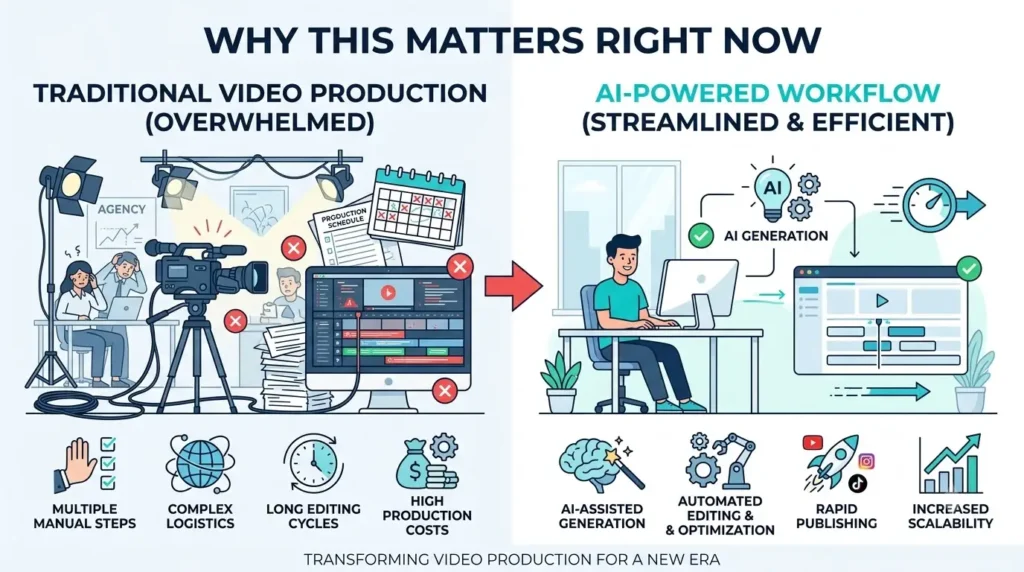
AI video has moved past novelty demos into daily production use for marketing and agency teams — the technology is genuinely fast enough and cheap enough now that skipping it means falling behind on output volume, not just missing a trend. Be skeptical of precise-sounding market-size or ROI percentages you see quoted for this category, though: much of the “AI video statistics” content circulating right now comes from companies selling AI video or writing tools themselves, publishing self-serving numbers dressed up as research. The safer signal is qualitative and consistent across real reporting: production costs and turnaround times have dropped substantially, and video remains one of the highest-ROI content formats for agencies to scale on behalf of clients. AI Video Tools for Agencies: 2026 Guide
What Happened to Sora (And What to Use Instead)
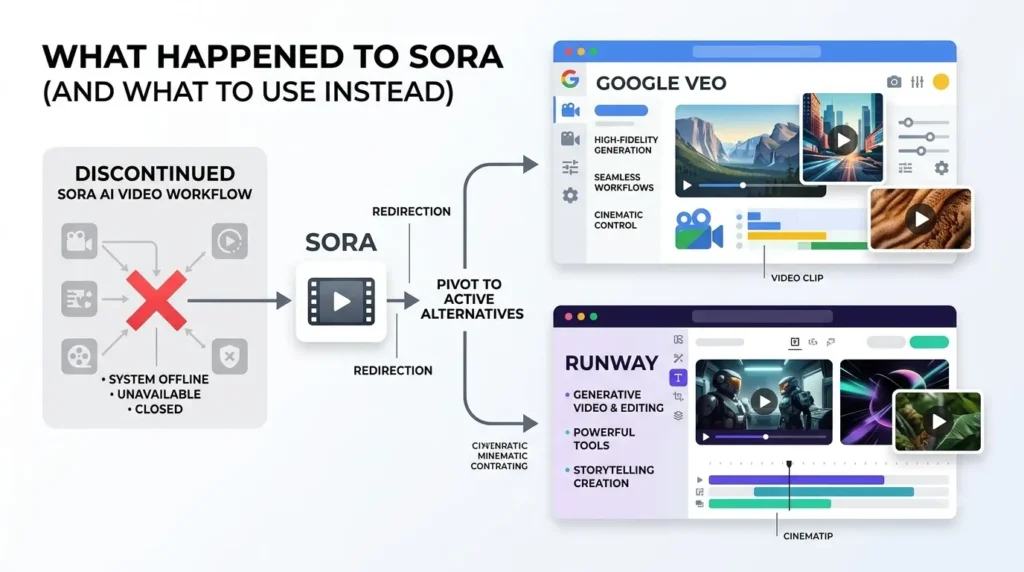
Worth addressing directly, since it’s not obvious from most existing content on this topic: OpenAI discontinued Sora, its text-to-video product, in 2026. The web and app experiences went dark on April 26, and the API is scheduled to shut down on September 24 — OpenAI cited the product’s cost (reportedly around $1 million a day to run against roughly $2.1 million in total revenue) alongside a collapsed $1 billion Disney content partnership. If you were planning around Sora, export any content now and redirect that workflow to Veo or Runway, both of which remain active and are the more durable choices for prompt-to-video generation going forward.
What These Tools Actually Do
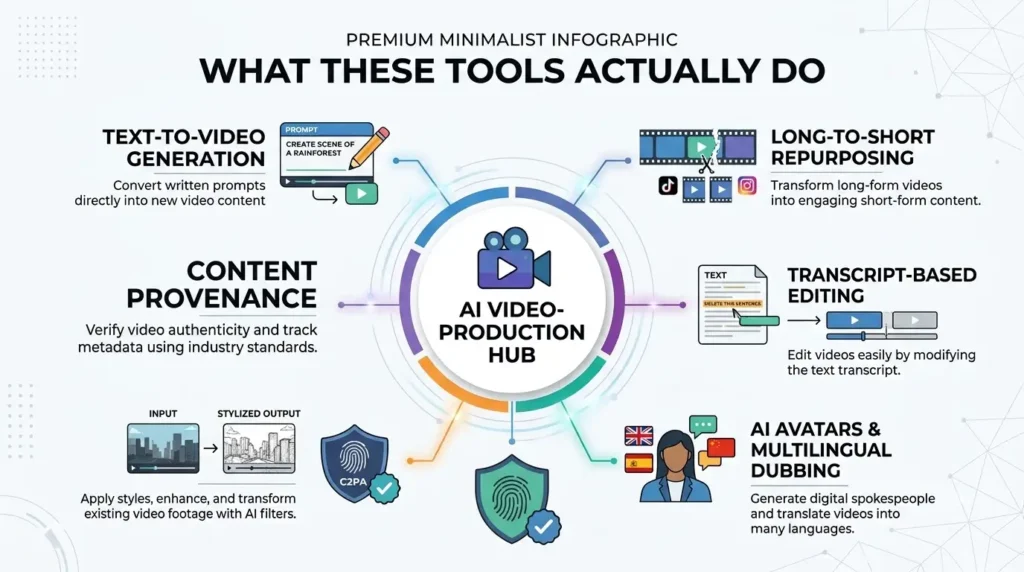
- Text-to-video and image-to-video generation — turning a prompt or reference image into a cinematic clip with camera control and integrated audio, led by Google Veo and Runway’s Gen-4.5.
- Long-to-short repurposing — auto-chopping a webinar or podcast into short-form clips with captions and engagement scoring, OpusClip’s core specialty.
- Transcript-based editing — cutting video by editing the transcript itself, removing filler words automatically — Descript’s approach, which speeds up revision cycles on talking-head content.
- AI avatars and multilingual dubbing — realistic presenters and one-click translation into over 100 languages without reshoots, where HeyGen and Synthesia both specialize.
- Video-to-video editing — prompt-based changes to lighting, framing, or objects in existing footage (Runway’s Aleph), adding shot variety without extra filming days.
- Content provenance and watermarking — C2PA Content Credentials, a real, industry-backed standard (supported by Adobe, Microsoft, the BBC, and others) that records what tools created or edited a piece of content — increasingly relevant for compliance and brand safety, not just a nice-to-have.
Comparing the Top Tools
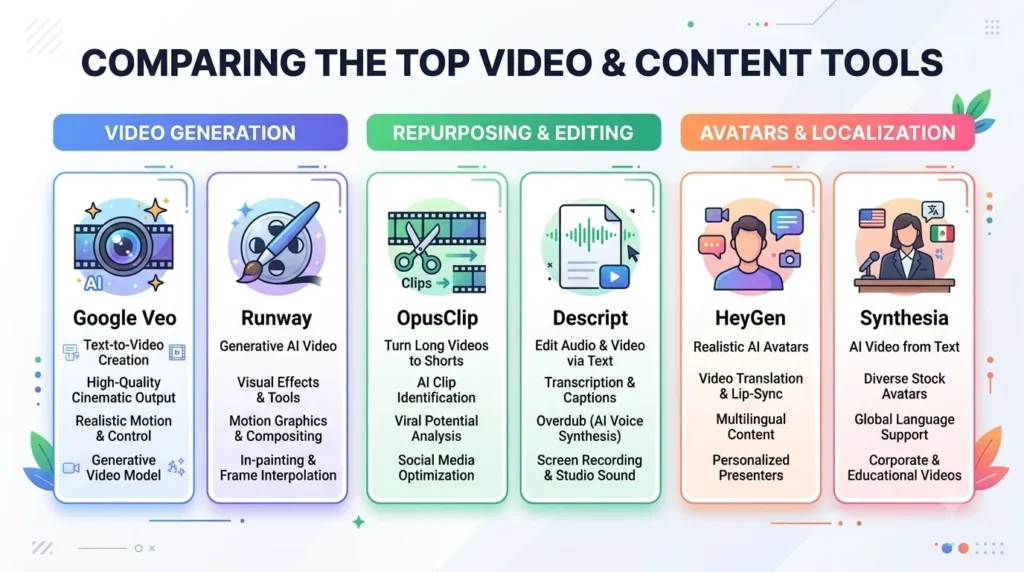
| Tool | Best For | Strengths | Watch Out For |
|---|---|---|---|
| Google Veo | Reliable, high-quality generation | Strong realism, integrated audio and lip-sync, easy to use | Watermark removal requires higher tiers |
| Runway | Cinematic generation and advanced editing | Top-tier visual quality, camera controls, video-to-video transforms | Steeper learning curve; credits can scale expensive at volume |
| OpusClip | Long-form to short-form repurposing | Automated highlight detection, captions, virality scoring | Built-in editor is limited for heavy finishing work |
| Descript | Transcript-based editing | Edit-by-text workflow, filler-word removal, brand controls | Doesn’t generate new footage — editing only |
| HeyGen | Fast avatar and translation workflows | Quick turnaround, strong lip-sync, 175+ languages | Avatar-only scope — not for B-roll or ad creative |
| Synthesia | Enterprise training and localization | SOC 2/GDPR compliant, custom avatars, broad language support | Better for structured comms than fast social content |
The selection logic: use Veo or Runway when you need original footage generated from scratch. Use OpusClip or Descript when the raw material already exists and the job is repurposing or precise editing. Use HeyGen or Synthesia specifically when a presenter-led or multilingual format is the point — they’re not a general-purpose video generator. For agencies batching variants across many clients, workflow-orchestration tools that chain several of these together can lock brand consistency, though they add their own learning curve — evaluate any single vendor’s “best practice” claims about this category with the same skepticism you’d apply to the stats above.
Choosing by Use Case
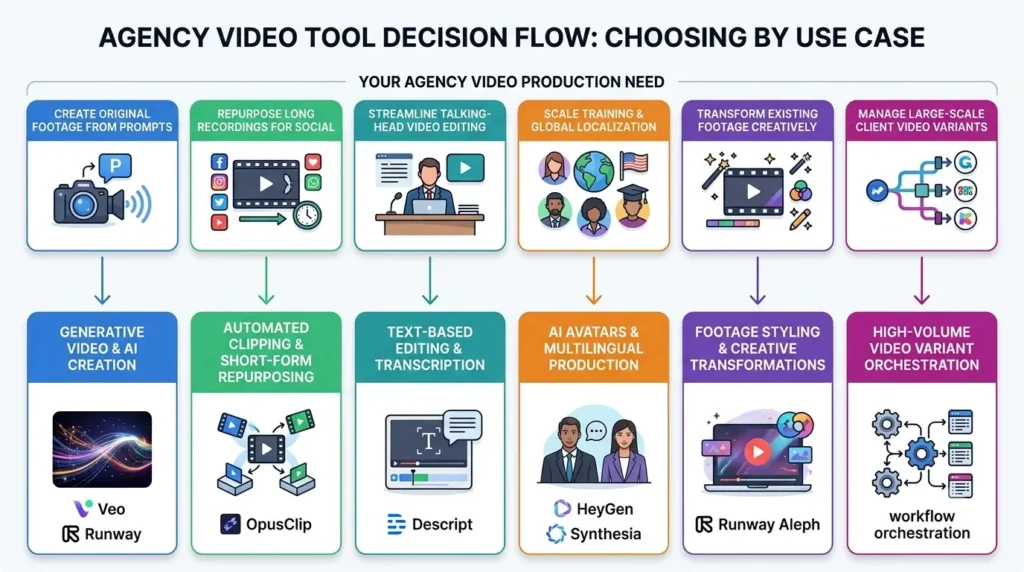
- Original brand or ad footage from a concept → Veo or Runway.
- A single long recording that needs to become a week of social content → OpusClip.
- Talking-head content needing fast, precise revisions → Descript.
- Training, onboarding, or localized campaigns without reshoots → HeyGen or Synthesia.
- Editing existing footage’s lighting, framing, or objects → Runway’s Aleph.
- Batching consistent-style variants across many clients → a workflow-orchestration layer on top of the above, once volume justifies the added complexity.
Common Mistakes Agencies Make
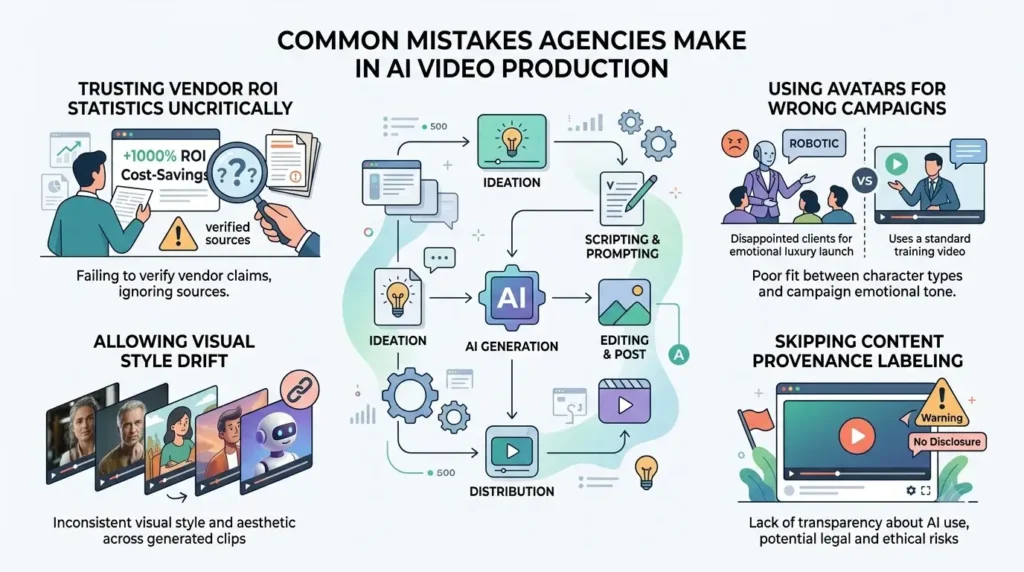
- Trusting precise ROI or market-size stats without checking who published them. This category is unusually full of vendors marketing their own tools through “statistics” content — verify the source’s business model before citing a number.
- Using an avatar tool for brand or performance ads. Avatars work well for training and localization; filmed or generated footage still tends to outperform them on engagement for consumer-facing ads.
- Assuming output consistency across a batch without a saved template or brand kit. Style drift between generated clips is a real, common problem — lock references and settings before scaling production.
- Skipping provenance labeling. C2PA content credentials matter more each year for compliance and brand safety — build the habit before it’s a requirement, not after.
also checkout – best AI BI Tools for Small Business: 2026 Guide
FAQs
What’s the best AI video generator for agencies in 2026? It depends on the job: Veo and Runway lead for generating original footage, OpusClip and Descript lead for repurposing and editing existing content, and HeyGen or Synthesia lead for avatar-based and multilingual videos. No single tool covers all three well.
Can AI video tools replace a production team? They replace specific stages — generation, first-cut editing, captioning, localization — not strategy, direction, or client relationship management. Most agencies use them to compress production time, not eliminate the people managing the process.
What happened to OpenAI’s Sora? OpenAI discontinued it in 2026: the web and app shut down April 26, and the API is scheduled to shut down September 24. The company cited unsustainable operating costs and the collapse of a major content partnership. Export any Sora content before the cutoff and plan around Veo or Runway instead.
Are AI avatars good enough for client campaigns? Yes for training, internal communications, and localized content where consistency matters more than a visibly human presenter. For brand or performance advertising specifically, filmed or fully generated footage still tends to perform better.
Sources
- NPR — “OpenAI’s Sora app may be going away”
- OpenAI Help Center — Sora discontinuation
- Emarketer — OpenAI to discontinue Sora app
- C2PA — Content Credentials implementation guide
- Google Veo, Runway, OpusClip, Descript, HeyGen, Synthesia — official product and pricing pages, current as of publication; verify before republishing
Fact-checked against primary reporting rather than secondary “best of” roundups.