
Best Multi-Agent AI Systems and Frameworks in 2026
Best Multi-Agent AI Systems and Frameworks in 2026. Multi-agent AI systems coordinate several specialized AI agents — a researcher, a writer, a reviewer — under an orchestrator that plans, delegates, and escalates to a human when needed, instead of relying on one model to handle an entire task in a single pass. The platform subscription is rarely the real cost: LangSmith, CrewAI, and Relevance AI all meter usage — traces, executions, or actions — separately from the seat price, and that usage-based line item routinely outgrows the subscription itself once a workflow hits production volume.
Table of Contents
Why 2026 Is the Year Agentic Systems Move Past the Demo Stage
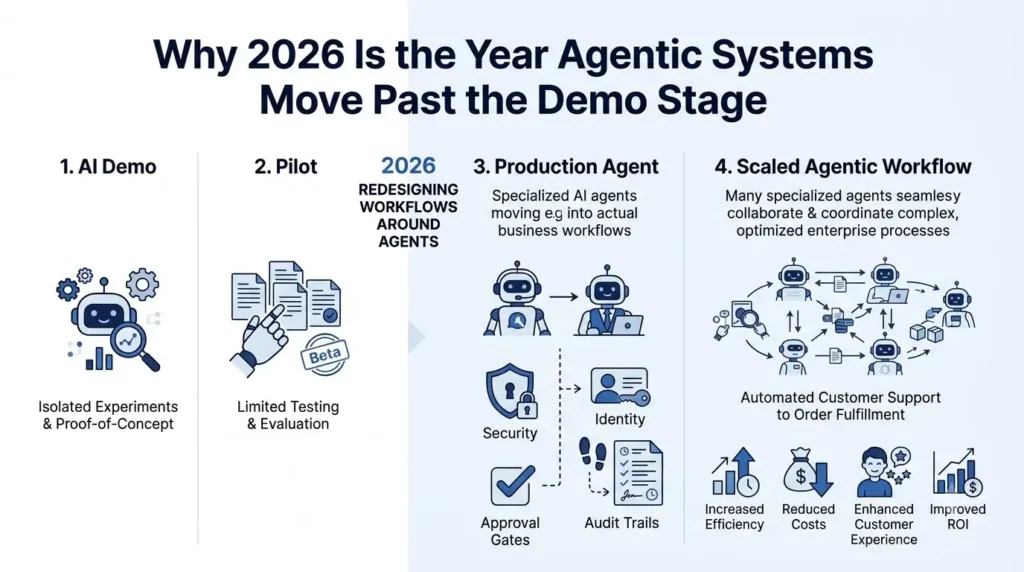
Best Multi-Agent AI Systems and Frameworks in 2026. McKinsey’s most recent State of AI research found 62% of organizations experimenting with AI agents in some form, including 23% actively scaling an agentic system somewhere in the enterprise and 39% still running experiments. The more telling number sits one layer down: 88% report regular AI use in at least one business function, but only about a third have started scaling programs enterprise-wide, and just 39% report any measurable EBIT impact from AI at all. Deployment and financial return are clearly two different milestones, and most organizations have only hit the first one.
A separate, more recent McKinsey survey — the State of Organizations 2026 report, covering more than 10,000 senior executives — adds an important qualifier worth sitting with: only 25% of leaders expect AI agents to act as genuinely autonomous teammates in the near term. Most still expect AI to function as a support tool augmenting human work rather than operating independently. The leaders who do see outsized returns share one trait: they redesigned the underlying workflow around AI rather than layering a chatbot onto an unchanged process. That’s the real 2026 lesson — the value isn’t in the model, it’s in the redesign.
The UK tells a consistent adoption story: businesses with 10+ employees using at least one AI technology climbed from about 12% in late 2023 to roughly 35% by June 2026, with adoption concentrated in larger firms — around 44% among businesses with 250+ employees, against roughly 25% economy-wide as of the most recent full survey. None of these figures isolate autonomous multi-agent deployment specifically; they measure AI adoption broadly, so treat any more specific “multi-agent adoption rate” you see quoted elsewhere with real skepticism about what was actually counted.
One trend worth flagging directly: agent security and identity are becoming procurement requirements, not afterthoughts. The Cloud Security Alliance found 40% of organizations already running agents in production, with another 31% in pilots and 19% planning deployment within a year — growth that’s driving real demand for least-privilege access, audit trails, sandboxing, and approval gates before a business will sign off on giving an agent write access to production systems.
What These Systems Actually Do
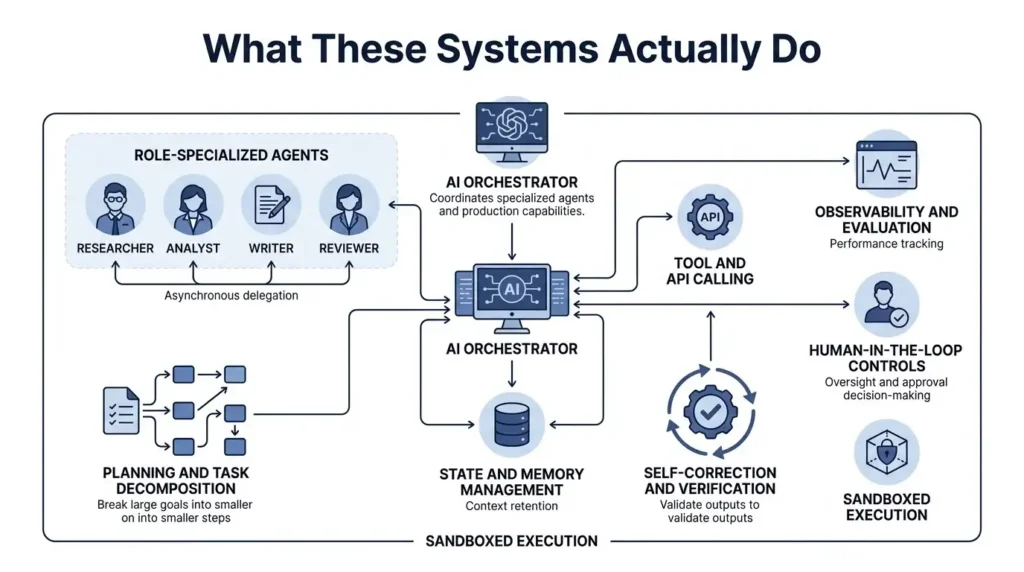
- Role-specialized agents. A workflow assigns separate roles — researcher, analyst, writer, reviewer — each with a narrower toolset and evaluation standard than one generalist model juggling everything at once.
- Planning and task decomposition. An orchestrator breaks a broad goal like “prepare a competitive analysis” into subtasks, dependencies, and assignments, rather than asking one model to handle an ambiguous, long prompt in a single pass.
- Asynchronous delegation. Independent subtasks run in parallel — one agent checks pricing while another reviews feedback and a third checks compliance — which cuts cycle time but can raise token and infrastructure cost as a trade-off worth planning for.
- State, memory, and context management. Production systems need durable records of what’s done, which sources were used, and what’s pending approval — this is where graph-based frameworks earn their complexity, especially for workflows that need to pause, retry, or recover after a failure.
- Tool and API calling. Agents interact with CRMs, ticketing systems, databases, and internal APIs — Relevance AI, for instance, advertises more than 2,000 app integrations for systems like Salesforce, Snowflake, and Zendesk.
- Self-correction and verification loops. A reviewer agent checks factual consistency, schema compliance, or numerical accuracy, and a failed check can trigger a retry, a different model, or a handoff to a human.
- Human-in-the-loop controls. Approval gates belong in front of anything with real consequence — sending external communications, changing customer records, approving payments, deleting data — with a record of who approved what and what evidence the agent used.
- Observability and evaluation. Production teams need traces of every model call, tool call, cost, latency, and failure — this is the exact capability LangSmith is built around, and it’s also where its billing gets interesting (more below).
- Sandboxed execution. Coding and browser-use agents should run in isolated environments with restricted credentials and limited execution time, which caps the damage from a prompt-injection attack or a bad autonomous decision.
Worth saying plainly: more agents isn’t automatically better. Each additional agent adds model calls, coordination overhead, latency, and another point where something can fail inconsistently. A single well-designed agent, or even a deterministic automation with no reasoning step at all, often beats a multi-agent system for a genuinely simple task.
The Catch: The Subscription Is Never the Real Bill
This is the section worth reading closely before committing engineering time to any of these platforms, because the pattern is remarkably consistent — it just shows up as usage metering instead of tier-gating.
LangSmith’s seat price is the easy part — Developer is free (5,000 traces/month, one seat), Plus runs $39/seat/month with 10,000 base traces included. The real cost driver is trace volume, and multi-step agents generate traces fast: a single RAG query with retrieval, reranking, and generation can produce five or more traces on its own. Once you exceed the included allowance, overage runs roughly $2.50 per 1,000 base traces (14-day retention) or $5 per 1,000 extended traces (400-day retention) — and at real production volume, that adds up dramatically. Detailed cost breakdowns put overage alone at around $1,225/month at 500,000 traces, climbing past $12,000/month at 5 million traces, entirely separate from seat costs.
CrewAI’s open-source framework is genuinely free — you only pay for hosting and LLM tokens. The managed AMP platform is a different story: a self-serve $25/month Professional tier existed from its October 2025 launch through spring 2026 and has since been quietly removed, leaving just a free Basic tier (50 executions/month) and a custom-quoted Enterprise plan with no public middle ground. And regardless of which AMP tier you’re on, LLM inference bills go directly to you — a typical three-agent crew running GPT-4o costs roughly $0.10–$0.20 per execution in token fees alone, a cost CrewAI never touches or discloses on its own pricing page.
Relevance AI splits billing into two separate meters — Actions (what an agent does) and Vendor Credits (the AI compute it consumes) — both of which can run out independently, which complicates forecasting. Pro starts at $19/month (annual) with 2,500 monthly actions; Team jumps to $234/month (annual) with no published tier in between, creating a real pricing cliff for a small team that’s outgrown Free’s 200 actions but doesn’t need Team’s full collaboration features. Action overages run about $80 per 1,000 beyond your plan’s allowance.
Microsoft Agent Framework doesn’t have a simple price at all — cost is entirely a function of Azure compute, model usage, and hosting, which makes it straightforward to estimate only if you’re already deep in Azure’s pricing model.
The practical takeaway: model your actual usage — trace volume, execution count, token consumption — before comparing platform fees. The platform with the lower sticker price is frequently the more expensive one in production once metered usage is added in.
Real 2026 Pricing at a Glance
| Platform | Best For | Published Price | The Real Cost Driver |
|---|---|---|---|
| LangGraph / LangSmith | Developer-first teams needing durable state, branching, and production-grade observability | LangSmith Developer free, Plus $39/seat/month; LangGraph itself is free | Trace-based overage can exceed $10,000/month at high volume — a chattier multi-step agent generates far more traces than a simple chatbot |
| CrewAI / CrewAI AMP | Python teams wanting a role-based “crew” model for prototypes through production | Open-source framework free; AMP Basic free (50 executions/mo); Enterprise custom (self-serve middle tier removed in 2026) | LLM token costs (not billed by CrewAI) run roughly $0.10–$0.20 per execution for a typical crew |
| Microsoft Agent Framework | Microsoft/Azure-centric enterprises needing identity, telemetry, and graph-based workflows | No fixed price — cost follows Azure consumption | Compute, model usage, and hosting fees scale with your Azure footprint, not a seat count |
| Relevance AI | No-code/low-code teams and agencies without a large engineering org | Free tier; Pro ~$19/mo (annual); Team ~$234/mo (annual); Enterprise custom | Dual-meter billing (Actions + Vendor Credits) with a real cliff between Free and Team, and ~$80 per 1,000 Actions in overage |
Every number above is a snapshot rather than a permanent rate — CrewAI alone changed its self-serve tier structure at least once within the past year, so confirm current terms directly before budgeting a production deployment.
Step-by-Step: Choosing and Deploying a Multi-Agent System Safely
- Start with one measurable, bounded workflow — lead enrichment, report generation, content QA — rather than an ambitious enterprise-wide rollout on day one.
- Map the existing process before adding agents. You can’t tell whether a multi-agent system improved anything if you never measured the baseline time, cost, and error rate.
- Decide whether you actually need multiple agents. Separable expertise, genuine parallel work, or independent validation justify the added complexity; simple classification or extraction usually doesn’t.
- Put approval gates in front of anything destructive or customer-facing before the first real deployment — sending emails, updating payment records, deleting data — not after an incident.
- Add observability before you scale the workflow, not after. You need traces and evaluation data to know whether version two is actually better than version one.
- Model your real usage against the platform’s metering unit — traces, executions, or actions — before comparing sticker prices between platforms.
- Expand into new departments only once the first workflow has stable, predictable economics. A workflow with an unpredictable monthly bill isn’t ready to multiply across the business.
Which Framework Fits Which Team
- Engineering-heavy team that needs durable state, branching, and rigorous testing — LangGraph with LangSmith is the strongest fit, provided you budget for trace volume, not just seats.
- Team that wants a fast, approachable role-based model for prototypes — CrewAI’s open-source framework gets you moving quickly; plan for a custom Enterprise conversation once you need the managed platform beyond the free tier.
- Enterprise already standardized on Microsoft, Azure, and Entra identity — Microsoft Agent Framework fits the existing procurement and security model better than a third-party platform would.
- Business team or agency without a large engineering org that needs a no-code path — Relevance AI’s workforce model is the most approachable, as long as you plan around the Free-to-Team pricing gap.
- Process is predictable and doesn’t need dynamic reasoning at all — skip agents entirely; a conventional automation tool like Zapier, Make, or n8n will be cheaper, easier to debug, and more predictable.
Bottom Line
The shift from single-prompt tools to coordinated agent systems is real, and the operational use cases — IT service-desk triage, research and reporting, sales enrichment — are where the McKinsey data shows the strongest early returns. What doesn’t show up on any of these platforms’ pricing pages is the actual production bill: trace volume, execution counts, and raw LLM token costs routinely dwarf the subscription fee once a workflow moves from prototype to real traffic. Model your usage before you pick a platform, put human approval in front of anything with real consequence, and resist the urge to add agents to a process that a simpler, deterministic tool would handle just as well.
also checkout – The Hybrid Human-AI Workforce: How Agencies Should Actually Structure It in 2026
FAQs
What are multi-agent AI systems?
They’re networks of specialized AI agents — each with a defined role, toolset, and evaluation standard — that collaborate under an orchestrator to plan, execute, verify, and complete a broader objective with limited human prompting, escalating to a person when a decision falls outside their bounded permissions.
What’s the difference between an AI agent and a multi-agent system?
A single agent plans and executes a task using available tools. A multi-agent system coordinates several agents with different roles or permissions — a researcher, an analyst, a reviewer — under a supervisor or workflow engine that manages handoffs between them.
Which multi-agent framework is best for enterprise workflows?
LangGraph suits developer-first teams that need stateful, controllable workflows with strong observability. Microsoft Agent Framework fits Microsoft-centric enterprises already invested in Azure and Entra identity. CrewAI is the most approachable for role-based prototyping. Relevance AI is the strongest no-code option for teams without a dedicated engineering org. The right choice depends more on your governance and integration needs than on raw model capability.
How much does it actually cost to run a multi-agent AI workflow in production?
Beyond the platform subscription — which is often free or under $50/month at entry level — expect real costs from LLM token usage, trace or execution-based overage, observability tooling, and engineering time to build and maintain integrations. Several of the platforms compared here show production bills running well past $1,000/month at real usage volume, even when the advertised entry price looks nearly free.