
best AI Sales CRM Software: The 2026 Guide for Small Business and Agencies
best AI Sales CRM Software: The 2026 Guide for Small Business and Agencies. AI sales CRM software now does more than store contacts — it enriches prospects automatically, scores leads by actual conversion likelihood, drafts follow-ups, and flags deals going stale before a renewal is at risk. HubSpot is the strongest all-in-one ecosystem, monday CRM suits agencies wanting visual no-code pipelines, Clay leads for enrichment and outbound orchestration, and Freshsales is the practical budget pick for small teams.
Table of Contents
Why This Matters Right Now
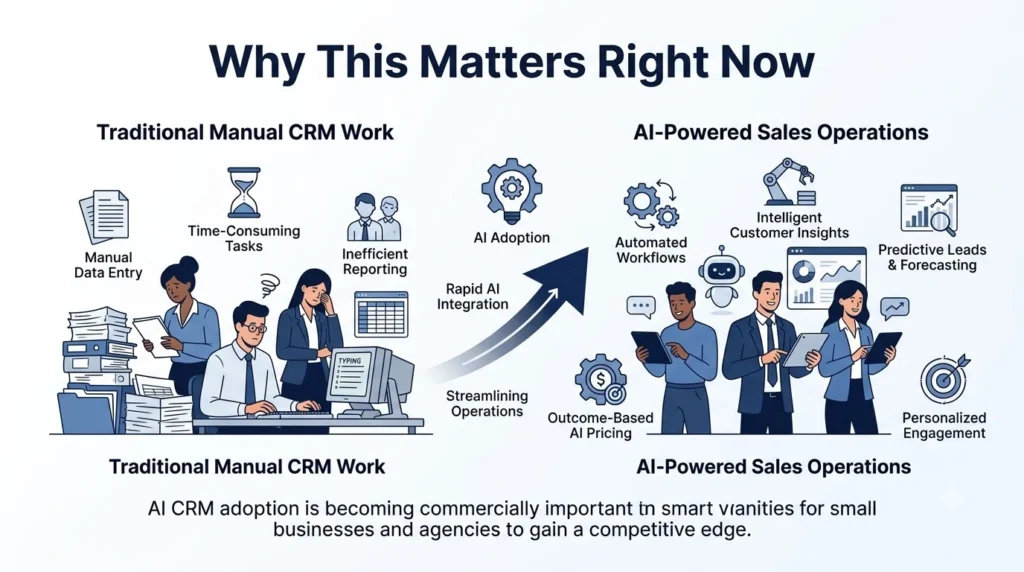
Adoption numbers for this category vary widely depending on what’s actually being measured, and it’s worth reading past the headline figure. In the UK, the government’s Business Data Survey found 41% of businesses handling digitized data used AI-based technologies in 2025-26, while a separate ONS measure put overall AI use at about 25% in late 2025, rising to 44% among businesses with 250+ employees. In the US, the U.S. Chamber of Commerce found 58% of small businesses used generative AI in 2025, up from about 40% in 2024 — a notably higher figure than the Census Bureau’s broader business survey, which measures AI use in production differently. One industry synthesis estimates CRM adoption specifically at around 91% among companies with 10+ employees versus roughly 50% among businesses under 10 employees — treat that as a directional signal rather than an official government statistic, since it comes from an industry blog rather than a national survey.
The more concrete, well-documented 2026 development is a real shift in how AI sales features get priced. HubSpot moved two of its Breeze AI agents to outcome-based pricing effective April 14, 2026: Customer Agent shifted from a flat $1.00 per conversation (charged whether it resolved anything or not) to $0.50 per resolved conversation, and Prospecting Agent moved from a recurring monthly charge per enrolled contact to $1 per qualified lead actually recommended for outreach. HubSpot reports its Customer Agent resolves 65% of conversations and cuts resolution time by 39% across more than 8,000 customers — a vendor-reported figure, but a specific and checkable one, not vague marketing language. best AI Sales CRM Software: The 2026 Guide for Small Business and Agencies.
What’s Actually Changed: From AI-Assisted to AI-Executed
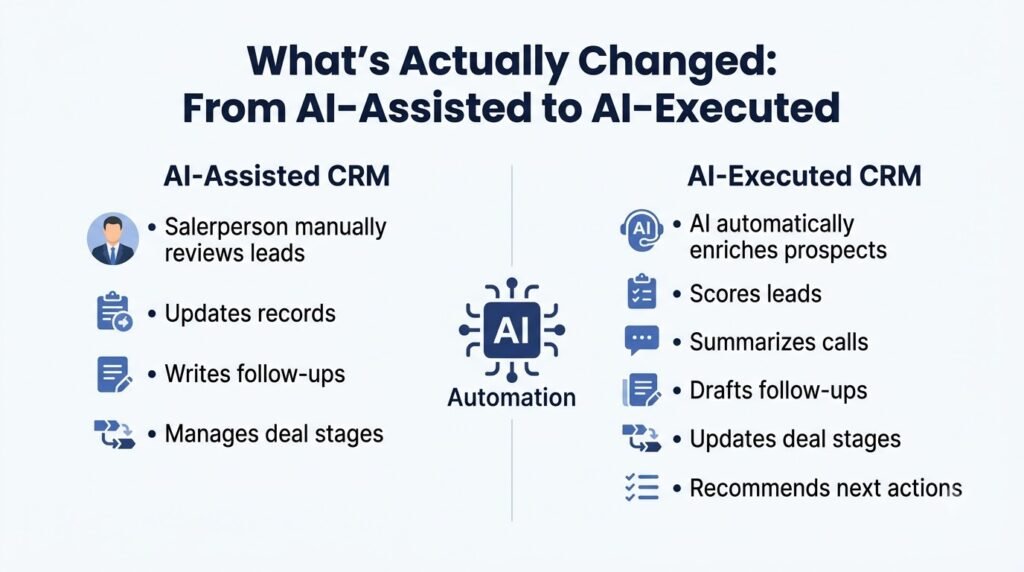
The meaningful shift isn’t “CRMs added a chatbot” — it’s that modern systems increasingly identify prospects, enrich records, summarize calls, score opportunities, draft follow-ups, and update deal stages without a salesperson manually maintaining every field. That matters because manual CRM upkeep has a real, well-documented cost: sales-productivity research estimates reps can spend several hours a week on manual CRM administration alone, time that comes directly out of actual selling. The realistic framing isn’t “AI replaces the salesperson” — it’s AI removing the low-value administrative layer so a founder or account executive spends more time on discovery, proposals, and closing.
What These Tools Actually Do
- Automatic prospect enrichment — adding company size, industry, job title, and technology stack to a contact record automatically, cutting the manual research time before a first outreach.
- AI lead scoring — ranking leads by fit, intent, engagement, and likelihood of conversion, though scoring should be checked against actual conversion outcomes rather than trusted blindly on a new or messy database.
- AI sequence co-pilots — drafting personalized emails and multistep follow-up sequences adapted to a prospect’s role, ideally with human approval before anything sends.
- Conversation intelligence — transcribing calls, extracting objections and buying signals, and attaching a summary directly to the right contact or deal record instead of leaving it in someone’s notes.
- Automatic activity capture — logging emails, calls, and meetings with minimal manual entry, which does more for data quality than any AI chatbot feature.
- Predictive deal scoring — flagging stalled deals, missing stakeholders, or unusual stage duration, giving early warning that a renewal or opportunity is at risk.
- Visual pipeline automation — triggering actions automatically as a deal moves stages (create a task, send a notification, generate a checklist) without custom code.
- AI-generated next-best actions — recommending whether to call, email, or move a dormant lead to nurture, turning a static database into something closer to a daily execution list.
Comparing the Top Platforms
| Platform | Best For | Strengths | Starting Price |
|---|---|---|---|
| HubSpot | Teams wanting CRM, marketing, and service in one ecosystem | Strong contact timeline, broad integrations, now-outcome-based AI pricing | Sales Hub Starter from ~$9/seat/mo (annual) or $15/mo |
| monday CRM | Agencies wanting visual, no-code pipelines | Highly configurable boards, AI summaries and autofill, approachable setup | Basic $12, Standard $17, Pro $28/seat/mo (annual) |
| Clay | Growth teams focused on enrichment and outbound orchestration | Multi-provider data enrichment, AI research, waterfall sourcing, CRM sync | Free plan; paid tiers reportedly from ~$185/mo — confirm current pricing directly |
| Freshsales | Budget-conscious small teams | Lower entry cost, built-in Freddy AI, simple interface | From ~$9/user/mo |
| Saleshandy | Small outbound teams doing cold email | CRM bundled with outreach, unlimited email accounts on entry plans, warm-up tools | Outreach Starter ~$25/mo |
The selection logic that actually matters: HubSpot wins when marketing, forms, and service need to share one customer record — the ecosystem value compounds beyond just the CRM. monday CRM fits agencies that want flexible boards over a prescriptive sales methodology. Clay is worth its price specifically when the bottleneck is finding and researching prospects before they ever enter a CRM, not as a CRM replacement. Freshsales is the practical shortlist candidate when you want native AI without adopting a bigger marketing platform. Saleshandy makes sense when outbound volume and inbox management matter more than sophisticated lifecycle CRM features.
Understanding the New AI Pricing Models
HubSpot’s shift to outcome-based pricing is worth understanding even if you’re not evaluating HubSpot specifically, because it signals where AI CRM pricing is heading industry-wide. The logic: charging a flat fee per AI action regardless of whether it worked doesn’t align vendor incentives with customer value — outcome-based pricing (pay per resolved conversation, pay per qualified lead) does. The practical catch is in the definition of “resolved” or “qualified” — those terms are set by the vendor, and a conversation that required a human handoff after 72 hours might not count as “resolved” the way you’d expect, which changes your actual monthly cost versus what the headline rate suggests. Ask any vendor using outcome-based AI pricing for their exact definition of the qualifying event before you budget around it.
Getting Started: 5 Steps
- Audit where leads actually leak today — forms, email, LinkedIn, referrals — before assuming a new CRM fixes routing you haven’t mapped yet.
- Define what “qualified” means for your business before turning on AI lead scoring, so the model has a real target instead of guessing at your definition.
- Start AI features on a subset of your pipeline, not the whole database at once, so you can check accuracy against real outcomes before trusting it broadly.
- Keep human approval on outbound messaging at least initially — AI-drafted sequences save time, but unreviewed messaging at scale is where reputational risk lives.
- Price out your actual seat and contact count, not the advertised starting price — AI credits, contact limits, and automation quotas can shift total cost significantly from the sticker price.
Common Mistakes Teams Make
- Buying the platform with the most AI features instead of the one with the best integrations. A CRM that doesn’t reliably sync your calendar and inbox will underperform a simpler one that does, regardless of how much AI it advertises.
- Trusting lead scores without checking them against real conversions. A score is a hypothesis until it’s validated against your own outcomes.
- Treating outcome-based pricing as automatically cheaper. Check the vendor’s specific definition of the qualifying event — a narrow definition of “resolved” can make the effective cost higher than it first appears.
- Skipping the ownership rules. AI can route and score leads, but if nobody’s accountable for follow-up within a defined window, the leak just moves downstream instead of closing.
also checkout – AI SEO Tools: The 2026 Guide to Content Optimization That Actually Works
FAQs
What is an AI sales CRM? A customer relationship management platform that uses AI to capture, enrich, score, summarize, and act on sales data — increasingly executing routine steps (drafting follow-ups, updating deal stages) rather than just displaying information for a rep to act on manually.
What is the best AI CRM for a small business? It depends on priorities: HubSpot for an integrated marketing-and-sales ecosystem, monday CRM for visual no-code workflows, Clay for prospect enrichment and outbound orchestration, and Freshsales for value-oriented core CRM functionality without a bigger platform commitment.
How does HubSpot’s new AI pricing work? As of April 2026, HubSpot’s Customer Agent and Prospecting Agent switched to outcome-based pricing — $0.50 per resolved conversation and $1 per qualified lead recommended for outreach, replacing flat per-conversation and per-contact charges. Check HubSpot’s specific definition of “resolved” before budgeting, since it affects your actual monthly cost.
Can AI automate the entire sales pipeline? It can automate many repeatable steps — capture, enrichment, reminders, scoring, and some outreach drafting — but human review still matters for qualification, pricing conversations, negotiation, and anything relationship-sensitive.