
AI SEO Tools: The 2026 Guide to Content Optimization That Actually Works
AI SEO Tools: The 2026 Guide to Content Optimization That Actually Works. AI SEO tools now score content against what’s actually ranking, extract the semantic terms top pages cover, and increasingly track whether your content gets cited in AI Overviews — not just where it lands in the traditional blue links. Surfer SEO and Clearscope lead for real-time content scoring, MarketMuse leads for topic-cluster strategy at scale, and Frase or NeuronWriter are the practical budget picks for solo creators and small teams.
Table of Contents
Why This Matters Right Now
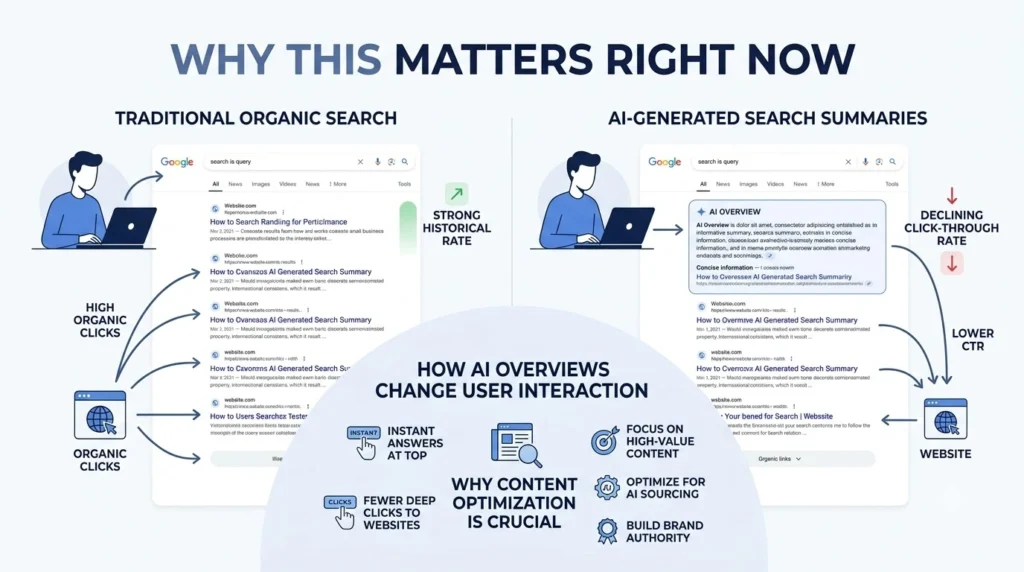
The data on how AI Overviews are actually affecting organic clicks is genuinely well-studied at this point, and it’s worth citing the real research rather than a single scary-sounding number. Ahrefs’ own study — analyzing 300,000 keywords using aggregated Google Search Console data, comparing March 2024 to March 2025 — found a 34.5% drop in average click-through rate for position-1 informational keywords when an AI Overview was present. Amsive Digital’s larger, more conservative study of 700,000 keywords found a 15.49% average decline, with non-branded queries hit harder at roughly 20% and combined AI Overview-plus-featured-snippet situations dropping CTR by over 37%. Pew Research Center — a genuinely independent, non-commercial research organization — tracked 68,879 real Google searches from 900 US adults and found clicks dropped from about 15% of searches to about 8% when an AI-generated summary appeared, a 46.7% relative decline.
Two things are worth knowing that complicate a purely doom-and-gloom read. First, branded searches behave differently: Amsive found branded queries with an AI Overview present actually saw an 18.68% CTR increase, likely because a familiar brand name in an AI summary builds confidence rather than replacing the click. Second, AI Overviews don’t yet dominate search the way some marketing content claims — as of early 2026, they were appearing in roughly a quarter to just under half of tracked US searches depending on the study, concentrated heavily in informational queries and much less common for transactional or e-commerce searches. The honest takeaway: AI Overviews are a real, measurable, negative pressure on organic CTR for informational content specifically, not an existential threat to all organic traffic everywhere.AI SEO Tools: The 2026 Guide to Content Optimization That Actually Works
What These Tools Actually Do
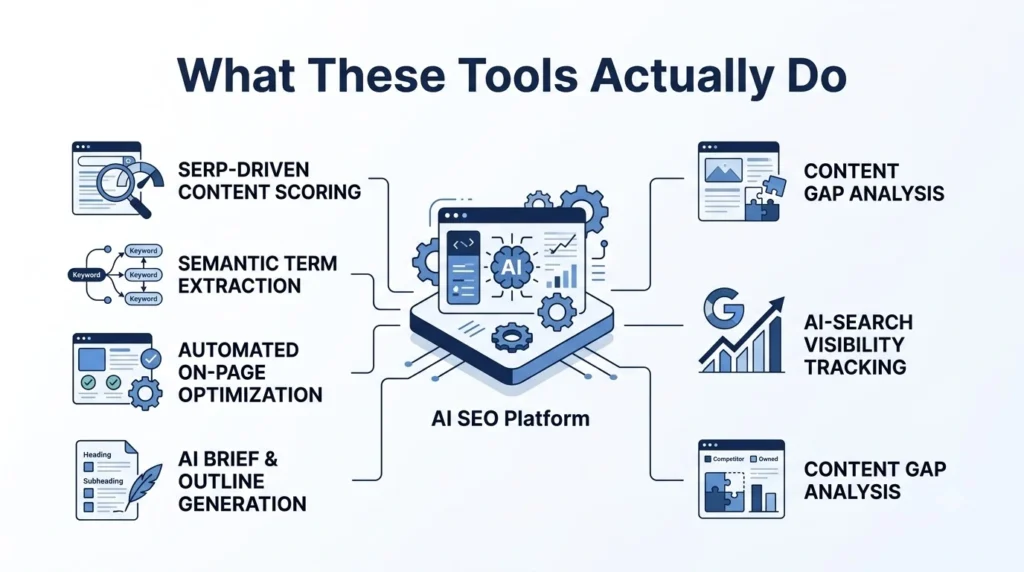
- Real-time SERP-driven content scoring — analyzing the top 20-30 ranking pages for a target keyword and providing a live score as you write, turning “write good SEO content” into a measurable, repeatable process rather than a subjective judgment call.
- NLP term extraction and semantic coverage — identifying the entities and related terms top-ranking content actually covers, replacing outdated keyword-density thinking with topical completeness.
- Automated on-page fixes — bulk-applying internal links, meta tags, and schema markup across many pages, which matters most for agencies managing several client sites at once.
- AI brief and outline generation — auto-generating H2/H3 structures, target word counts, and term lists from SERP data so a team can scale content production without losing topical depth on every piece.
- AI-search visibility tracking — newer tooling that estimates how likely a piece of content is to get cited in an AI Overview or LLM answer, not just where it ranks in traditional results.
- Content gap analysis — mapping existing content against topic clusters to flag what’s missing or needs a refresh, rather than guessing at what to write next.
Comparing the Top Platforms
| Tool | Best For | Starting Price | Key Strength |
|---|---|---|---|
| Surfer SEO | Real-time on-page optimization | ~$49-89/mo (tier-dependent) | Live SERP-based content scoring while you write |
| Clearscope | Agency-scale content briefs and editorial grading | ~$129-170/mo | Writer-friendly letter-grade system tied to top-ranking pages |
| MarketMuse | Content strategy and topic-cluster planning | Free plan; paid pricing by contact | ML-driven topic modeling for large content portfolios |
| NeuronWriter | Budget-friendly semantic SEO | From ~$23/mo | Cost-effective NLP editor with WordPress/GSC integration |
| Frase | AI briefs plus research and drafting on a budget | ~$15-49/mo | Fast brief generation for smaller teams |
| Semrush | All-in-one suite for agencies | ~$139-140/mo | Keyword research, audits, and backlinks alongside content tools |
The selection logic that actually matters: solo creators and small teams get the most value starting with Surfer or NeuronWriter for hands-on content scoring, adding Frase for briefs if volume picks up. Agencies managing multiple clients typically pair Semrush for research and audits with Surfer or Clearscope for content execution. Content-heavy publishers and enterprise teams tend to use MarketMuse for strategy and cluster planning, then execute with Clearscope or Surfer.
What Actually Predicts AI Citation (Not Just Ranking)
Ranking well and getting cited in an AI Overview aren’t the same job anymore, and the factors that predict each are starting to diverge. Ahrefs’ analysis found only a modest overlap between top-10 organic rankings and AI Overview citations — being on page one no longer guarantees inclusion in the AI-generated summary. The factors that do correlate with citation: external brand mentions (a meaningfully strong signal per Ahrefs’ data), overall domain authority, and clear content structure that’s easy for a model to parse — headers, FAQ sections, and well-organized information rather than dense unstructured prose. Practically, that means digital PR and structured content are becoming AI-visibility tactics, not just traditional SEO ones.
Getting Started: 5 Steps
- Audit your existing content for structure before writing anything new. Clear headers, FAQ sections, and scannable formatting help both traditional rankings and AI citation — it’s a shared investment, not two separate projects.
- Pick one tool that matches your actual scale, not the one with the most features. A five-person team doesn’t need MarketMuse’s enterprise cluster modeling; a 500-page publisher probably does.
- Prioritize informational content for AI-visibility work specifically, since that’s where AI Overviews concentrate — transactional and product pages face meaningfully less CTR pressure right now.
- Build brand mentions deliberately, not just backlinks — the data suggests external brand recognition correlates with AI citation more than raw link count alone.
- Track AI Overview presence on your own target keywords before assuming every query in your space is affected the same way — coverage varies a lot by query type and industry.
Common Mistakes Teams Make
- Treating every “AI SEO statistics” source as equally credible. A lot of content in this exact space is published by tools trying to sell you their AI writing or SEO service — check whether the source publishing the stat has something to gain from the number sounding dramatic.
- Optimizing only for traditional ranking and ignoring AI citation factors. They’re correlated but not identical — content built purely around keyword density misses the structural and brand-authority signals that drive AI Overview inclusion.
- Panicking over aggregate CTR stats that don’t apply to your query mix. If your content is mostly transactional or branded, the informational-query CTR decline matters much less to your actual traffic.
- Buying enterprise-tier tools before you have enterprise-scale content. MarketMuse and Clearscope’s advanced tiers solve problems a five-page-a-month operation doesn’t have yet.
also checkout – Best AI Cybersecurity Tools for Small Businesses in 2026
FAQs
What are the best AI SEO tools for small businesses and agencies in 2026? It depends on scale: Surfer SEO or NeuronWriter for hands-on content scoring on a budget, Frase for AI-generated briefs, Clearscope for agency-scale editorial consistency, and MarketMuse for larger content portfolios needing topic-cluster strategy.
How much are AI Overviews actually hurting organic traffic? Real, independently verified studies show a meaningful CTR decline for informational content — Ahrefs measured 34.5% for position-1 pages, Pew Research measured a 46.7% relative decline, and Amsive’s larger, more conservative study found 15.49%. The effect concentrates on informational queries; branded and transactional searches are affected much less, and branded queries can actually see a CTR increase.
How do AI SEO tools improve content rankings compared to traditional SEO? They shift the focus from keyword density to semantic completeness — identifying the entities and related terms that top-ranking pages actually cover, then scoring your draft against that benchmark in real time rather than relying on a static keyword checklist.
Can AI SEO tools help with Google AI Overview visibility specifically? Some newer tiers track AI Overview and LLM citation likelihood, not just traditional rankings. The stronger lever, based on verified research, is structural: clear headers, FAQ formatting, and building genuine brand mentions matter more for AI citation than traditional keyword optimization alone.