
Best AI Cybersecurity Tools for Small Businesses in 2026
Best AI Cybersecurity Tools for Small Businesses in 2026. AI cybersecurity tools for small businesses split into two genuinely different jobs: compliance automation platforms like Vanta and Drata that get you SOC 2 or ISO 27001 ready for enterprise deals, and AI threat-detection platforms like Darktrace that actually watch your network for an attack. Most small agencies need the first one immediately, since clients increasingly require proof of certification before they’ll sign — the second is worth layering in once there’s a real security budget behind it, often through a managed provider rather than buying enterprise-grade detection directly.
Table of Contents
Why This Became a Revenue Question, Not Just a Security One
Compliance automation has gone from a nice-to-have to table stakes for SaaS startups and digital agencies — Uzado’s research puts the majority of scaling companies on automated SOC 2 workflows now, specifically to cut months of manual evidence-gathering out of the audit process. The reason it matters commercially, not just technically: US and UK buyers increasingly ask for SOC 2 or ISO 27001 proof before they’ll sign a contract at all, turning what used to be a back-office security decision into a revenue-enabling requirement — miss it, and you’re out of the deal before pricing even comes up.
On the threat-detection side, worth being precise about the spending numbers, since a few figures floating around this space don’t trace cleanly to their cited source. What Gartner has actually published: AI-specific cybersecurity spending is set to nearly double from $25.9 billion in 2025 to $51.3 billion in 2026, then climb to $85.9 billion by 2027 — a 231% increase in just two years. Set against Gartner’s separate total global information-security spending forecast of $244.2 billion for 2026, that puts AI-driven security spending at a meaningful and fast-growing slice of the overall budget, even if it’s not yet the outright majority some secondary sources imply. Either way, the direction is unambiguous: AI is moving from an add-on feature to a core line item in security budgets, fast.
What These Tools Actually Do
- Anomaly detection across network, cloud, identity, and endpoint. Self-learning models build a behavioral baseline for each user and device, then flag deviations — unusual data access, odd API call patterns, lateral movement — that a signature-based tool would miss entirely.
- Autonomous investigation and response. AI “analysts” triage alerts, correlate related events, and can suggest or execute containment steps like isolating a device or killing a malicious session. Vendors in this space publish striking efficiency numbers — claims of dramatically faster incident response and major reductions in manual triage time show up regularly in vendor marketing. Treat any specific percentage a vendor reports about its own product the way you’d treat any self-graded claim: a reasonable starting expectation, not a guarantee for your environment.
- AI-powered phishing and business email compromise (BEC) defense. Unsupervised models learn normal communication patterns to catch novel phishing campaigns and deepfake-driven social engineering that don’t match any known signature yet.
- Automated compliance monitoring. Continuous evidence collection from cloud, HR, endpoint, and code tools, mapped across multiple frameworks at once, with an audit-ready dashboard instead of a shared folder of screenshots.
- AI-aware data loss prevention and LLM usage controls. Tracks how data moves through SaaS and AI tools specifically, flagging sensitive information sent to public LLMs — the practical fix for “shadow AI,” where an employee pastes client data into a public chatbot nobody approved.
The Catch: The Platform Fee Is Rarely the Whole Compliance Bill
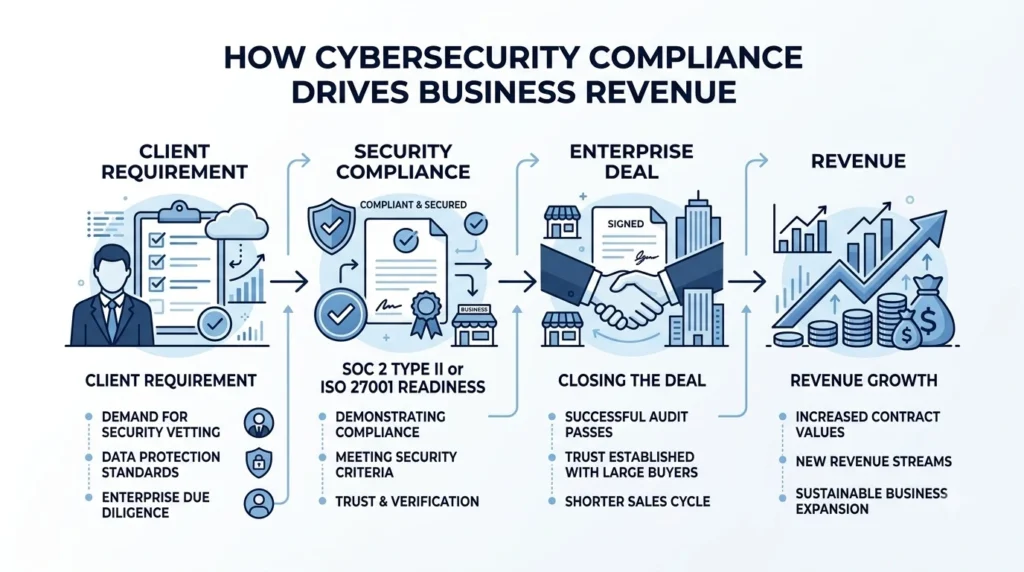
This is the section worth reading before you budget a compliance project, because the pattern here is less about hidden AI features and more about a cost most first-time buyers simply don’t know to expect.
Vanta and Drata’s platform fees are well-documented and, for once, roughly line up with what most research on this shows: Vanta commonly runs $10,000–$25,000/year for a single framework at a small company, scaling to $30,000–$80,000+ for multi-framework mid-market deals. Drata lands in a similar range, generally starting around $7,500–$15,000 and scaling past $60,000–$100,000 for larger, multi-framework organizations. What both platforms’ own marketing tends to underplay: the CPA audit itself is a separate, mandatory cost that sits on top of the platform fee. A SOC 2 Type II audit independently runs anywhere from roughly $8,000 at the low end to $60,000+ for a large, complex scope — though using the platform’s partnered auditor network can bring a Type I audit for a security-only scope down to as little as $2,500–$7,500, since the platform has already done most of the evidence-collection work the auditor would otherwise bill for. Budget both line items, not just the subscription.
Darktrace publishes no pricing at all, and for good reason — it’s genuinely built for mid-market and enterprise, not a five-person agency. Real negotiated deals cluster around a median of roughly $55,000/year, but range from about $12,000 for a small single-module deployment up past $500,000/year for multi-module enterprise coverage (Network, Email, Cloud, Endpoint, OT, and Identity are priced as separate modules that stack). For a small agency, an MSSP that bundles Darktrace-equivalent AI-NDR capability into a managed service is almost always the more realistic path than a direct enterprise contract.
Cloudflare has one genuinely good surprise in this comparison: its AI Gateway — the specific feature that controls and logs what leaves your organization through public LLM APIs — is free on every plan, including the free tier, with usage limited to 100,000 logged events per month before you need a paid Workers plan to raise the ceiling. If shadow AI and LLM data leakage are your actual worry, that’s a genuinely low-cost starting point before you buy anything dedicated to the problem.
Real 2026 Pricing at a Glance
| Platform | Best For | Platform Fee (2026) | What’s Billed Separately |
|---|---|---|---|
| Vanta | Fast first-time SOC 2/ISO 27001 for SaaS startups and agencies | ~$10,000–$25,000/year (single framework, small team) up to $80,000+ (multi-framework, mid-market) | The CPA audit itself — $8,000–$60,000+ depending on type and scope, discounted through Vanta’s partnered auditor network |
| Drata | Similar compliance automation with strong developer-facing UX | ~$7,500–$15,000/year (entry) up to $60,000–$100,000+ (enterprise, multi-framework) | Same audit-fee structure as Vanta — budget it as a separate line, not bundled into the subscription |
| Darktrace | Mid-market/enterprise agencies needing real AI-driven threat detection and response | No public pricing; real deployments median around $55,000/year, ranging ~$12,000–$500,000+ by module count and scale | Hardware appliances for on-prem deployment ($10,000–$50,000+) and managed-detection services, if you add them |
| Cloudflare | Agencies already on Cloudflare wanting edge security plus LLM traffic control | Business-tier web security around $200/month; AI Gateway itself is free on every tier | Actual AI/LLM inference costs and high-volume logging beyond the free allowance |
Every number above reflects current market research rather than a published rate card for the quote-based platforms — get an actual quote before budgeting, since company size, framework count, and module selection all move these figures meaningfully.
Step-by-Step: Building a Security and Compliance Stack in the Right Order
- Ask what your next enterprise client will actually require first. For most agencies that’s SOC 2 before it’s advanced threat detection — build toward the thing that’s blocking a real deal.
- Budget the full compliance cost, not just the platform subscription. Platform fee plus CPA audit fee is the real number; treat the platform-only quote as half the picture.
- Start compliance automation before you’re mid-negotiation on a deal that needs it. SOC 2 evidence collection realistically takes weeks even with automation — starting during a live sales cycle puts you behind.
- Add LLM usage controls if staff use any public AI tool at all, even informally. A free AI Gateway or equivalent logging layer is a low-cost first step before committing to a dedicated DLP platform.
- Route threat detection through an MSSP before buying enterprise NDR direct, unless you already have the security budget and staff to run it yourselves.
- Set explicit approval gates for what AI triage is allowed to auto-contain versus escalate to a human — isolating a laptop automatically is very different from an AI system making that call on a production server.
- Check any vendor’s efficiency claims against your own incident data once you’re live, rather than budgeting around the number in their sales deck.
Which Combination Fits Which Agency
- Early-stage agency chasing its first enterprise client — Vanta or Drata alone, prioritizing whichever gets your specific framework audit-ready fastest; skip dedicated threat detection until there’s budget for it.
- Growing agency handling sensitive client data across a distributed team — compliance automation plus Cloudflare’s free AI Gateway for LLM visibility is a genuinely low-cost way to close the biggest gaps before a bigger security spend is justified.
- Agency big enough to have a real security budget and multiple sensitive client relationships — layer an MSSP-delivered AI-NDR service (Darktrace-equivalent) on top of compliance automation, rather than trying to self-manage enterprise threat detection with a small team.
- Agency already living on Cloudflare for DNS/CDN — extend into their Zero Trust and AI Gateway tools before evaluating a separate security vendor; consolidating in a stack you already pay for is usually cheaper than adding a new one.
Bottom Line
Compliance and threat detection solve two different problems and get budgeted very differently — one is close to mandatory for winning enterprise deals, the other scales with how much you actually have to lose. Whichever you buy first, price the whole cost: the audit fee that sits outside a compliance platform’s subscription, or the module-by-module way threat-detection contracts actually get priced once you’re past the sales call. And keep a healthy distance from any vendor’s self-reported efficiency numbers until you’ve watched the tool work on your own incidents.
also checkout – best AI Video Repurposing Tools for Agencies: The 2026 Guide
FAQs
What are the best AI cybersecurity tools for small businesses in 2026?
It depends on what you need first: Vanta or Drata for fast SOC 2/ISO 27001 compliance automation, Darktrace (often via an MSSP) for genuine AI-driven threat detection, and Cloudflare if edge security and LLM traffic control matter alongside either. Most small agencies need compliance automation before they need enterprise-grade threat detection.
How do AI threat detection and automated compliance tools work together?
They cover different layers — compliance platforms collect evidence and map controls to frameworks like SOC 2 and GDPR, while threat-detection platforms actively monitor your network and respond to live incidents. Most small teams run them as separate, complementary tools rather than expecting one platform to do both well.
Are AI cybersecurity tools affordable for small businesses, or only enterprises?
Compliance automation is genuinely reachable for small teams — expect roughly $10,000–$25,000/year for a single framework, plus a separate audit fee. AI-driven threat detection platforms like Darktrace are priced for mid-market and enterprise; small agencies are usually better served accessing similar capability through an MSSP than buying it direct.
How can AI help prevent data leaks when employees use public AI tools?
An AI-aware DLP layer or LLM gateway logs and can block sensitive data before it reaches a public model, addressing “shadow AI” — unsanctioned tool use that bypasses your normal controls entirely. Cloudflare’s AI Gateway is a genuinely free starting point for this specific problem before investing in a dedicated platform.