
No-Code AI Agent Builders: The 2026 Guide
No-Code AI Agent Builders: The 2026 Guide. No-code AI agent builders let non-developers describe what they want in plain English and get a working agent — for scheduling, email triage, customer support, or internal workflows — without hiring an engineer or learning a framework. Lindy is the fastest starting point for business-task agents, Voiceflow leads for customer-facing conversational agents, Stack AI covers enterprise compliance and document search, Relevance AI suits multi-agent GTM workflows, and n8n is the pick for technical teams that want to self-host.
Table of Contents
What “No-Code AI Agent” Actually Means
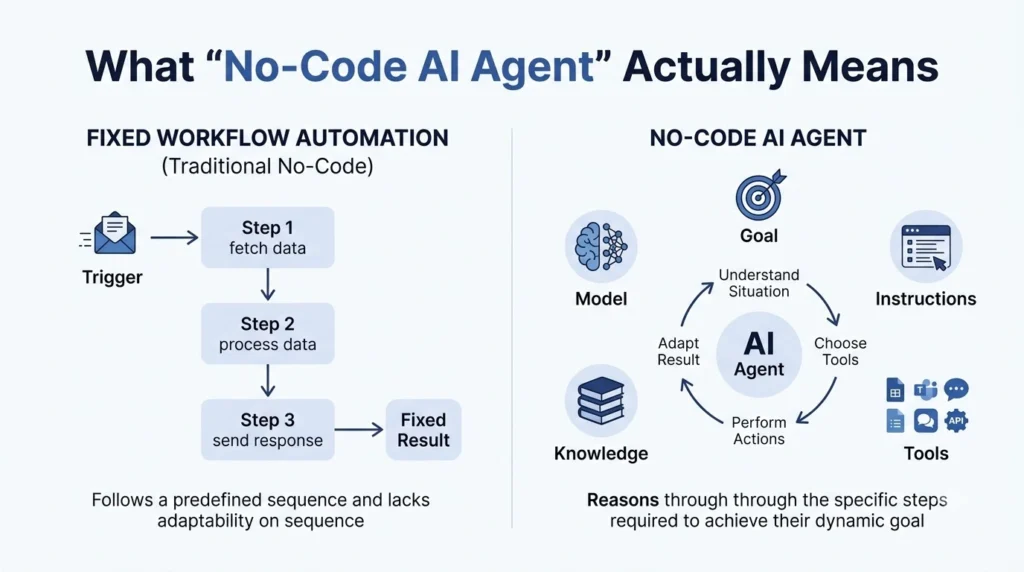
No-Code AI Agent Builders: The 2026 Guide. The useful distinction isn’t “no-code vs. code” — it’s autonomy. A no-code automation tool executes a fixed sequence when triggered. A no-code agent builder gives you a platform where you configure four things — the model, the instructions, the knowledge it can reference, and the tools it’s allowed to use — and the agent reasons through the specific steps itself rather than following a rigid script. That’s what separates this category from a classic Zapier-style trigger-action flow, even though several platforms (Zapier included) now offer both.
Why This Matters Right Now
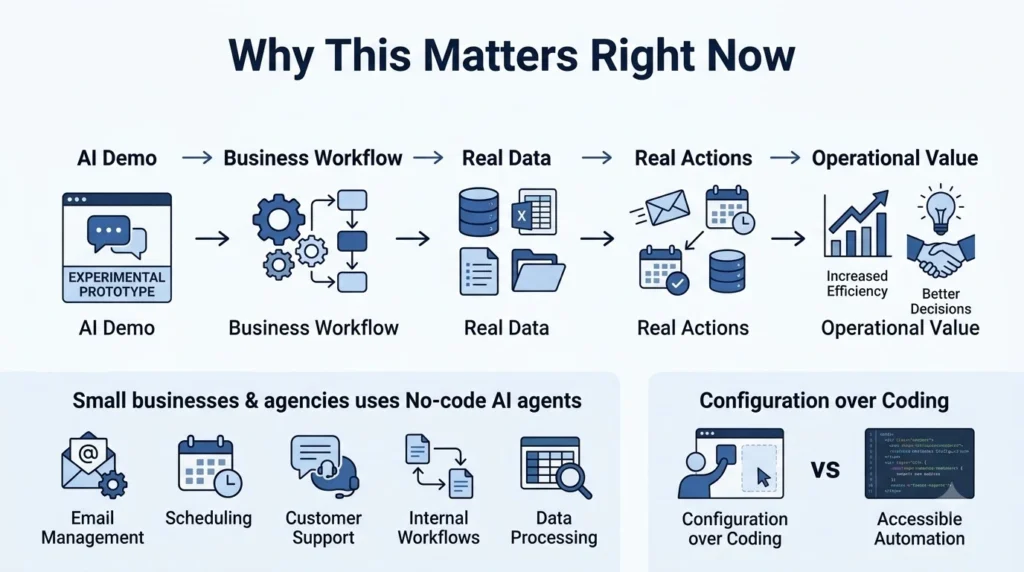
This category has moved from demo-stage novelty to genuinely operational use — real businesses are running these agents against real workflows with real money and data behind them, not just prototyping. The pattern across every credible source on this topic is the same: no-code agent platforms have made building an agent a configuration task instead of an engineering project, which matters most for small businesses and agencies that don’t have a developer on staff to spare for internal tooling. Exact market-size figures for this specific category vary widely between research sources and are worth treating skeptically regardless of which one you see quoted — the more reliable signal is the consistent set of platforms independent reviewers keep naming as genuine leaders, which is what the comparison below is built around.
What These Platforms Actually Do
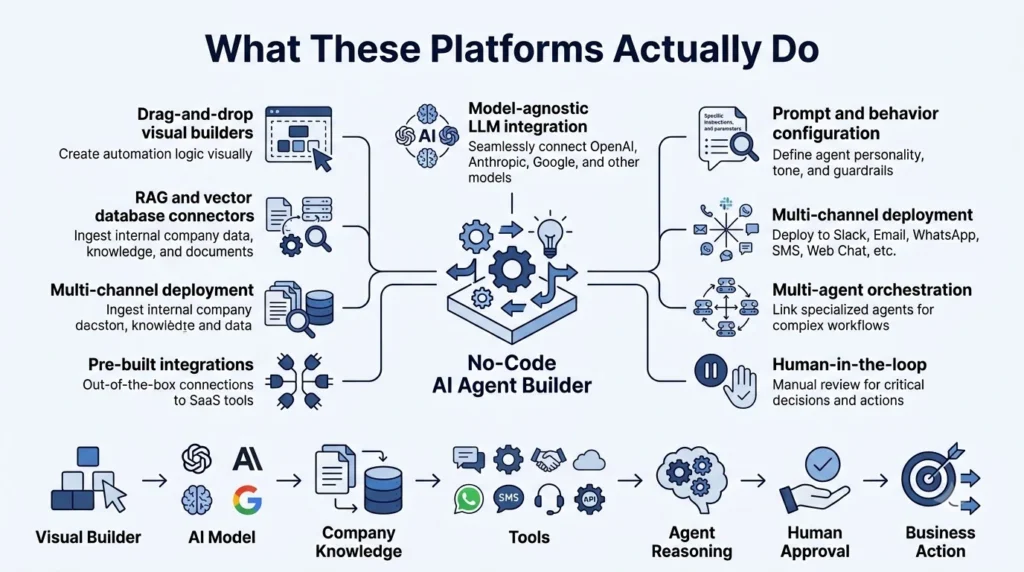
- Drag-and-drop visual builders — mapping workflow logic, conversation flow, or multi-agent handoffs on a canvas instead of writing code.
- Model-agnostic LLM integration — connecting to OpenAI, Anthropic, Google, or other providers, often with one-click switching between them.
- RAG and vector database connectors — indexing internal documents (PDFs, Notion, Google Drive, SQL databases) so an agent’s answers are grounded in your actual data rather than general knowledge.
- Prompt and behavior configuration — visual editors for system prompts, temperature, and testing sandboxes to refine how an agent responds before it goes live.
- Multi-channel deployment — publishing an agent as a web app, embeddable widget, API, or channel-specific bot (WhatsApp, SMS, voice) without separate builds for each.
- Multi-agent orchestration — coordinating several specialized agents (a researcher, a writer, a verifier) that hand off work to each other on a shared task.
- Human-in-the-loop approval gates — requiring sign-off before a sensitive action (a payment, a public post) executes, which matters more as agents get more autonomy.
- Pre-built integrations — direct connectors to tools like Slack, Gmail, Salesforce, and Stripe, plus webhook support for anything without a native connector.
Comparing the Top Platforms
| Platform | Best For | Strengths | Starting Price |
|---|---|---|---|
| Lindy | Business-task agents (email, scheduling, CRM) | Fastest time-to-value — describe the task in plain English and it’s running quickly; ready-made templates for common business tasks; SOC 2 Type II and HIPAA options | Free (400 credits); Pro $49.99/mo, extra credits at $10/1,000 |
| Voiceflow | Customer-facing conversational agents | Most intuitive conversation-design canvas in the category; strong omnichannel deployment (chat, voice, WhatsApp, SMS) that works out of the box | Free tier; Team plans from roughly $50/mo |
| Stack AI | Enterprise knowledge work and compliance-sensitive use cases | Strong RAG performance against internal databases and unstructured documents; SOC 2, HIPAA, and on-prem/VPC deployment options | From roughly $200/mo — priced for enterprise, not a small-team budget |
| Relevance AI | Multi-agent GTM and RevOps workflows | Purpose-built for coordinating specialized agents that pass work across stages; SOC 2 Type II and GDPR-certified | Free (~200 Actions/mo); Pro ~$19–29/mo; Team ~$234–349/mo |
| n8n | Technical teams wanting full control and self-hosting | Free unlimited executions if self-hosted; native LangChain support; full data sovereignty | Free self-hosted; Cloud from ~$20–24/mo |
Worth naming as a genuine alternative, not just a footnote: Zapier’s agent features (Central/Agents) are newer and less mature than dedicated agent builders like Lindy or Voiceflow, but they’re a reasonable default if you’re already deep in the Zapier ecosystem — the free plan includes 400 agent activities monthly, with a $33/month add-on bumping that to 1,500. Gumloop and Botpress are also consistently mentioned by independent reviewers for AI-native workflow building and conversational agents respectively, and worth a look depending on your specific use case.
Choosing by Use Case
- If you need a personal or small-team productivity agent (inbox triage, scheduling, CRM updates), start with Lindy — it has the shortest path from idea to working agent of anything in this category.
- If the agent faces your customers directly (support, sales conversations), go with Voiceflow — conversation design and omnichannel deployment are its actual specialty, not a bolted-on feature.
- If you’re in a regulated industry or need to search internal documents accurately, Stack AI’s compliance certifications and RAG performance are built for exactly that job.
- If you’re building a multi-agent workflow — several specialized agents handing off structured work — Relevance AI is purpose-built for that pattern in a way general-purpose tools aren’t.
- If data sovereignty or self-hosting is a hard requirement, n8n is the only platform here that lets you own the infrastructure without paying per execution.
- If you’re already committed to Zapier for everything else, its agent features are a reasonable default, with the caveat that they’re newer and less specialized than a dedicated agent builder.
Common Mistakes Teams Make
- Picking a platform because a “best of” list ranked it first, without checking whether that list’s publisher had a stake in the ranking. Cross-reference more than one source, especially when a vendor’s own blog is doing the ranking.
- Choosing based on feature breadth instead of the actual job. A platform with the most features isn’t automatically the right one — Stack AI’s compliance depth is wasted on a solo founder’s scheduling agent, and Lindy’s speed-to-value isn’t the priority for a regulated enterprise workflow.
- Underestimating credit-based pricing at real usage volume. Several platforms in this category price by credits or actions rather than a flat fee — run your actual expected workload through a free tier before sizing a paid plan.
- Skipping the human-approval step on consequential actions. An agent drafting an email is low-risk; one sending it, updating a CRM record, or processing a payment deserves an approval gate, at least until it has a track record.
also checkout – best No-Code RAG Chatbot Builders: The 2026 Guide
FAQs
What is the best no-code AI agent builder in 2026? It depends on the job: Lindy is the fastest starting point for business-task agents like email and scheduling, Voiceflow leads for customer-facing conversational agents, Stack AI suits regulated or compliance-heavy use cases, and Relevance AI is purpose-built for multi-agent workflows. There’s no single universal winner — match the platform to what you’re actually building.
Can I build a custom AI agent without any coding skills? Yes — visual builders and plain-English instructions let non-technical users configure a working agent by defining its model, instructions, knowledge sources, and available tools, without writing code. The tradeoff is less low-level control than a code-first framework offers.
How much does a no-code AI agent builder cost? Most platforms offer a free tier for testing, with paid plans commonly starting in the $20–50/month range for individuals or small teams and climbing significantly for enterprise-grade compliance features (Stack AI, for instance, starts around $200/month). Credit- or action-based pricing means your actual monthly cost depends heavily on usage volume, not just the advertised starting price.
How is a no-code AI agent builder different from a workflow automation tool like Zapier? A traditional automation tool executes a fixed sequence of steps when triggered. An AI agent builder gives the agent reasoning ability — it can interpret a situation and decide on a response rather than following a rigid script. Zapier now offers both: its core automation engine plus newer agent features that are less mature than dedicated agent-first platforms like Lindy or Voiceflow.