
AI Churn Prediction Software: The 2026 Guide for SaaS and Agencies
best AI Churn Prediction Software: The 2026 Guide for SaaS and Agencies. AI churn prediction software combines product usage, support activity, sentiment, and renewal data into a health score that flags at-risk accounts before a cancellation shows up in billing — the value isn’t the score itself, it’s catching risk early enough to actually do something about it. Gainsight leads for complex enterprise renewal operations, ChurnZero and Vitally are the practical starting points for most mid-market teams, and Totango stands out for a standalone AI intelligence layer that can run alongside an existing CS platform.
Table of Contents
Why This Matters Right Now
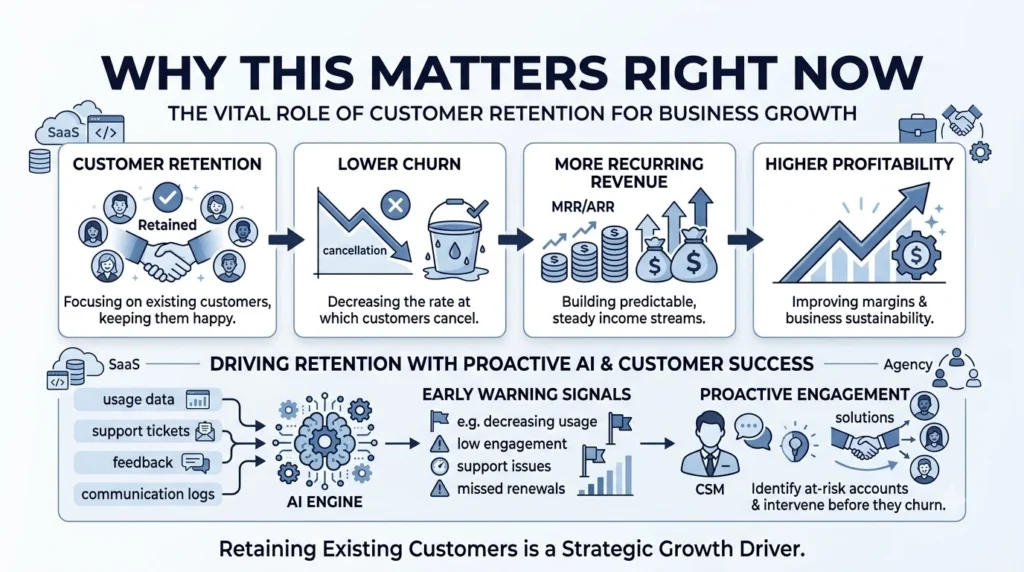
The economics behind this category are genuinely well-established, not hype. Bain & Company’s research — cited widely, including by Harvard Business Review — found that increasing customer retention by just 5% can increase profits by roughly 25% to 95%, depending on the company and industry. That’s one of the most durable, independently corroborated findings in business strategy, and it’s the actual reason retention has become a board-level priority rather than something customer success teams manage quietly in the background.
Adoption of AI specifically for this purpose is accelerating. Gainsight’s own State of AI in Customer Success survey (produced with Benchmarkit) found 52% of CS organizations were incorporating AI into their workflows in 2025 — worth reading as a directional industry signal rather than a neutral benchmark, since Gainsight is also a vendor in this space and has an obvious interest in showing strong category momentum. Independent of that specific survey, the broader pattern holds up: Intercom’s 2026 customer-service research found 82% of senior leaders had invested in AI for customer service in the prior 12 months, with 87% planning further investment in 2026. In the UK, one 2026 business survey found 39% of companies using AI in some form, with 45% specifically for customer support and chatbots and 46% for analytics and reporting. best AI Churn Prediction Software: The 2026 Guide for SaaS and Agencies
How AI Churn Prediction Actually Works
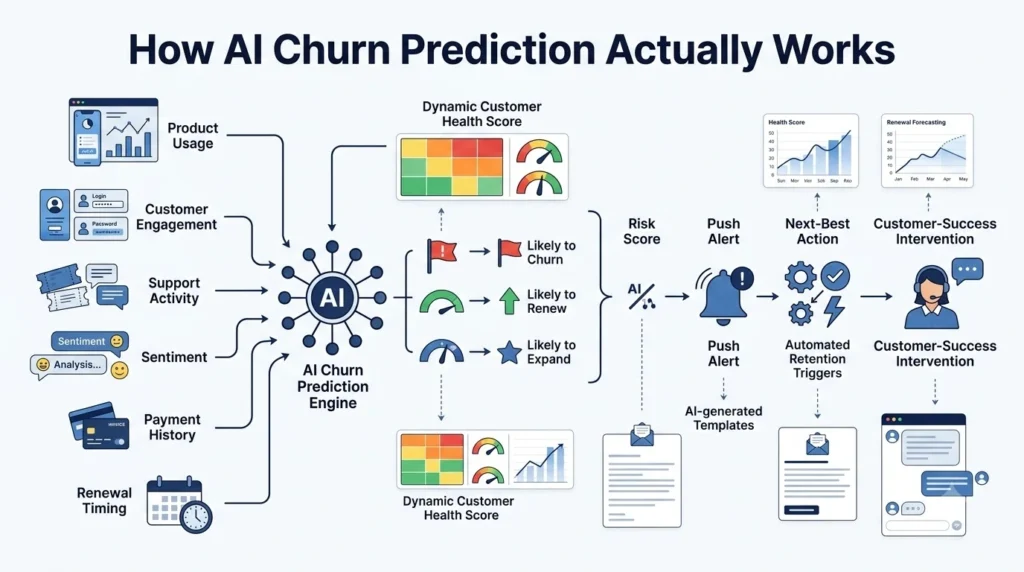
- Predictive churn-risk scoring — combining historical churn, usage, engagement, support activity, payment history, and renewal timing to estimate churn probability, with the better platforms distinguishing “likely to churn” from “likely to renew” and “likely to expand” rather than one flat score.
- Dynamic health scores — a continuously updated account view built from login frequency, feature adoption, meeting attendance, responsiveness, open tickets, and contract value.
- AI-powered sentiment analysis — reviewing support tickets, emails, and call notes for frustration, unresolved issues, or declining executive engagement that wouldn’t show up in usage data alone.
- Automated retention triggers — a health-score decline automatically creating a task, Slack alert, or playbook, rather than waiting for someone to notice manually.
- Next-best-action recommendations — connecting a risk score to an actual suggested intervention (executive outreach, training, service recovery) instead of just displaying a red flag.
- Renewal forecasting — rolling account-level risk up into a portfolio view of revenue at risk, expected contraction, and expansion potential.
- Automated communications — drafting renewal emails, QBR content, and follow-ups, freeing account teams from writing the same update from scratch every cycle.
What Agencies Specifically Should Track
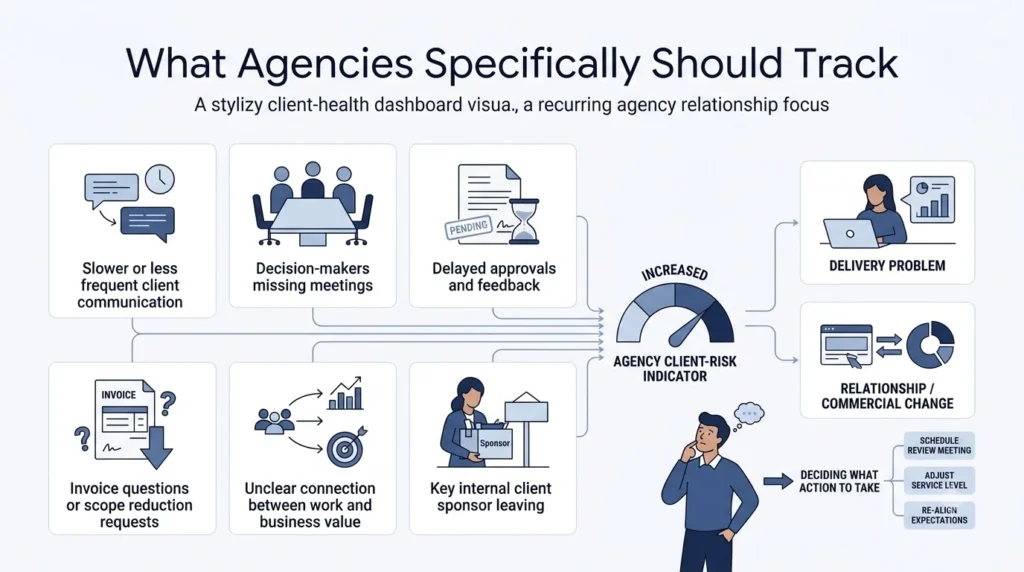
Client churn often shows up differently than product churn does, and it’s worth having a distinct list for it:
- Slower or less frequent client communication.
- Decision-makers no longer attending meetings.
- Delayed approvals and feedback cycles.
- Invoice questions or requests to reduce scope.
- Project outcomes not clearly connected to business value in the client’s mind.
- A key internal sponsor leaving the client organization.
The hard part for agencies specifically is separating a genuine delivery problem from a commercial or relationship one — a churn signal that looks like “the client is unhappy with our work” might actually be “our sponsor left and the new stakeholder doesn’t understand our value,” which calls for a very different response.
Comparing the Top Platforms
| Platform | Best Fit | Strengths | Estimated Annual Pricing |
|---|---|---|---|
| ChurnZero | Mid-market SaaS wanting operational automation | Strong risk scoring, alerts, journeys, playbooks; moved to flat-rate AI subscription pricing in 2026 | ~$20,000–$80,000+ (third-party estimate, verify directly) |
| Gainsight | Enterprise SaaS and large agencies with complex renewals | Broadest depth: renewal forecasting, sentiment, adoption analytics, journey automation | ~$50,000–$150,000+ (third-party estimate, verify directly) |
| Totango | Growing SaaS needing configurable intelligence | Standalone AI Customer Intelligence Engine that can run alongside an existing CS stack | ~$20,000–$100,000+ (third-party estimate, verify directly) |
| Vitally | Lean mid-market teams needing usability | No-code health-score builder, faster to configure than heavyweight enterprise platforms | ~$15,000–$50,000+ (third-party estimate, verify directly) |
All four use largely quote-led pricing — the ranges above are third-party estimates, not published rate cards, so confirm actual cost during procurement rather than budgeting off these figures. Worth knowing about beyond this core four: Custify and Planhat are common picks for smaller SaaS teams wanting simpler health scoring, and product analytics tools like Amplitude, Mixpanel, or Pendo paired with a CRM can cover adoption analysis, though they typically need extra tooling to turn behavioral signals into an actual renewal workflow.
Before You Trust the Score
This is the section vendors don’t lead with, and it matters. Buyers in Gainsight’s own survey reported real skepticism about AI churn scores as currently delivered: roughly seven in ten cited insufficient transparency in how recommendations were generated, and meaningful shares wanted better prediction accuracy and stronger integrations before trusting the output more. Treat that as a signal to demand specifics from any vendor, not a reason to avoid the category — ask for precision and recall metrics, historical back-testing against your own data, and evidence that acting on past recommendations actually improved retention, not just that the model produced a plausible-looking score.
Getting Started: 7 Steps
- Define churn, contraction, renewal, and expansion precisely before you build or buy anything — vague definitions produce a model nobody trusts.
- Start with a small number of signals, not every data point available — a simpler model you understand beats a complex one you can’t explain to your team.
- Build separate models for distinct customer segments or service lines rather than one blended score across very different account types.
- Back-test against historical churn and renewal outcomes before rolling the model out live.
- Assign a clear owner and playbook to each risk category — a score with no defined next action is just a dashboard, not a retention tool.
- Track intervention rate and save rate, not just the score’s existence — measure whether acting on the signal actually changed the outcome.
- Review model performance quarterly and recalibrate thresholds as your customer base and product change.
Common Mistakes Teams Make
- Treating a red score as a verdict instead of a starting point. The score should trigger investigation and a human decision, not an automatic action.
- Importing every available data point on day one. More signals without a clear model design usually produces more noise, not more accuracy.
- Skipping the back-test. A model that hasn’t been checked against your own historical outcomes is an unverified guess with a confident-looking dashboard.
- Buying enterprise depth before you need it. A small agency with a handful of retainer clients doesn’t need Gainsight’s full renewal-operations suite — start with the lightest tool that actually solves your current problem.
Also Checkout – great No-Code AI Agent Builders: The 2026 Guide
FAQs
What is an AI churn prediction tool? Software that analyzes customer behavior, engagement, support activity, sentiment, and commercial data to estimate which accounts are at risk of canceling or failing to renew, typically surfacing that risk as a score or alert well before it would show up in billing data.
What is the best AI churn prediction software for a SaaS company? It depends on scale and complexity: Gainsight suits complex enterprise renewal operations, ChurnZero and Vitally are practical starting points for most mid-market teams, and Totango is worth a look for its standalone AI intelligence layer that can work alongside an existing platform.
How accurate are AI churn prediction models? Accuracy varies significantly by data quality, customer volume, and model design. Ask any vendor for precision and recall metrics, back-tested results against your own historical data, and evidence that past recommendations actually improved retention — a plausible-looking score isn’t the same as a validated one.
Is AI churn prediction worth it for a small agency? It’s worth considering when recurring revenue is material and account managers are covering enough clients that early warning signs are easy to miss. Start with a lightweight health-score and alert system before investing in a full enterprise platform — most small agencies don’t need Gainsight-level depth on day one.