
Best AI Influencer Marketing Platforms in 2026
Best AI Influencer Marketing Platforms in 2026. AI influencer marketing platforms now handle creator discovery, fraud detection, outreach, and sales attribution well enough that picking one comes down to database size, pricing transparency, and how deep your e-commerce integration needs to be. GRIN and CreatorIQ lead for enterprise programs, Upfluence for mid-market sales attribution, and Modash for self-serve SMB access — but before trusting the next “X% of influencers are fake” statistic you read, it’s worth knowing that several of the most-cited fraud numbers in this space don’t trace back to a real, checkable source.
Table of Contents
Why Brands Are Scaling Creator Programs With AI in 2026
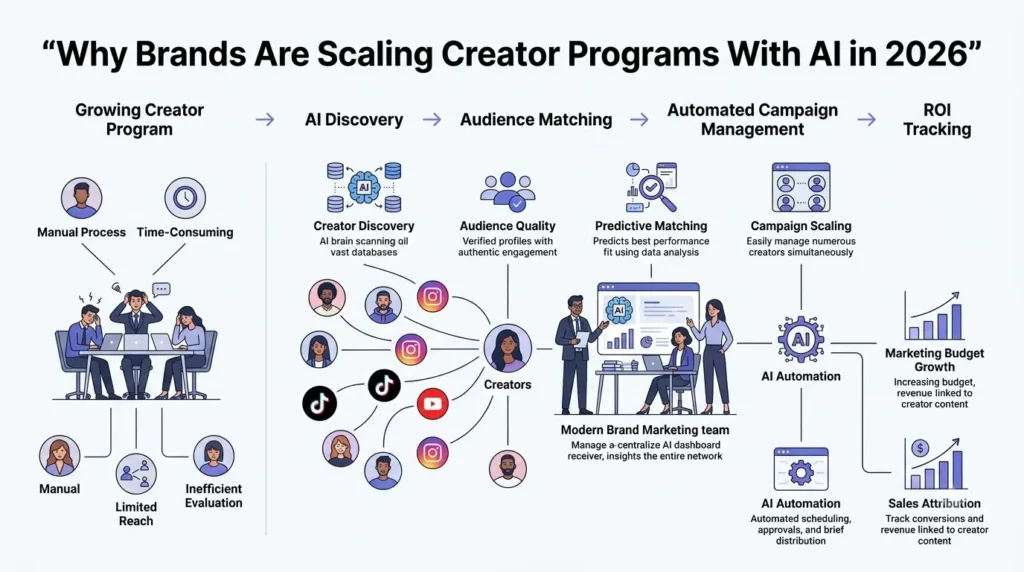
The category is genuinely large — estimates put the US influencer marketing industry around $12.2 billion in 2026, with the global market somewhere in the $24–32.5 billion range depending on which analyst you ask. Treat any single figure here as an estimate rather than a settled number; market-sizing reports in this space vary a fair amount by methodology, same as they do in most fast-growing software categories.
What’s more consistent across sources is the shift in how brands evaluate creators. Platforms like GRIN, CreatorIQ, Upfluence, and Modash have moved audience-quality scoring and predictive matching to the center of the discovery process, replacing the old habit of sorting by raw follower count. That shift is a direct response to two pressures: brands report plans to increase influencer budgets heading into 2026, and manual sourcing, vetting, and reporting simply don’t scale once a program grows past a handful of creators. AI compresses the sourcing and reporting work; it doesn’t replace the judgment call of whether a creator is actually a good fit.Best AI Influencer Marketing Platforms in 2026.
What These Platforms Actually Do
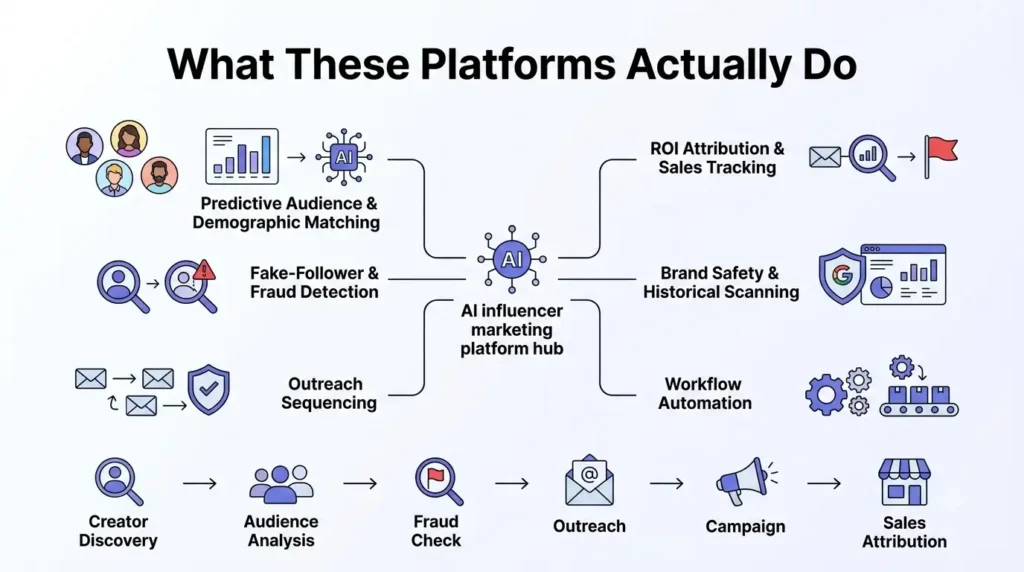
- Predictive audience and demographic matching. AI models match creators to a brand’s ideal customer using audience geography, language, interests, and past brand affinities — not just follower count or niche keywords.
- Fake-follower and fraud detection. Multi-signal scoring — growth spikes, engagement variance, comment quality, follower-account age — produces an audience quality score or authenticity percentage per creator.
- Automated outreach sequencing. AI drafts personalized outreach, sequences follow-ups, and tracks response rates; some platforms extend this into rate negotiation and contract generation.
- ROI attribution and sales tracking. Shopify and WooCommerce integrations enable discount-code tracking, multi-touch attribution, and revenue-per-creator dashboards — the feature that most separates the e-commerce-focused platforms from pure discovery tools.
- Brand safety and historical scanning. AI scans a creator’s post history for controversy, hate speech, or risky affiliations before a contract gets signed.
- Workflow automation. Product seeding, gifting fulfillment, affiliate link generation, and creator payments run automatically instead of through a spreadsheet and a lot of manual follow-up.
A Number Worth Treating With Real Skepticism
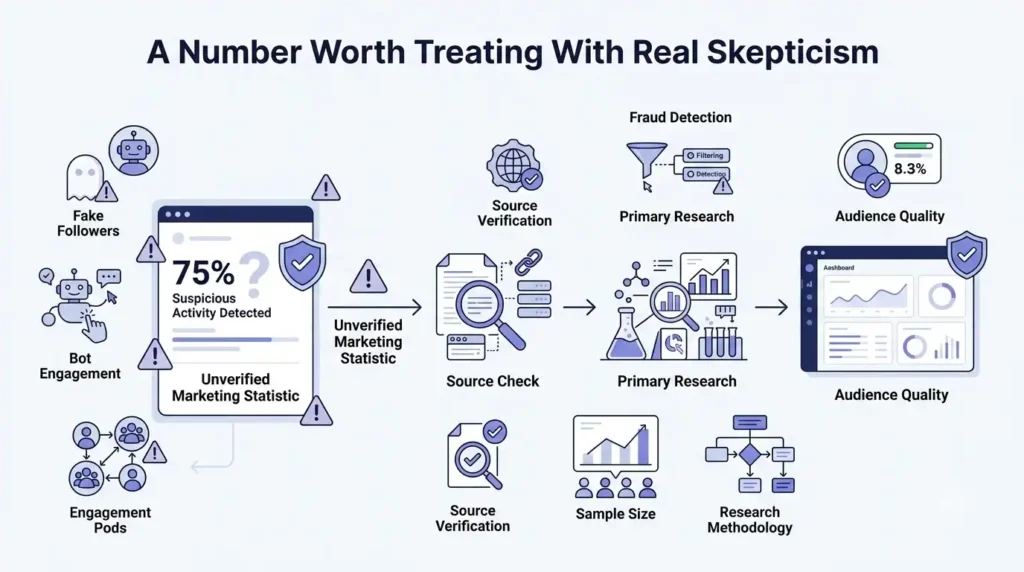
Influencer fraud is a genuine, well-documented problem — bought followers, engagement pods, and bot activity are real, and audience-quality tooling exists because brands kept getting burned by follower counts that didn’t reflect a real audience. That much is solid.
What’s less solid: dig into where the specific “X% of influencers are fraudulent” statistics circulating in 2026 content actually come from, and a lot of them don’t hold up. One widely-repeated figure attributes a 52.3%-fraud finding to a joint Modash and “Credibility Corporation” study — except Credibility Corporation doesn’t appear to be a real influencer-analytics company at all. Another commonly cited number claims $4.8 billion in 2026 fraud losses from CHEQ, a 269% jump from an earlier figure — except CHEQ’s own published material only contains an older 2019 estimate, with no 2026 update anywhere in their current content. These aren’t isolated typos; the same handful of dramatic-sounding numbers get copied across dozens of marketing blogs, each citing the others rather than a traceable primary source.
The more defensible figure available: a disclosed, 100,000-account study across Instagram and TikTok found a fraud rate around 41.8% on Instagram and 32.6% on TikTok, with mid-tier creators (100K–500K followers) the riskiest segment. That’s still a striking number — but it comes from a source that at least describes its sample size and method, which is more than most of the figures getting passed around.
The practical lesson for anyone evaluating these platforms: don’t take a vendor’s “we catch X% of fraud” claim, or any single quoted industry statistic, at face value. Ask what the audience-quality score actually measures, then spot-check it yourself against a few creators you already know something about before trusting it across an entire program.
The Real 2026 Pricing Picture — Where the Easy Answer Is Wrong
Pricing in this category ranges from fully transparent to completely sales-gated, and it’s worth knowing which is which before you request a demo.
GRIN does not publish pricing anywhere, on any tier. It’s a fully custom-quoted enterprise platform — no self-serve plans, no free trial, and reported entry contracts starting around $25,000 per year, with enterprise deals reported well into six figures depending on creator volume and integrations. If you see a specific published dollar figure for a “GRIN” tier anywhere, treat it with suspicion; multiple independent pricing-research firms confirm there’s no public rate card, only a sales conversation.
CreatorIQ is the same model at a similar altitude: no public pricing, annual contracts only, reported entry around $30,000/year with a median closer to $39,250 and top-end deals near $59,500 — built for Fortune 500-scale programs, not a brand running its first creator campaign.
Upfluence is genuinely more transparent, with modular, per-feature pricing starting around $478/month for a single search-and-contact module, scaling up as you add outreach, payments, or attribution modules — still a sales conversation for the full stack, but with a real published starting number.
Modash is the self-serve option of the group, with published tiers now starting closer to $299/month (up from the sub-$250 entry point some older comparisons still cite) and no free plan, but no sales call required either.
Real 2026 Pricing at a Glance
| Platform | Best For | Real 2026 Pricing Model | What You Actually Get In |
|---|---|---|---|
| GRIN | DTC/e-commerce brands running mature, high-volume creator programs | No public pricing; custom quote only, reported from ~$25,000/year | Deep Shopify integration, full creator CRM, payments, and workflow automation |
| CreatorIQ | Global enterprise programs and multi-brand agencies | No public pricing; annual contracts only, reported ~$30,000–$59,500+/year | Advanced AI discovery, brand safety scanning, Salesforce integration, global compliance tooling |
| Upfluence | Mid-market e-commerce needing sales attribution | Modular, published starting price ~$478/month per module | Search and outreach at entry; payments and attribution as added modules |
| Modash | SMBs and agencies wanting self-serve access without a sales call | Published tiers from ~$299/month, no free plan | Fraud detection, audience analytics, and a large creator database with monthly flexibility |
Every figure above is a reported or published snapshot rather than a guaranteed rate — confirm current numbers directly with the vendor, especially for the two custom-quoted platforms where the number you get depends entirely on your program’s scope.
Step-by-Step: Vetting and Launching an AI-Assisted Creator Program
- Verify a sample of the platform’s audience-quality scores yourself before trusting it across your whole program — check a few creators you already have context on and see if the score matches what you’d expect.
- Get the real number for sales-gated platforms before you fall for the feature list. A demo for GRIN or CreatorIQ is a sales conversation, not a pricing page — ask directly what a program your size typically costs.
- Build FTC disclosure requirements into the contract, not just the campaign brief. A creator’s post needs a clear, conspicuous disclosure before the fold — platform-native “Paid Partnership” tags alone aren’t considered sufficient on their own.
- Run brand-safety scanning before signing, not after a post goes live. History-scanning tools exist specifically to catch this earlier in the process than a post-launch surprise.
- Connect attribution before the first campaign launches, not after — a discount code or tracking link set up mid-campaign loses you the baseline data you’d need to prove ROI.
- Document your review process for AI-drafted outreach and contracts. Automated negotiation and contract generation still need a human check before anything goes out with your brand’s name on it.
- Revisit your fraud-detection assumptions periodically, given how much of the public data in this space turns out to be unreliable — don’t let a single vendor claim or industry stat set your risk tolerance permanently.
Which Platform Fits Which Brand
- Established e-commerce brand running a mature, high-volume creator program — GRIN’s Shopify-native workflow justifies the enterprise price once you’re managing real volume, but budget for a real sales negotiation, not a quick signup.
- Global or multi-brand enterprise needing compliance and Salesforce integration — CreatorIQ’s scale and brand-safety tooling fit Fortune 500-style programs; smaller teams will find it overbuilt and priced accordingly.
- Mid-market e-commerce brand that needs to prove sales attribution, not just reach — Upfluence’s modular pricing lets you pay for outreach and attribution without buying the full enterprise stack.
- SMB or agency wanting to start without a sales call — Modash’s self-serve access and large database make it the most accessible entry point in this group.
Bottom Line
The AI in these platforms has genuinely solved discovery and reporting at scale — narrowing hundreds of millions of profiles to a vetted shortlist in minutes is a real capability, not marketing language. What it hasn’t solved is the trust problem underneath the category: audience-quality claims and fraud statistics both need independent verification, whether that claim comes from a vendor’s pricing page or an industry stat you found in someone else’s blog post. Check the number yourself before it goes into your budget or your board deck.
also checkout – Best AI Internal Wiki Tools for Remote Agencies in 2026
FAQs
What is the best AI influencer marketing platform for small businesses in 2026?
Modash is the most accessible option for smaller teams, with published self-serve pricing and no sales call required. Upfluence’s modular pricing is worth considering too if sales attribution matters more than a large discovery database — both let you start without committing to an enterprise-scale annual contract.
How do AI tools detect fake followers and bot engagement?
They combine multiple signals — sudden follower-growth spikes, unusual engagement-to-follower ratios, low-quality or generic comments, and the age and behavior pattern of the follower accounts themselves — into a single audience-quality or authenticity score. No single signal is definitive, which is why spot-checking a platform’s score against creators you already know is worth doing before trusting it at scale.
Which influencer platforms offer real ROI tracking and sales attribution?
GRIN and Upfluence both build directly on Shopify and WooCommerce integrations for discount-code tracking and revenue-per-creator reporting. CreatorIQ offers attribution as well, aimed at larger, more complex multi-brand programs rather than a single-store DTC setup.
What’s the actual difference between GRIN, CreatorIQ, and Modash?
GRIN is built for e-commerce brands and centers on Shopify integration, creator payments, and workflow automation at enterprise pricing. CreatorIQ targets global, multi-brand enterprise programs with deeper compliance and Salesforce tooling at a similar price altitude. Modash is the self-serve alternative to both — a large creator database and solid fraud detection at a fraction of the cost, without the enterprise workflow depth.