
AI Financial Tools: A Data Privacy and Security Guide for 2026
AI Financial Tools: A Data Privacy and Security Guide for 2026
AI financial tools create real data privacy and security exposure the moment they connect to your accounting platform, bank feed, or payroll system — the risk isn’t just whether the vendor seems trustworthy, it’s what data the tool can actually see, where that data goes, and whether it’s retained or used to train models. The safest approach uses read-only permissions, field-level data masking, and a written data policy rather than taking a vendor’s “secure” marketing claim at face value.
Why This Matters Right Now
AI adoption is accelerating fast enough that governance is visibly lagging behind it, on both sides of the Atlantic. The Federal Reserve’s own analysis found about 18% of US firms had adopted AI by the end of 2025, with more than 20% expecting to start within the first half of 2026 — and adoption running notably higher in financial and professional services, the sectors most likely to be feeding sensitive data into these tools.
In the UK, the government’s Business Data Survey 2026 found 41% of businesses handling digitized data used AI for at least one purpose, rising to 82% among large businesses — but comfort with how that data gets used hasn’t kept pace. Only 18% of UK businesses said they’d be comfortable with their business data training external AI models, while 73% said they’d be uncomfortable. Governance is the visible gap: 17% of AI-using UK businesses had no AI policy at all, just 53% were aware of relevant regulatory guidance, and only 19% found that guidance actually clear.
That gap between adoption and governance is exactly where the risk concentrates — not in AI itself, but in AI connected to systems it shouldn’t have full access to, with no one tracking what it can see.
AI Financial Tools: A Data Privacy and Security Guide for 2026
Table of Contents
Where the Real Risk Actually Comes From
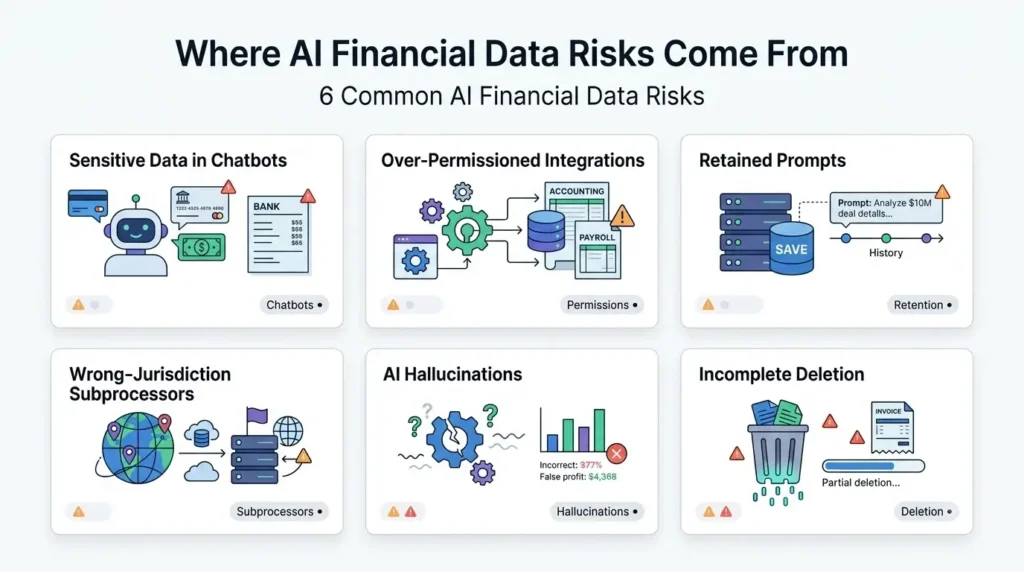
- Employees pasting sensitive data into consumer chatbots — bank statements, payroll exports, or customer ledgers dropped into a general-purpose AI tool with no enterprise controls.
- Over-permissioned integrations — an AI accounting assistant connected via OAuth that can write to your ledger or change bank details when it only needed read access to categorize transactions.
- Retained prompts and outputs — vendor logs kept for debugging, abuse monitoring, or product improvement that outlive the task you actually asked the AI to do.
- Subprocessors in the wrong jurisdiction — a vendor’s own AI provider or storage partner operating in a location that creates contractual or data-residency problems you never agreed to.
- Hallucinated financial output — an AI-generated summary containing a fabricated transaction or incorrect tax treatment that looks confident enough to go unquestioned.
- Incomplete deletion — a source ledger deleted from your main system while copies persist in vendor backups, embeddings, or logs.
- Shared-workspace exposure — a financial report visible to the wrong employee, contractor, or (for agencies) the wrong client entirely.
What to Look For in a Secure Platform
- Read-only access wherever possible — a tool that only needs to read transactions shouldn’t have write permissions to your ledger or bank details.
- Granular role-based permissions — separate controls for viewing, exporting, editing, paying suppliers, and changing bank information, not one blanket access level.
- Strong authentication — SSO and multi-factor authentication as standard, not an add-on.
- Encryption in transit and at rest, with customer-managed keys where the option exists.
- Complete audit logs — user access, prompts, file uploads, API calls, model outputs, and admin changes, all reviewable after the fact.
- Data-loss-prevention rules that block account numbers, tax IDs, and payroll files from leaving approved environments.
- Human approval built into the workflow for payments, tax submissions, credit decisions, and ledger changes — not fully autonomous execution on financial actions.
- Independent assurance — SOC 2 or ISO 27001 documentation, not just a claim of being “enterprise-grade.”
Data masking and tokenization add another layer worth using before data ever reaches an AI model — replacing names, account numbers, and tax IDs with tokens so the model only sees what it needs to classify or summarize. It’s not a complete solution on its own, though: free-text notes, unusual transaction descriptions, and small datasets can still identify a person or business, so masking works best combined with access controls and retention limits, not as a substitute for them.
“No Training” and “Zero Retention” Are Different Promises
This distinction gets conflated constantly, and it matters:
- “No training” means your data isn’t used to improve the provider’s general models.
- “Zero retention” means your prompts and outputs aren’t stored beyond what’s technically required to deliver the response.
A vendor can honestly promise one without the other. OpenAI’s own documentation, for instance, describes zero-data-retention configurations available for qualifying API use — but eligibility varies by endpoint, and neither promise automatically covers backups, subprocessors, your own exported files, or data sitting in the connected accounting platform itself. Get the specific answer in writing, scoped to the exact product and endpoint you’re using, not a general company-wide claim.
Where Enterprise Governance Tools Fit
| Tool/Category | Best Fit | Strengths | Watch Out For |
|---|---|---|---|
| Microsoft Purview | Organizations already on Microsoft 365/Azure | Data classification, sensitivity labels, DLP, audit logs across Microsoft and third-party AI environments | Licensing and configuration complexity; strongest value requires an established Microsoft ecosystem |
| Collibra AI Governance | Larger orgs needing AI model inventories | Central repository for models/agents, ownership workflows, data lineage | Governance-heavy — substantial process design and specialist expertise to implement well |
| Kiteworks | Regulated firms exchanging financial documents externally | Zero-trust controls, end-to-end encryption, transaction logging for data in motion | More data-exchange focused than AI-model governance specifically; may be more infrastructure than a small business needs |
| Native enterprise AI controls (ChatGPT Enterprise, Azure OpenAI, Bedrock, Vertex AI) | Teams with developers who can build a controlled pipeline | Enterprise contracts, private networking, configurable retention | Security depends entirely on implementation — a secure model is still exposed by poor connector permissions |
| Privacy-focused specialist tools | SMEs with one or two narrow AI financial workflows | Easier to deploy for a specific task like invoice extraction | Often less mature auditability and fewer certifications — verify “private” or “zero storage” claims in the actual contract |
A sensible progression for most small businesses: approved business-grade AI account → documented data policy → read-only integrations → masking/DLP → signed vendor DPA → retention verification → quarterly access review. Save a full governance platform like Purview or Collibra for when you’re managing AI across many models, jurisdictions, and data domains — most small businesses aren’t there yet, and buying the enterprise platform first usually means it goes unused.
The Compliance Landscape You Actually Need to Know
In the UK, obligations run through UK GDPR and the Data Protection Act 2018: document a lawful basis, apply data minimization, provide transparency, and support individual rights. The ICO’s AI guidance covers fairness, transparency, and automated decision-making specifically. The newer Data (Use and Access) Act changes parts of this landscape, so review your privacy notices and AI governance documentation rather than relying on an older GDPR checklist. A Data Protection Impact Assessment is the practical baseline before deploying generative AI that processes personal data, especially for profiling or automated decisions.
In the US, there’s no single federal privacy law — expect a patchwork of state laws, sector rules, and contractual obligations. California is the one most businesses need to track closely: CPPA regulations effective January 1, 2026 address privacy risk assessments, cybersecurity audits, and automated decision-making technology, with some automated-decision-making obligations phasing in on January 1, 2027. If you’re a covered financial institution under FTC jurisdiction, the FTC Safeguards Rule requires documented administrative, technical, and physical safeguards, including oversight of service providers. And NIST’s AI Risk Management Framework is a genuinely useful voluntary structure for building an AI inventory and risk assessment process, even though it isn’t legally mandatory.
A Practical Rollout Checklist
- Inventory every AI financial tool, connector, and employee account currently in use — you can’t govern what you don’t know exists.
- Classify your data as public, internal, confidential, personal, or highly sensitive before deciding what any AI tool is allowed to touch.
- Prohibit unrestricted uploads of ledgers, payroll files, and bank statements to consumer AI accounts.
- Default to read-only access and least privilege on every integration, upgrading permissions only when a specific task genuinely requires it.
- Get retention and training terms in writing, scoped to the specific product and endpoint — not a general marketing statement.
- Require human approval on payments, tax submissions, and any high-impact financial action.
- Review access quarterly, not just at initial setup.
Common Mistakes Businesses Make
- Trusting a vendor’s “secure” claim without asking what it actually means. “Secure” isn’t a specific commitment — retention period, training policy, and subprocessor list are.
- Granting write access when read access would do. Most AI financial workflows need to see data, not change it — check before you approve broader permissions than the task requires.
- Treating masking as a complete fix. Removing names and account numbers helps, but small datasets and unusual transaction details can still be identifying — pair masking with access controls and retention limits.
- Assuming deletion is complete. Deleting a source file doesn’t guarantee it’s gone from vendor backups, logs, or embeddings — confirm the actual deletion process, not just the delete button.
also checkout – AI Data Security in Finance: 2026 How to Protect Financial Data While Still Using AI
FAQs
Is it safe to connect ChatGPT or similar AI tools to accounting software like QuickBooks? It depends entirely on the specific integration’s permissions and the account tier. A consumer account with broad, unrestricted access carries meaningfully more risk than a business or API-tier account configured with read-only permissions, logging, and verified retention terms — check the specific configuration, not the brand name.
Does AI accounting software use my business data to train its models? It depends on the vendor, product tier, and contract — there’s no universal answer. Get this in writing, and make sure the answer distinguishes model training from abuse-monitoring logs, backups, and subprocessor storage, since a vendor can honestly deny one while still doing another.
What financial information should never go into a public AI chatbot? Avoid bank credentials, full bank statements, payroll files, tax IDs, unredacted invoices, credit reports, and confidential forecasts. Use redacted, aggregated, or synthetic examples when you need to test how a tool handles a specific type of document.
How can a small business stay GDPR or CCPA compliant while using AI financial tools? Identify your lawful basis for processing, minimize the data you send to any AI tool, document your processing activities, and get the right vendor terms in place (a DPA at minimum). For CCPA specifically, check whether your AI vendor counts as a service provider or an independent recipient under the law, since that changes your disclosure obligations.