
AI Data Security in Finance: 2026 How to Protect Financial Data While Still Using AI
AI Data Security in Finance: 2026 How to Protect Financial Data While Still Using AI
AI data security in finance means locking down account numbers, ledgers, and customer PII before any of it reaches an AI prompt — through zero data retention (ZDR) agreements, field-level masking, tightly scoped access, and a signed data processing agreement with every vendor involved. Skipping any of that isn’t just a security gap: GDPR, the UK’s Data (Use and Access) Act, California’s new automated-decision rules, and the EU AI Act’s August 2026 provisions all now expect firms to prove these controls exist.
Table of Contents
Why This Is a Board Problem Now, Not Just IT’s
By mid-2026, AI has moved well past the pilot stage. Forecasting models, reconciliation bots, covenant-analysis agents, and AI-drafted client communications are running inside core finance workflows at most mid-size and large firms. That’s exactly why security researchers now rank AI-specific threats — prompt injection, shadow AI, and data leakage — among the top emerging risk categories facing any enterprise, according to a 2026 research report from Practical DevSecOps.
Regulators noticed the same shift. GDPR’s automated-processing rules and the EU AI Act’s phased rollout now expect firms to document exactly how AI touches personal data and to show a human can still step in on decisions that matter, per Gray Group International‘s 2026 compliance rundown.
Stack financial-sector rules on top of that — the GLBA Safeguards Rule, PCI DSS for card data, SOC 2 and ISO 27001 expectations, and (for EU-facing firms) DORA’s operational-resilience requirements — and you get a genuinely high-compliance surface, as Cincom puts it in its breakdown of the “compliance trilemma” facing financial communications teams.
Put simply: boards want AI velocity in 2026, and regulators want proof of control. You can have both — but only if the data security work happens before you scale usage, not after an incident forces it.
AI Data Security in Finance: 2026 How to Protect Financial Data While Still Using AI
Where Financial Data Actually Leaks When Teams Use AI
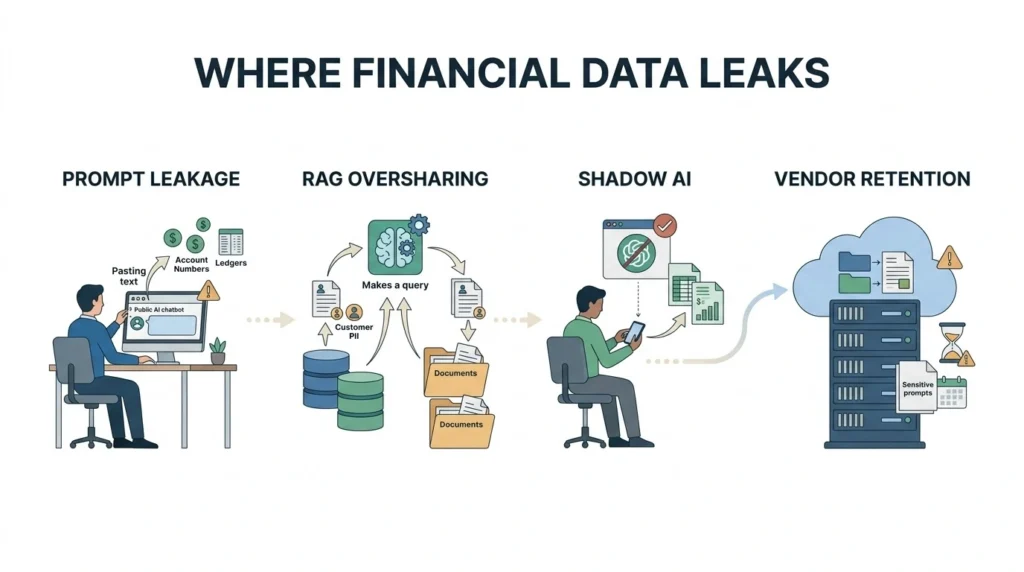
Most leaks don’t come from a dramatic hack. They come from ordinary AI usage nobody scoped properly in the first place:
- Prompt and output leakage. Someone under deadline pressure drops a client’s account number or an unfinished ledger into a free chatbot to save time. From that point you’ve lost visibility — that text might sit in a vendor’s logs indefinitely, get swept into a future training run, or resurface in someone else’s output months later, a pattern GoodData has documented across financial-services security reviews.
- RAG oversharing. Retrieval-augmented generation is excellent at answering questions, and just as good at over-fetching. Ask a narrow question, and a loosely scoped RAG pipeline can pull an entire client file into the prompt behind the scenes, per LangProtect‘s look at enterprise AI data leakage.
- Shadow AI. Employees adopt ChatGPT, Copilot, or Claude on their own, outside procurement and outside your DLP tooling — meaning data leaves the building through a door security never signed off on, as EverWorker describes it.
- Vendor retention gaps. Skip the ZDR clause and skip confirming where the data physically sits, and you’ve effectively signed a blank check: financial data can outlive your retention policy and land in a jurisdiction your legal team never approved, notes Protecto.
The Controls That Actually Stop the Leak
None of this requires banning AI from finance work. It requires putting real controls between your data and the model.
Zero data retention (ZDR). Under a ZDR agreement, the vendor doesn’t keep your prompts or outputs once it hands back a response. That one contractual line does a lot of work — it’s often the difference between a clean GDPR/CCPA posture and a data flow your privacy counsel can’t fully explain, and it’s usually the first thing an auditor asks about. A recent research overview confirms ZDR is now standard on enterprise tiers across the major providers. Anthropic documents its version clearly: qualifying commercial API and Enterprise customers can enable a ZDR arrangement where inputs and outputs aren’t stored at rest after the response returns, and that content is never used for model training — a materially stricter setup than the free consumer tier, which works on an opt-out basis rather than zero-by-default (see Anthropic’s own privacy documentation and API retention docs). Worth confirming directly with whatever vendor you’re evaluating — “enterprise-grade privacy” means different things at different companies.
Masking and tokenization at the gateway. Think of it as a decoy layer: a gateway swaps every account number, SSN, or ID field for a stand-in token before the prompt ever leaves your network. The model still sees enough shape and structure to summarize, categorize, or flag anomalies — it just never sees the real number. Seclore’s ARMOR product is one example built specifically for this kind of bidirectional masking, per Yahoo Finance‘s coverage of the launch.
Data minimization and access control. Classify what’s genuinely sensitive, then restrict which AI tools — and which employees — can reach it. EverWorker frames this as shrinking the “blast radius” of any single prompt or agent run, which is the right mental model: assume something will eventually go wrong, and design so the damage stays small when it does.
Encryption and key management. TLS 1.2+ in transit, AES-256 at rest, and bring-your-own-key or hold-your-own-key arrangements wherever the vendor supports them. EverWorker flags this as table stakes for any AI tool that touches regulated financial data — not a nice-to-have.
Audit trails. Log every AI interaction with financial data — prompt, output, user, timestamp — and enforce DLP policy at the point where the tool actually calls out to a model, not just at the network edge. That log is what turns “trust us” into evidence you can hand an auditor, per EverWorker‘s CFO-focused controls checklist.
Step-by-Step: Rolling Out AI Across a Finance Team Without Leaking Data
This is the order that tends to work in practice:
- Inventory and classify your data. Know which fields are PII, which are regulated (account numbers, SSNs), and which are genuinely safe to expose to any tool.
- Shortlist vendors that offer contractual ZDR. Don’t take a sales deck’s word for it — ask to see the actual clause in the Data Processing Addendum.
- Sign the DPA and confirm the transfer mechanism. If data crosses the EU/UK–US border, you need Standard Contractual Clauses or DPF coverage, not just an assurance.
- Put a masking or tokenization gateway in front of general-purpose tools. Purpose-built finance AI may not need this layer; a general chatbot almost always does.
- Set access by role, not by default. Most employees don’t need a tool that can see the full ledger — scope it to what the job actually requires.
- Turn on logging before go-live, not after an incident. Retrofitting an audit trail once something’s already gone wrong costs far more than building it in from day one.
- Run a DPIA for any AI use case that makes or informs a “significant decision” — credit decisions, underwriting, fraud flags — since that’s precisely what regulators are watching in 2026.
- Write, and actually enforce, an acceptable-use policy that bans pasting raw client data into anything off the approved list, and train staff on what “approved” means in practice.
- Revisit vendor attestations on a schedule. SOC 2 and ISO 27001 reports expire; a vendor that was compliant at signing isn’t automatically compliant a year later.
What the Rules Actually Require Right Now (US, UK, EU)
The picture shifts depending on where your customers sit, and it has moved meaningfully in the last few months alone:
| Region | Key Rule(s) | What It Means for AI in Finance Today |
|---|---|---|
| EU | GDPR + EU AI Act | GDPR’s lawful-basis and DPIA duties already apply. The AI Act’s transparency rules and full penalty regime became enforceable August 2, 2026 — but the specific high-risk obligations for uses like credit scoring and underwriting (Annex III) were pushed back to December 2027, with embedded systems given until August 2028, following an EU Parliament vote to delay them. |
| UK | Data (Use and Access) Act 2025 | Phased in across three stages between August 2025 and June 2026. It actually loosens some automated-decision restrictions compared with the old UK GDPR Article 22 regime — but firms still owe people transparency and a route to request human review of a “significant decision.” |
| US — financial sector | GLBA Safeguards Rule, PCI DSS, DORA (for EU-facing operations) | Risk assessments, encryption, access controls, and vendor oversight are already baseline expectations, AI or no AI. |
| US — state | California’s CPPA rules on automated decision-making technology (ADMT) | Took effect January 1, 2026, with ADMT-specific compliance required by January 1, 2027 for decisions already in production. |
If you operate in Colorado, note that the state’s own AI Act took effect June 30, 2026 and adds obligations specifically for high-risk AI systems that materially affect access to financial services — disclosures, consumer notice, and a duty of “reasonable care” against algorithmic discrimination.
Don’t build a compliance program around a single deadline — the EU AI Act alone has moved its own goalposts twice in the past year. Build to the strictest version of these rules and you’re covered no matter which timeline actually holds.
Comparing the Platforms Teams Actually Use to Lock This Down
If you’re evaluating a governance layer to sit on top of your AI stack, these four keep coming up in 2026 buyer conversations:
| Platform | Best Fit | Where It Wins | Where It Struggles |
|---|---|---|---|
| Microsoft Purview | Enterprises already committed to Microsoft 365 and Azure | Classification happens automatically once you’re inside the Microsoft ecosystem, and rollout is noticeably faster than most competitors — if you’re already there | Per-seat and per-source pricing climbs quickly, and it’s a much harder sell once data lives outside Azure, per CheckThat |
| Collibra | Large regulated institutions running hybrid or multi-cloud estates | Handles federated stewardship and data lineage at a depth few tools attempt, built for organizations with real governance bureaucracy to satisfy, per WindowsForum | Budget for the better part of a year to get fully live, and the invoice tends to match that timeline, per CheckThat |
| Atlan | Cloud-native stacks on Snowflake, Databricks, or dbt that want speed over ceremony | Metadata updates propagate close to real time, with most teams reporting a usable core deployment inside four to six weeks, per WindowsForum | Won’t enforce policy as aggressively as Collibra out of the box — plan to pair it with dedicated DLP if enforcement, not just visibility, is the goal, per Improvado |
| Kiteworks | Teams most worried about a single file walking out the door, not governing an entire data estate | Purpose-built encrypted, policy-gated file sharing for regulated content — a narrower job than the others, done deliberately well, per Kiteworks | Not really an AI-native governance or catalog platform — treat it as a file-security layer, not a full governance suite |
None of these replace the vendor-level controls above — a governance platform tells you where sensitive data lives and who’s touching it, while ZDR and masking control what the AI model itself ever sees. Most finance teams end up needing both, layered with dedicated AI-DLP tools like Seclore’s ARMOR, per Yahoo Finance, or the enterprise ZDR tiers offered by providers such as Anthropic, OpenAI (via Azure), and Mistral AI, as this research overview notes. For smaller teams without a dedicated security hire, AI Policy Desk and SORN Security both cover lighter-weight ways to get most of this in place without a six-figure governance budget.
Bottom Line for Finance and Compliance Teams
AI isn’t the risk. Unscoped AI is. The firms moving fastest in 2026 aren’t avoiding AI in finance workflows — they classified their data, locked down retention and access before rollout, and can produce an audit trail on demand. Build that foundation once, and every AI use case that comes after it gets faster to approve, not slower.
ALSO CHECKOUT – Best AI CRM Software in 2026: What Each Platform Actually Costs and Does
FAQs
Is it safe to use AI tools for financial data at a small business?
Yes, but only with real guardrails in place, not by default. Layer in zero-data-retention terms, encryption, tightly scoped access, and a hard rule against pasting raw PII or ledgers into public tools. GDPR, CCPA, and GLBA don’t carve out exceptions for size — they just assume smaller teams have fewer people to enforce the policy, so document it clearly.
What data protection laws apply to AI tools used in finance in the US and UK?
In the EU/UK: GDPR plus the EU AI Act’s obligations, and the UK’s Data (Use and Access) Act 2025. In the US: sector rules like GLBA and PCI DSS, plus a growing list of state privacy laws — California’s CPPA rules on automated decision-making chief among them — that increasingly hand consumers an opt-out from automated profiling, per Gray Group International.
How do I stop AI tools from leaking financial data during accounting or forecasting?
Sanitize inputs before they reach the model, add field-level masking or tokenization, insist on ZDR terms in the contract, enforce DLP at the point the AI tool is actually invoked, and scope access to the minimum dataset each tool needs — not your full ledger, per EverWorker.
Do AI vendors actually offer zero data retention, and how do you verify it?
Many do at enterprise or commercial tiers — Anthropic, OpenAI (via Azure), and Mistral AI all support it for qualifying accounts, per this research overview and Kreante’s 2026 rundown of ZDR offerings. Don’t take it on faith: ask for the specific ZDR clause in the contract, confirm the setting in the vendor’s admin console, and check for a current SOC 2 or ISO 27001 attestation before you connect anything to real customer data.