
No-Code RAG Chatbot Builders: The 2026 Guide
No-Code RAG Chatbot Builders: The 2026 Guide. A no-code RAG chatbot builder lets you upload your company’s documents, policies, and product information, then publish a chatbot that answers questions using that specific content — with citations — instead of relying on a general-purpose model’s training data alone. CustomGPT.ai is the fastest path to a managed, citation-focused bot, Voiceflow suits teams designing more complex customer journeys, Dify gives technical teams full infrastructure control, and Coze fits rapid, lightweight experimentation.
Table of Contents
What RAG Actually Means (and Why It’s Not Fine-Tuning)
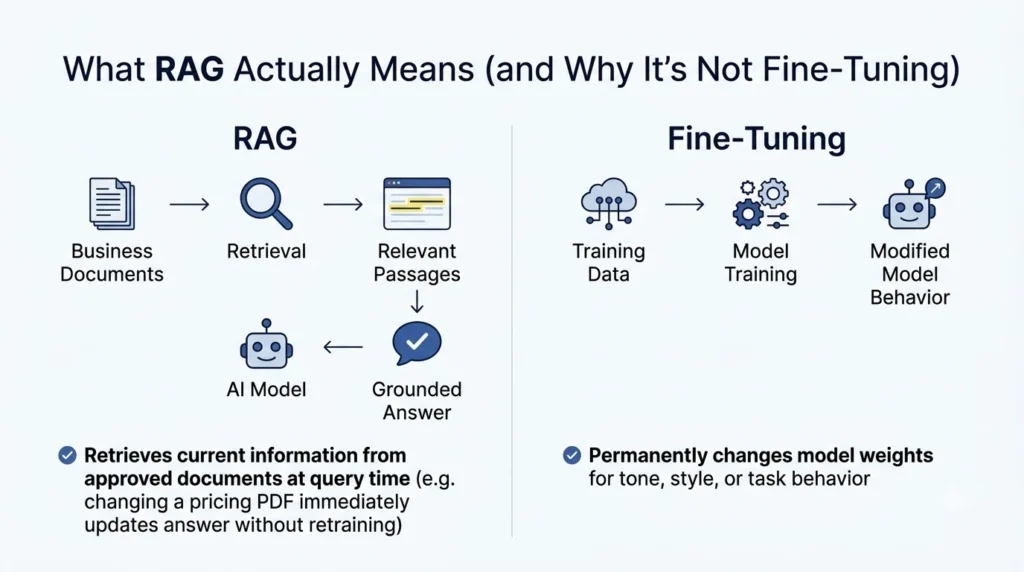
No-Code RAG Chatbot Builders: The 2026 GuideA “custom-trained chatbot” gets used loosely to describe several genuinely different products, and knowing which one you’re evaluating matters. Retrieval-augmented generation (RAG) retrieves relevant passages from your approved documents at the moment someone asks a question, then hands that context to the model to generate an answer — the model itself never changes. Fine-tuning, by contrast, actually adapts the model’s weights, which is more useful for changing tone or task behavior than for keeping up with fast-changing facts like pricing or policies. For most small-business documentation and support use cases, RAG is the more practical starting point specifically because you can update your source documents without retraining anything — swap a PDF, and the bot’s answers update immediately.
Why This Matters Right Now
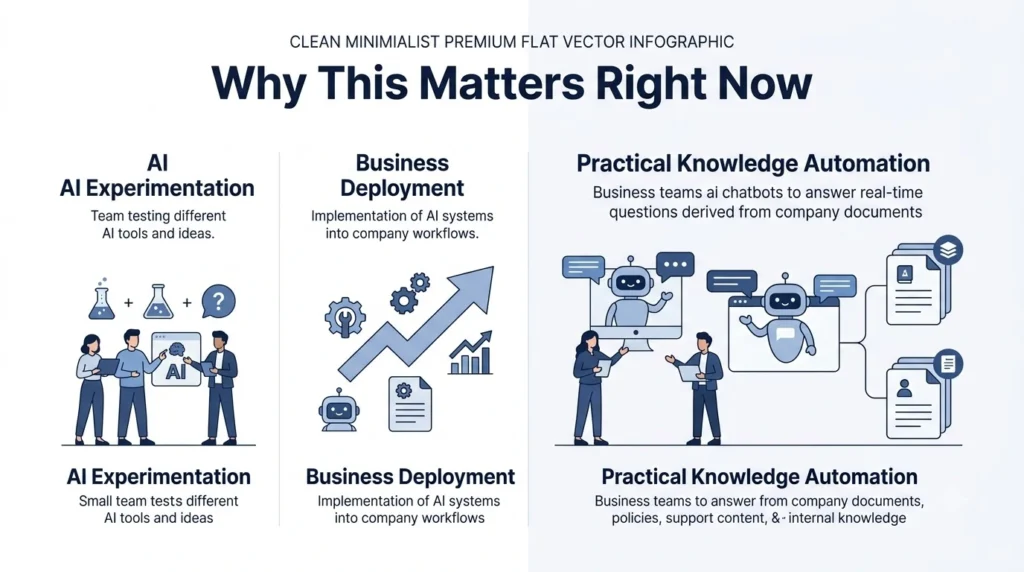
AI adoption has crossed from early-adopter territory into the mainstream, though the depth of that adoption varies a lot depending on how you measure it. McKinsey’s 2025 State of AI survey — nearly 2,000 respondents across 105 countries — found 88% of organizations now use AI in at least one business function, up from 78% the year before. But adoption and real transformation aren’t the same thing: nearly two-thirds of organizations remain in experiment or pilot mode, and only about 6% qualify as “high performers” attributing more than 5% of EBIT to AI. On the agent side specifically, 62% of organizations are at least experimenting with AI agents, but no single business function has more than roughly 10% reporting agents as fully scaled — a useful reality check against any “AI agents are everywhere” framing.
Small-business adoption in the US is already commercially significant: the U.S. Chamber of Commerce found 58% of small businesses used generative AI in 2025, up from 40% in 2024 and 23% in 2023. In the UK, government DSIT research found 16% of businesses with 5+ employees used at least one AI technology, and within that group, 85% used natural-language processing or text generation — but only 7% used agentic AI, showing the gap between “using AI” and “using autonomous agents” is real. A separate ONS measure covering businesses with 10+ employees found usage rose from about 12% in late 2023 to around 35% by June 2026, though only 10% of AI-using businesses described their usage as extensive. Canada shows a similar growth curve: Statistics Canada found 12.2% of Canadian businesses used AI to produce goods or deliver services in the year before Q2 2025, with another 14.5% planning to adopt within 12 months.
One honest caveat worth stating plainly: there’s no reliable official statistic for “RAG adoption” specifically in the US, UK, or Canada. National surveys measure AI, generative AI, or virtual agents broadly — not the underlying retrieval architecture — so be skeptical of any article that claims a precise percentage of companies use RAG specifically.
What These Platforms Actually Do
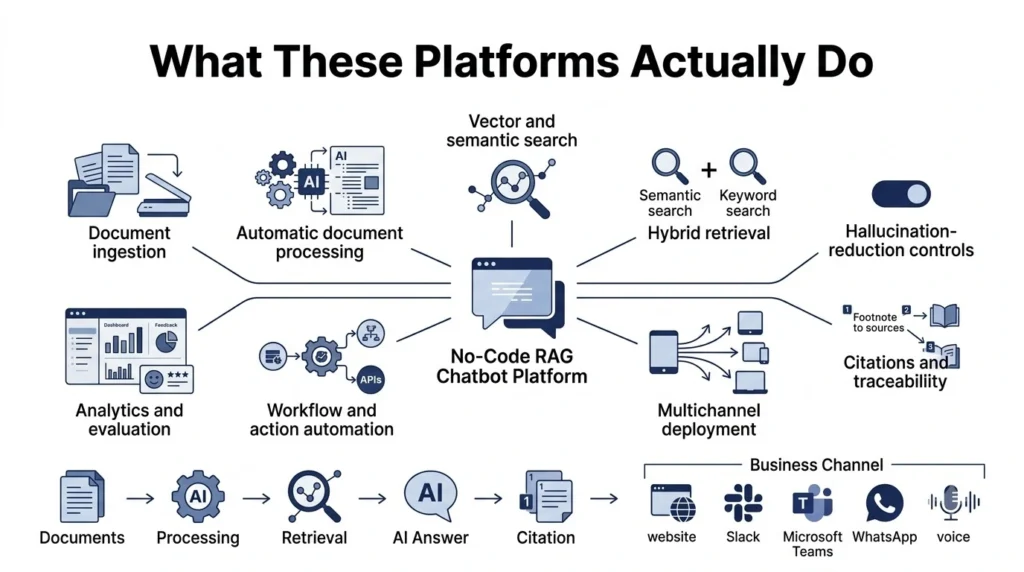
- No-code source ingestion — uploading PDFs, DOCX, spreadsheets, and Markdown files, or importing webpages, sitemaps, and connected systems like Notion, without any manual data engineering.
- Automatic document processing — extracting text, cleaning out headers and navigation clutter, and chunking content into retrievable passages, with the ability to manually adjust chunk boundaries when the automatic split gets something wrong.
- Vector search and retrieval controls — semantic (meaning-based) search, keyword search for exact model numbers or error codes, hybrid retrieval combining both, and reranking to prioritize the most relevant passages before generating an answer.
- Hallucination-reduction controls — instructing the bot to answer only from retrieved sources, return “I don’t know” when evidence is insufficient, require citations, and hand off to a human when confidence is low.
- Citations and traceability — linking answers back to the specific source passage, which lets a user or support agent actually verify a claim instead of trusting it blindly.
- Multichannel deployment — website widgets, REST APIs, Slack, Microsoft Teams, WhatsApp, and voice, often without rebuilding the bot separately for each channel.
- Workflow and action automation — classifying intent before retrieval, routing billing versus technical questions differently, and calling external APIs for things like order status or appointment booking.
- Analytics and evaluation — conversation logs, unanswered-question reports, retrieval-quality testing, and cost/token monitoring to catch documentation gaps and control spend.
Comparing the Top Platforms
| Platform | Best For | Strengths | Pricing |
|---|---|---|---|
| CustomGPT.ai | Managed, citation-focused bots with minimal setup | High ease of use for non-technical teams; strong emphasis on citations and enterprise security (SOC 2 Type II) | Standard $89–99/mo; Premium $449–499/mo; Enterprise by contact |
| Voiceflow | Sophisticated customer journeys, voice, agency collaboration | Visual design for complex conversation flows; strong for CX and product teams building beyond a simple FAQ bot | Free trial; usage-based billing (plan fee + seats + credits — harder to forecast at high volume) |
| Dify | Technical teams wanting infrastructure control | Open-source, self-hostable, strongest vector-database flexibility (Weaviate, Qdrant, Milvus, pgvector, Chroma, Elasticsearch, and more) | Free self-hosted (you manage infrastructure) plus managed cloud plans |
| Coze | Fast, lightweight bot experimentation | Template-driven, quick to launch a working bot; good for testing an idea before committing to a bigger build | Freemium; availability and terms vary by region — verify current pricing directly |
The selection logic that actually matters: choose CustomGPT.ai when you want a citation-first bot live quickly without managing infrastructure. Choose Voiceflow when the project needs real conversation design — voice, multi-turn flows, agency collaboration — not just a document-answering widget. Choose Dify when you specifically need control over which vector database you use, or when self-hosting for data control matters more than turnkey simplicity. Choose Coze for a fast, low-commitment prototype before you decide whether the use case justifies a bigger platform.
How to Actually Test One Before You Buy
This is the step most buyers skip, and it’s the one that actually predicts whether a chatbot will work once it’s live with real customers or employees asking real questions.
- Collect 50–100 real questions people would actually ask — including ambiguous and deliberately tricky ones, not just the clean examples from a vendor demo.
- Upload your actual source documents, not sample content the platform provides — a demo that works great on curated files tells you very little about your messy real ones.
- Score accuracy, citation correctness, and refusal behavior — does it say “I don’t know” when it should, or does it confidently guess?
- Test that updates actually propagate. Change or delete a source document and confirm the old answer disappears — this is where a lot of platforms quietly fail.
- Test access boundaries with users in different roles, if the bot needs to keep one customer’s or department’s information separate from another’s.
- Calculate expected cost at low, normal, and peak volume — not just the advertised starting price, since usage-based components can shift the real number significantly.
- Get the data-processing and model-training policy in writing before uploading anything sensitive.
Common Mistakes Businesses Make
- Testing only on vendor demo content. A bot that performs well on curated sample documents tells you little about how it’ll handle your actual, messier files.
- Skipping the “delete a source and check the answer” test. Outdated information lingering after a document changes is one of the most common — and most embarrassing — failures in production.
- Treating citations as optional. A bot that can’t point to its source is much harder to trust and much harder to debug when it gets something wrong.
- Ignoring channel depth versus channel breadth. “Can embed a chatbot” on a website is very different from “can securely perform an authenticated business action” — confirm which one you actually need before assuming a platform covers it.
also check – Best AI Project Management Software for Agencies in 2026
FAQs
What is a no-code RAG chatbot? A visual chatbot builder that retrieves relevant information from your company’s uploaded documents or connected systems and supplies that context to an AI model before generating an answer — grounding responses in your actual content instead of the model’s general training data alone.
What’s the best no-code RAG chatbot builder for a small business? It depends on priorities: CustomGPT.ai favors managed simplicity and citations, Voiceflow favors visual customer-journey design, Dify favors infrastructure flexibility and self-hosting, and Coze favors rapid, lightweight experimentation.
How do I make an AI chatbot answer only from my documents? Use grounded retrieval with source restrictions, require citations, set retrieval confidence thresholds, give it explicit refusal instructions for low-confidence situations, and add human escalation. No platform guarantees perfect factuality, so ongoing monitoring after launch is still necessary.
Is RAG better than fine-tuning for a business chatbot? For frequently changing content like policies and product documentation, yes — RAG lets you update the knowledge base without retraining anything. Fine-tuning is better suited to changing how a model responds (tone, format, task behavior) than to continuously adding new factual business knowledge.