
AI Stock Analysis and Portfolio Management Tools: The 2026 Guide
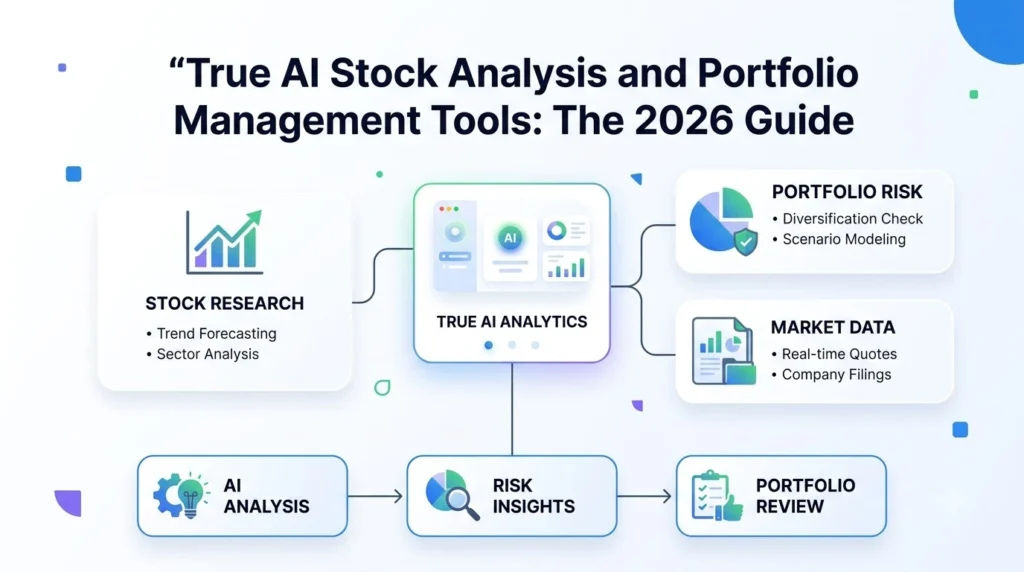
True AI Stock Analysis and Portfolio Management Tools: The 2026 GuideAI stock analysis and portfolio management tools now go well beyond a chatbot answering questions — the strongest ones link every claim back to a filing, transcript, or dataset, and increasingly analyze your whole portfolio for concentration and risk instead of just ranking individual stocks. None of them predict the market reliably, and none should be treated as a substitute for regulated financial advice — they’re research and diagnostic tools, not a guarantee of returns. (This article is informational and comparative, not personalized investment advice.
Table of Contents
Why This Matters Right Now
AI has become the default starting point for investment research faster than most other categories of AI tool. BridgeWise’s State of AI for Wealth 2026 report — a survey of 2,100 people across 19 countries — found 78.3% of respondents have already used AI for investment-related queries, with 45.7% calling themselves regular users and 65.1% saying they’re likely to replace part of their manual research with AI within the next year. That’s a vendor-commissioned survey (BridgeWise sells AI wealth tools), so treat the exact numbers as directional rather than gospel — but the finding has been independently reported across multiple financial trade outlets, and it lines up with what’s happening at the product level.
Regional adoption varies. Fidelity International’s own research found 23% of UK retail investors use generative AI to support investment decisions, rising to 36% among investors aged 18–34. A separate 2026 survey of 938 US retail investors found 62% had used AI tools in investing in some form — including regular, occasional, and one-time trial users combined — which is useful survey evidence but shouldn’t be read as a precise national adoption rate given the sample size and methodology.
What These Tools Actually Do
- Natural-language investment research — asking a plain question like “what are the main risks to this company’s margins” and getting an answer linked to actual filings, transcripts, and data rather than unsupported prose.
- Fundamental stock analysis — revenue, margins, free cash flow, balance-sheet strength, and valuation multiples, with historical and forward estimates.
- AI stock scoring and ranking — quantitative models combining technical, fundamental, and sentiment indicators into a single score or rank. Treat any such score as one input, not a verdict — a probability of outperforming over a short window is not a guarantee.
- Portfolio diagnostics — analyzing your actual holdings for allocation, sector concentration, correlation, fees, and drawdown risk, rather than just ranking individual stocks in isolation.
- Scenario and “what-if” testing — modeling the effect of adding a holding, increasing cash, or rebalancing sector weights before you actually do it.
- Monitoring and alerts — tracking earnings releases, analyst estimate changes, insider transactions, and portfolio drift automatically.
- Research workflow automation — generating investment memos, summarizing earnings calls, and comparing competitors, especially useful for institutional or batch-analysis workflows.
Comparing the Tools by Job-to-Be-Done
There’s no single “best” AI investing tool — the right one depends entirely on what you’re trying to do.
| Tool | Best For | Strengths | Watch Out For |
|---|---|---|---|
| Fiscal.ai | Fundamental research at a desk | Long financial histories, company KPIs, analyst estimates, filing-linked AI copilot | More research terminal than automated portfolio manager; verify UK/international market depth before subscribing |
| AlphaSense | Institutional research, strategy, and consulting teams | Enormous premium content library, batch document analysis, sentence-level citations | Enterprise pricing and positioning — overkill for a casual retail investor or small business tracking a simple portfolio |
| Danelfin | Transparent, explainable stock scoring | Simple 1–10 AI Score with stated methodology, daily updates, portfolio-level metrics | A 3-month outperformance probability isn’t a guarantee and may not suit long-term fundamental investors |
| PortfolioPilot | Whole-portfolio risk and allocation review | Portfolio critiques covering exposure, fees, taxes, and scenario analysis without requiring custody | Feature set leans US-centric; may not map well to UK tax wrappers and pension structures |
| Barebone AI | Mobile-first stock research and quick portfolio checks | Real-time data, filings-linked analysis, read-only broker sync, active development | Newer entrant — independently verify data coverage and track record before relying on it for material decisions |
| Portfolio Visualizer | Backtesting and quantitative analysis (non-AI) | Monte Carlo simulation, correlation and factor analysis, optimization — a solid complement to any AI research tool | Not a generative-AI research layer — it’s a quantitative analysis tool, not a conversational assistant |
For a broader portfolio, traditional robo-advisers like Betterment or Wealthfront remain better suited to hands-off, automated ETF management than to detailed individual-stock research — they solve a different problem than the tools above.
What Regulators Want You to Know
This is worth taking seriously, not treating as boilerplate. FINRA warns that AI-generated investment information can be inaccurate, biased, or misleading, and recommends verifying sources rather than relying on AI-generated predictions alone — advice that’s especially relevant given how confidently a language model can present a wrong answer. In the UK, the FCA expects firms using AI in financial services to provide fair value and communicate clearly with customers, and the distinction between general information and personalized regulated advice matters — a tool that gives you a recommendation based on your specific circumstances may be operating in regulated territory, whether or not it’s licensed to.
Before connecting a brokerage account to any of these tools: prefer read-only connections where the option exists, confirm the platform can’t execute trades unless you specifically want that, use multifactor authentication, and never share account passwords directly with an AI chatbot.
How to Evaluate an AI Investing Tool: 5 Steps
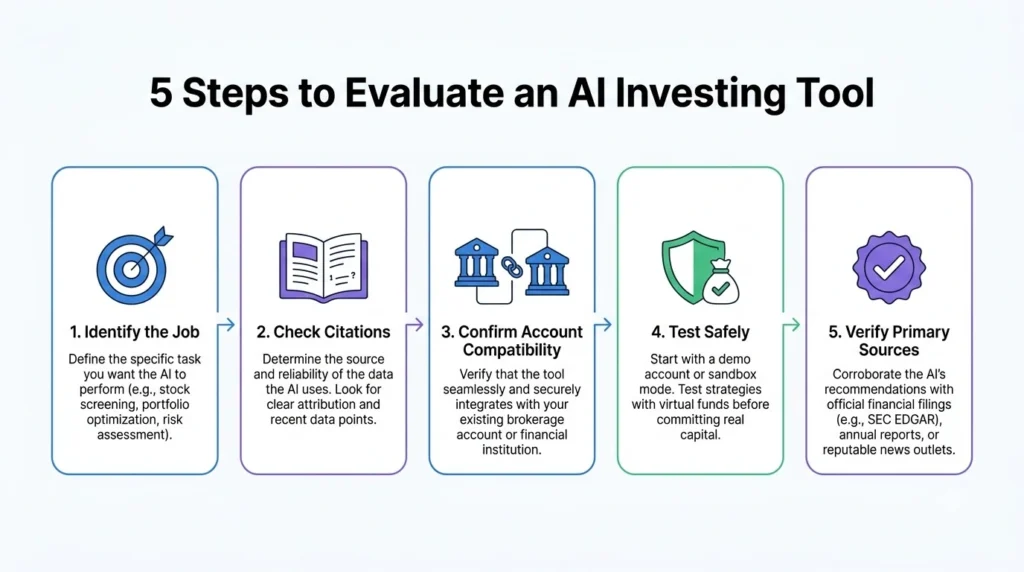
- Identify the actual job — research assistant, stock screener, or whole-portfolio analyzer are different tools solving different problems; don’t buy one expecting it to do another’s job.
- Check the citation trail. A tool that links its claims to the underlying filing or transcript is verifiable; one that just asserts a conclusion isn’t.
- Confirm broker and account compatibility — especially UK ISAs, SIPPs, and pensions, or US retirement accounts, since coverage varies a lot by platform.
- Test with a small, non-sensitive watchlist first, rather than connecting every financial account on day one.
- Verify any headline claim against a primary source before it changes a real decision — an earnings estimate, a risk score, or a stated “average return” should hold up against the filing or dataset behind it.
Common Mistakes Investors Make
- Treating an AI score as a buy signal. A 1–10 stock score or an “outperformance probability” is one data point, not a recommendation to act on alone.
- Connecting a brokerage account before checking the security model. Read-only access matters — don’t assume a platform can’t trade just because it says it’s “for research.”
- Skipping the primary source. If a tool’s answer would actually change a real financial decision, check it against the filing or transcript it’s citing.
- Assuming US-built tools fully cover UK accounts. Tax wrappers, pension structures, and broker connectivity often lag for UK-specific coverage — verify before relying on it.
Also Checkout – The Best AI Workflow Automation Tools for Small Business in 2026
FAQs
What are the best AI stock analysis and portfolio management tools in 2026? It depends on the job: Fiscal.ai for deep fundamental research, AlphaSense for institutional-grade intelligence, Danelfin for explainable stock scoring, and PortfolioPilot or a comparable analyzer for whole-portfolio risk review. There’s no single universal winner.
Can AI reliably predict which stocks will go up? No. AI can process large datasets, rank securities, and identify patterns, but no tool can guarantee market direction or future returns — results remain sensitive to data quality, model design, and shifting market conditions.
Are AI investing tools safe and legitimate? It depends on the provider’s security practices, account-linking method, and transparency about data sources and limitations. Be cautious of any tool promising guaranteed returns or making unverifiable “proprietary AI” claims, and prefer platforms that link conclusions back to primary sources.
Is it safe to connect my brokerage account to an AI investing app? Prefer read-only connections, use multifactor authentication, and confirm the platform’s legal entity and privacy practices before connecting. Never share account passwords or sensitive account numbers directly with an AI chatbot.