
AI SaaS Trends 2026: What’s Actually Changing for Buyers
best AI SaaS Trends 2026: What’s Actually Changing for Buyers
AI SaaS in 2026 has shifted from bolting a chatbot onto existing software to shipping agents that complete multi-step work on their own, and from broad horizontal tools toward vertical, industry-specific platforms that go deep on one workflow instead of wide across many. For buyers, the more useful signal isn’t which tool launched this week — it’s whether a platform can genuinely act on your behalf with real guardrails, and whether your stack is consolidating or just quietly adding another subscription.
Table of Contents
The Real Shift: From Copilots to Autonomous Agents
best AI SaaS Trends 2026: What’s Actually Changing for Buyers
The clearest evidence of this shift is Databricks’ Agent Bricks platform, which the company expanded into a full developer agent platform at its 2026 Data + AI Summit in June. Since its 2025 launch, more than 100,000 agents have been built on it, processing over a quadrillion tokens a year, with real production deployments at companies including AstraZeneca, 7-Eleven, Fox Corporation, and Block. That scale matters because it shows agentic AI has moved well past demo-stage hype into production use at large enterprises — the platform’s own stated lesson from a year of real deployments is that the agent loop itself is the easy 1%; the hard 99% is governance, context, evaluation, and cost control once an agent is actually making decisions.
That’s the pattern worth watching across the category generally: a copilot answers when you ask; an agent reads a situation, decides on a multi-step response, and acts — ideally with an approval step before anything consequential happens. The tools worth evaluating in 2026 are the ones that can show you the governance layer, not just the demo.
Vertical AI Is Outgrowing Horizontal Tools
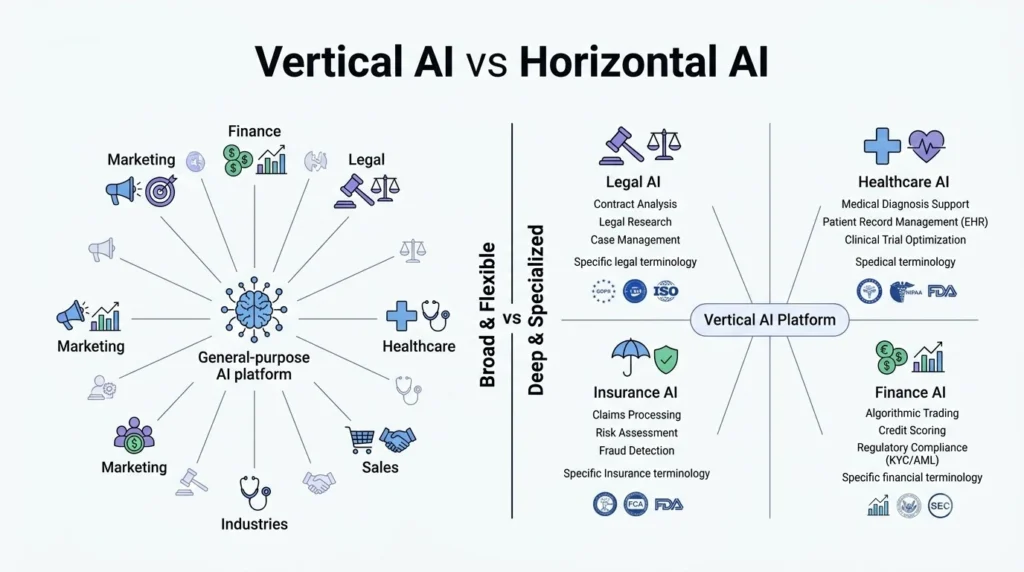
The other durable pattern is specialization. General-purpose AI writing or research tools are increasingly commoditized — most major platforms can draft an email or summarize a document reasonably well now, so that’s no longer a differentiator on its own. The growth is concentrating in tools built for one industry’s specific workflow: underwriting logic for insurance, compliance-aware document review for legal and financial services, clinical documentation for healthcare. A horizontal tool has to explain what it does; a vertical tool already knows your terminology, your compliance requirements, and your edge cases, which shortens the sales cycle and the time to real value.
The Real Pain Point Is Tool Sprawl, Not Tool Shortage
This is the part of the AI SaaS conversation that gets the least attention, and it’s the one with the strongest data behind it. According to BetterCloud’s 2025 State of SaaSOps report, the average company now runs 106 SaaS applications — down from 112 in 2024 and 130 at the 2022 peak, as companies actively consolidate. Despite that pullback, 49% of SaaS licenses go unused, and SaaS spend now averages $5,607 per employee. Gartner’s research (via the same report) adds a sharper warning: organizations that don’t centrally manage their SaaS lifecycle are 5 times more vulnerable to a data-loss or cyber incident tied to misconfiguration, and Gartner projects 40% of multi-SaaS organizations will centralize management through a SaaS Management Platform by 2027, up from under 25% in 2022.
Adding another AI tool to an already-sprawling stack doesn’t solve this — it’s often the same problem in a shinier wrapper. The agencies and small businesses getting real value from AI SaaS in 2026 tend to be the ones consolidating first and adding AI second, not the reverse.
Where the Market Size Numbers Actually Land
Be skeptical of any single precise-looking “AI SaaS market size” figure you see quoted — estimates for this specific slice of the market vary enormously by scope and methodology, similar to how AI-adoption survey numbers vary by definition. What’s better supported: the broader SaaS market is valued in the $390–466 billion range for 2025–2026 according to Statista-sourced tracking, and it’s expected to roughly double by 2029. Within that broader market, AI-native and AI-embedded products are consistently reported as the fastest-growing segment — that directional claim holds up across sources even when the specific dollar figure attached to “AI SaaS” alone doesn’t.
Outcome-Based Pricing Is Gaining Ground
The per-seat pricing model that’s defined SaaS for two decades is under real pressure. As AI features let a smaller team accomplish more, charging by seat count increasingly doesn’t match the value delivered — a five-person team getting agent-driven output equivalent to a fifteen-person team isn’t going to pay per-seat pricing designed for the old ratio. The shift toward usage-based and outcome-based pricing (pay per resolved ticket, per qualified lead, per completed workflow) is still early, but it’s the pricing model most aligned with what agentic tools actually do, and cost-conscious SMBs are a natural early audience for it.
Categories Worth Watching
| Category | Companies to Know | What They Actually Do |
|---|---|---|
| Agentic AI / Automation | Databricks Agent Bricks, Moveworks, Workato, Cognition AI | Building, governing, and deploying AI agents that take multi-step action across enterprise data and systems |
| Product Analytics | Mixpanel, PostHog, Heap | Event tracking and behavioral analytics, increasingly layered with AI-assisted insight generation |
| Cloud & AI Spend Management | Vantage, CloudZero, ProsperOps | Tracking and optimizing cloud and AI compute costs as usage-based spending replaces flat licensing |
Two of these categories exist largely because of the trends above: spend-management tools are a direct response to usage-based pricing making costs harder to predict, and agent platforms exist because governance turned out to be the hard part of agentic AI, not the agent loop itself.
What This Means If You’re Buying
- Audit your current stack before adding anything new. If you don’t know how many SaaS tools your team actually uses, start there — BetterCloud’s data suggests you’re probably paying for licenses nobody’s touching.
- Ask whether a tool acts or just assists. A genuine agent should be able to describe its own approval and rollback process; if a vendor can’t explain that clearly, it’s a copilot with agent branding.
- Weigh a vertical tool against a horizontal one for anything industry-specific. The setup cost of teaching a general tool your compliance requirements often exceeds the price premium of a tool that already knows them.
- Ask about pricing model, not just price. A usage-based or outcome-based model may cost less at your actual volume than per-seat pricing designed for a pre-AI team size.
- Don’t chase a tool because it launched this week. New products announce constantly; the ones worth adopting are the ones with real production deployments and a track record, not just a press release.
Common Mistakes Buyers Make
- Adding an AI tool instead of consolidating an existing one. More subscriptions rarely solves a workflow problem that a properly configured existing tool could handle.
- Buying “agentic” branding without checking for real governance. Approval steps, audit logs, and rollback aren’t nice-to-haves once a tool is taking action on your behalf.
- Assuming a horizontal tool is cheaper. By the time you’ve customized it to your industry’s edge cases, a vertical tool built for that exact problem is often the better deal.
- Ignoring unused licenses. Nearly half of SaaS seats go unused industry-wide — check your own usage data before renewing anything.
also checkout – Great AI Financial Forecasting Software for Small Business: The 2026 Guide
FAQs
What’s the biggest AI SaaS trend for 2026? The shift from AI copilots that answer questions to AI agents that take multi-step action on your behalf, with governance — approval steps, audit logs, rollback — becoming the real differentiator between platforms rather than raw model capability.
Is vertical AI really growing faster than general-purpose AI tools? Directionally, yes — industry-specific AI tools that understand a sector’s terminology, compliance requirements, and workflows are consistently reported as the faster-growing segment, since they shorten time-to-value compared to configuring a horizontal tool for the same use case.
What’s the biggest hidden cost in AI SaaS adoption? Tool sprawl. Companies run over 100 SaaS applications on average, with roughly half of licenses going unused — adding AI tools on top of an unmanaged stack usually compounds the problem rather than solving it.
Should a small business wait to adopt AI SaaS tools, or move now? Move on consolidation first, AI second. Auditing and trimming your existing stack typically has faster, more measurable ROI than adding a new AI tool to an already-sprawling one, and it puts you in a better position to evaluate whether a given AI tool is actually solving a real gap.