
AI Invoicing and Cash-Flow Forecasting: The 2026 Guide for Startups
best AI Invoicing and Cash-Flow Forecasting: The 2026 Guide for Startups
AI invoicing and cash-flow forecasting tools now do more than generate a PDF and hope you get paid — the better ones connect billing directly to a rolling cash forecast, flagging risk before a shortfall becomes an emergency. For most startups, an all-in-one platform like QuickBooks or Xero covers invoicing, reminders, and forecasting in a single system, while a dedicated tool like Float is worth adding once your books are clean but your forecasting still isn’t sharp enough.
Table of Contents
Why This Matters for Startups Right Now
AI adoption among small businesses has moved fast enough that a survey from a year ago already reads as dated. Intuit QuickBooks’ own Small Business Insights survey — roughly 2,200 US businesses with up to 100 employees, fielded quarterly — found regular AI use jumped from 48% in July 2024 to 68% by April 2025, with 28% using it daily. That climb didn’t stop: by January 2026, the same tracking series put US adoption at 77%.
The UK numbers are messier, and worth understanding rather than just picking whichever one sounds best:
- The UK government’s own DSIT research (roughly 3,500 business interviews, a stricter definition of “using AI”) puts adoption at 16%.
- The Office for National Statistics, tracking businesses with 10 or more employees, reports somewhere in the 21–25% range as of mid-2026.
- The British Chambers of Commerce, surveying SMEs specifically with a broader definition, reports 54%.
best AI Invoicing and Cash-Flow Forecasting: The 2026 Guide for Startups
These aren’t contradictory studies — they’re measuring different populations with different definitions of “using AI.” What’s consistent across all three is the direction: every version of this number has been rising steadily since 2023. Canada shows the same trend more simply: Intuit’s Canadian survey found 62% of 1,031 respondents using AI at least monthly, up from 51% just a few months earlier in January 2025.
None of that matters much without the second half of the picture — getting paid. In the UK, a QuickBooks survey found 62% of small businesses were owed money on unpaid invoices, carrying an average outstanding balance of £21,400, with 54% having at least one invoice more than 30 days overdue. In Canada, Xero’s own small business data for the June 2026 quarter showed businesses being paid an average of 11.3 days late, with 29.8 days elapsing on average between invoice and payment. That gap between billing and actually holding the cash is exactly what AI cash-flow tools are now built to close.
Also Chekout the – best AI Lead Generation Tools for B2B Tech Agencies: The 2026 Guide
Is AI Cash-Flow Forecasting Worth It for a Startup?
best AI Invoicing and Cash-Flow Forecasting: The 2026 Guide for Startups
For very early-stage businesses with only a handful of invoices and simple expenses, a basic accounting system may be enough.
As the company grows, however, cash-flow management becomes more complicated. More customers mean more invoices, more payment schedules, more expenses, and more uncertainty around when money will actually arrive.
This is where the best AI Invoicing and Cash-Flow Forecasting: The 2026 Guide for Startups strategy becomes useful. The goal isn’t to automate everything simply because AI is available. The goal is to automate repetitive financial work while giving founders a clearer view of future cash requirements.
A good starting point is to automate invoicing and reminders first. Once the accounting data is reliable, a startup can add more advanced forecasting and scenario planning.
What’s Changed: From Basic Invoicing to Agentic Finance
The clearest signal of where this category is headed came from Xero’s Xerocon London event in July 2026, where the company announced new features under its agentic AI platform, JAX, alongside crossing 5 million customers globally. The announced capabilities include Payment Follow-Ups (JAX adapts collection timing and channel to a customer’s actual payment behavior, including switching to SMS for non-responders), Bill Protection (automatically screening bills for unusual amounts, changed bank details, or unfamiliar suppliers before payment), and Cash Flow Actions (proactively suggesting which bills to delay or how to protect payroll when a shortfall is coming). Worth knowing if you’re evaluating Xero specifically: independent trade coverage of the announcement noted that several of these cash-flow features were still in beta or “coming soon” at launch, not universally live — confirm current availability before you plan around a specific one.
The broader pattern holds regardless of which vendor you pick: the market is moving from “extract data off a PDF invoice” toward tools that combine invoicing, collections, reconciliation, forecasting, and anomaly detection into one connected workflow.
What These Tools Actually Automate
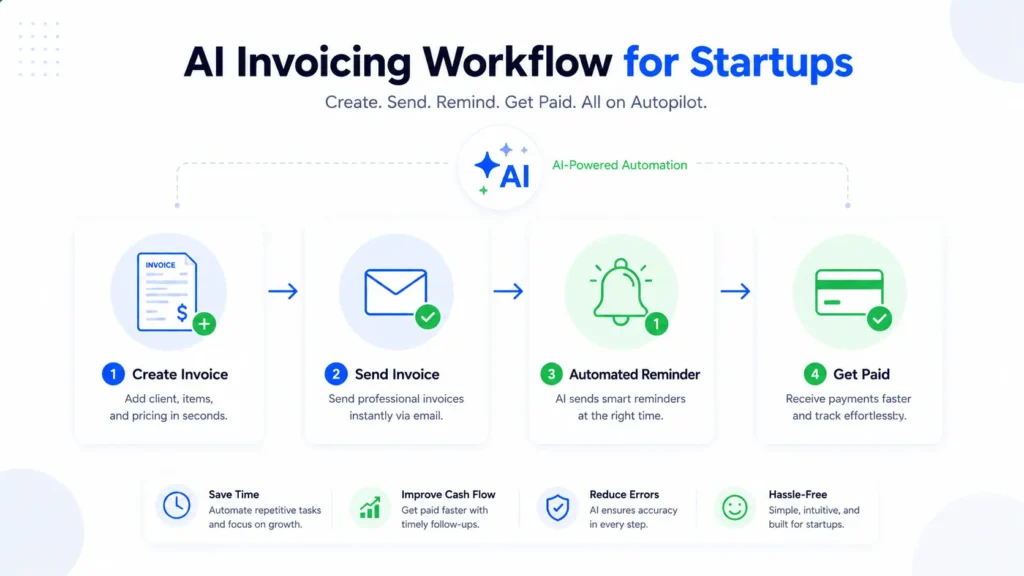
- Invoice creation from estimates, contracts, time entries, or project milestones — useful for agencies, consultants, and any startup billing on a recurring or milestone basis.
- Recurring billing and subscriptions, so revenue doesn’t depend on someone remembering to rebuild an invoice every month.
- Payment links and online collection (card, ACH, bank payment) built directly into the invoice, which tends to get paid faster than a request for a manual transfer.
- Automated, behavior-aware reminders — the more advanced versions time and channel-shift reminders based on how a specific customer has responded before, rather than sending the same generic nudge to everyone.
- Invoice and receipt data extraction, pulling vendor, date, tax, and line-item data off incoming bills automatically.
- Bank reconciliation and transaction categorization, matching transactions to the books without manual entry.
- Rolling cash-flow forecasting — typically 30, 60, or 180 days out — built from bank transactions, unpaid invoices, recurring bills, and historical payment behavior.
- Scenario planning: modeling what happens if a customer pays 30 days late, you hire someone, or a supplier payment gets pushed back — genuinely more useful to a founder than a static balance sheet.
- Accounts-receivable prioritization, ranking customers by overdue value or likelihood of paying late so a small team focuses collection effort where it matters most.
- Fraud and anomaly detection, flagging unusual invoice amounts, changed supplier bank details, or duplicate bills before they get paid.
Choosing a Tool: Comparison
| Tool | Best For | Strengths | Watch Out For |
|---|---|---|---|
| QuickBooks Online | All-in-one US/UK startups | Broad ecosystem, AI-assisted Cash Flow Planner | Feature availability varies by plan and country |
| Xero | UK, Canadian, and internationally oriented startups | Strong bank-feed workflow, new agentic AI (JAX) for reminders, bill screening, and cash actions | Several 2026 AI features are still rolling out from beta — confirm what’s actually live on your plan |
| FreshBooks | Freelancers and service businesses | Simple, fast invoicing and time tracking | Not built for complex SaaS billing or multi-entity finance |
| Zoho Invoice / Zoho Books | Startups already using other Zoho apps | Competitive pricing, connects to Zoho CRM and Projects | Less familiar to US/UK accountants than QuickBooks or Xero |
| Float | Startups with clean books that need sharper forecasting | Visual 13-week-to-36-month forecasts, scenario modeling, syncs with Xero, QuickBooks, and FreeAgent | A separate subscription on top of your accounting software, not a replacement for it |
The selection principle that actually matters: if your core problem is fragmented bookkeeping and invoicing, start with an accounting-led platform. If your books are already reliable but you still don’t have a rolling forecast or runway visibility, that’s when a dedicated tool like Float earns its separate subscription. If you’re running usage-based or SaaS billing specifically, evaluate specialist billing platforms on contract interpretation, metering, and revenue recognition — invoice design isn’t the hard part of that problem.
Building a Cash-Flow Safety Net: 5 Steps
- Connect your bank feed and accounting platform first. Every forecast — AI-assisted or not — is only as reliable as the transaction data underneath it.
- Automate the invoice-to-reminder pipeline before anything else. This is the highest-leverage, lowest-risk place to start, since it directly shortens the gap between billing and getting paid.
- Turn on a rolling forecast, not just a monthly snapshot — 30- and 60-day views catch problems a static balance sheet won’t show you until it’s too late.
- Set a cash-shortfall alert threshold tied to actual upcoming obligations — payroll, tax, and supplier payments — not just a flat dollar figure.
- Keep human approval on anything unusual: large invoices, changed bank details, new vendors, or tax treatment. AI forecasting is a decision-support tool, not a decision-maker.
Common Mistakes Startups Make
- Trusting the forecast more than the data behind it. A forecast built on a stale bank feed or messy categorization will confidently give you the wrong number.
- Turning off human review to save time. The startups that get burned are usually the ones that let AI auto-approve unusual invoices or changed payment details rather than just flagging them.
- Adding a dedicated forecasting tool before the books are actually reliable. Float and similar tools make a clean set of books more useful — they don’t fix a messy one.
- Treating “AI use” adoption stats as a benchmark to hit rather than looking at what specific workflow is actually costing your business time or cash today.
FAQs
What is the best AI invoicing and cash-flow tool for startups? It depends on your accounting platform, country, and billing complexity. QuickBooks and Xero are strong all-in-one choices that combine invoicing with forecasting; FreshBooks suits simpler service businesses; and a dedicated tool like Float makes sense once your books are clean but you need sharper forecasting than your accounting platform provides on its own.
Can AI create and send invoices automatically? Yes — depending on the platform, AI can generate invoices from recurring schedules, time entries, projects, or contracts, then handle reminders and payment links without manual work. Keep human review turned on for unusual invoices, tax changes, and large customer accounts.
How does AI actually improve cash-flow forecasting? It combines bank transactions, unpaid invoices, recurring bills, and historical payment behavior into a rolling forecast, rather than a static month-end snapshot. Treat the output as decision support — a well-informed estimate, not a guarantee.
Are AI invoicing tools safe for sensitive financial data? Check the vendor’s encryption, access controls, audit logging, and — specifically — whether they train models on your data before connecting your bank accounts. This varies by vendor and isn’t something to assume either way.
The future belongs to businesses that embrace AI before it becomes the standard. From intelligent automation to custom AI solutions, every step you take today can create a significant competitive advantage tomorrow.
Ready to transform your business with AI? Explore our latest resources, services, and expert insights to discover how AI can help you save time, reduce costs, and unlock new opportunities for growth.
Visit On- https://wealthmintai.com/