
Best AI Landing Page Builders for Conversion Optimization in 2026
Best AI Landing Page Builders for Conversion Optimization in 2026. The best AI landing page builder depends on whether you need real conversion-rate optimization — testing, personalization, traffic routing — or just a fast, polished page to launch a campaign. Unbounce and Instapage lead on CRO specifically, while Framer, Wix Studio, and Durable prioritize speed and design. The catch almost every comparison skips: on most of these platforms, the AI optimization features are gated behind a higher tier than the one shown in the headline price.
Table of Contents
Why This Category Matters More in 2026, Not Less
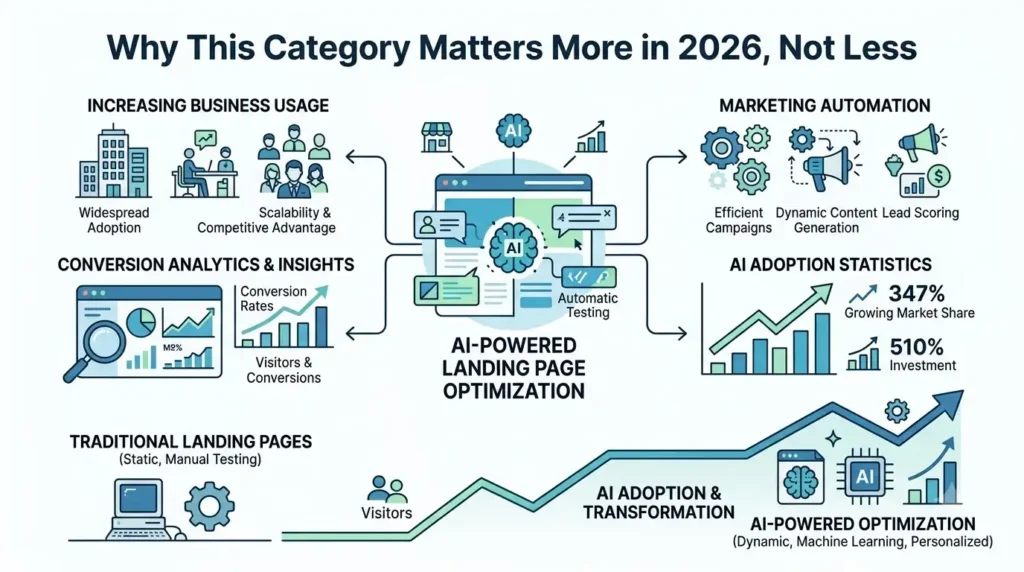
Nailing down exactly how many US or UK businesses use AI landing-page tools specifically is harder than it sounds — no survey isolates that number cleanly. The closest proxies tell a genuinely mixed story. US Census Bureau survey data from December 2025 through May 2026 put general business AI use at roughly 17–20%, with another 20–23% expecting to adopt within six months, concentrated heavily in large companies and knowledge-intensive sectors like professional services and finance. In the UK, government research puts adoption around 16% of businesses, while a separate July 2026 YouGov survey of SME decision-makers found 31% already using AI and another 15% planning to, with marketing and media firms among the most active adopters. Those numbers disagree because they’re measuring different populations and different definitions of “using AI” — treat any single figure presented as the US or UK adoption rate with real skepticism.
Zoom out and the broader momentum is unambiguous: Stanford’s 2026 AI Index found AI in use in at least one business function at 70% of organizations globally, per Stanford HAI — though that’s a much broader measure than landing-page or CRO tooling specifically, and it’s worth not conflating the two. Among small businesses specifically, the SBA’s own analysis found AI use climbing from 6.3% to 8.8%, held back mainly by perceived irrelevance, limited know-how, cost, and uncertainty about regulation — not by the technology’s capability.
The reason it’s worth adopting anyway: conversion rates are a genuinely stubborn, expensive problem regardless of how many competitors have caught on. Unbounce’s own benchmark, built from 464 million visits and 41,000 landing pages, found a 6.6% median conversion rate across industries — with real variation by sector (3.8% for SaaS, 4.2% for ecommerce). And landing-page optimization only solves part of the funnel: Baymard’s ongoing research puts average cart abandonment around 70%, which no amount of pre-checkout page polish will fix on its own. The category has genuinely shifted from “build a page” to “generate, personalize, measure, and keep optimizing one” — the differentiator now is experimentation quality and traffic allocation, not just how fast the first draft comes together.Best AI Landing Page Builders for Conversion Optimization in 2026
What These Tools Actually Do
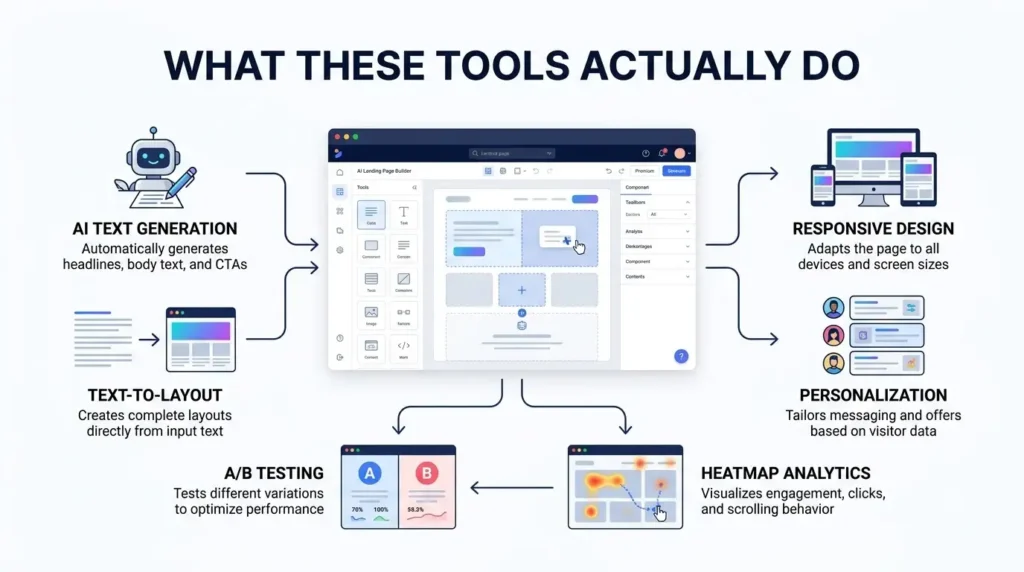
- Text-to-layout generation. Describe an offer, audience, and goal, and the platform drafts a full page structure — hero, value prop, benefits, testimonials, FAQ, form, CTA.
- AI copy generation. Headlines, subheads, CTAs, and follow-up emails, ideally with control over tone, reading level, and brand vocabulary rather than generic output.
- Editable visual output. The stronger platforms generate real editable sections, not locked images — Framer’s AI workflow, for instance, produces pages you refine directly on the canvas rather than starting over.
- Responsive design assistance. AI adapts layouts across devices and flags spacing or hierarchy issues — Wix Studio builds this in alongside copy, imagery, and SEO metadata while leaving a designer in control of the final call.
- Dynamic personalization. Headlines, offers, and CTAs shift based on the keyword, UTM source, location, device, or funnel stage a visitor arrived from — the single biggest lever for paid-search message match.
- Automated A/B testing and AI traffic optimization. Beyond simple split tests, Unbounce’s Smart Traffic uses a contextual multi-armed-bandit model to route each visitor toward whichever variant people like them tend to convert on, based on signals like location and device.
- Heatmaps and behavioral analytics. Click maps, scroll depth, and rage-click detection point at where visitors lose confidence — genuinely useful, but correlation isn’t causation, and a human still has to interpret what the data means before acting on it.
Worth saying plainly: AI can produce a visually polished page that’s strategically weak — invented claims, vague positioning, generic testimonials, or a design that optimizes for clicks instead of qualified pipeline. Brand review, accessibility checks, legal sign-off, and real user testing aren’t optional steps you skip because the AI did the drafting.
The Catch: AI and Testing Features Are Usually Gated Higher Than the Sticker Price Suggests
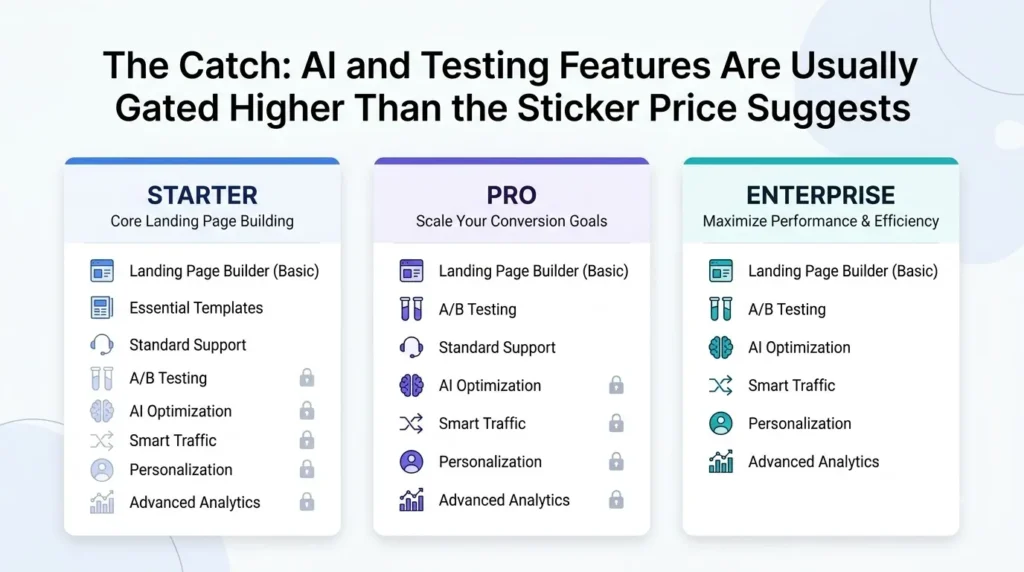
This is the part a demo won’t show you, and it’s consistent across the two CRO-focused platforms specifically.
Unbounce. The entry Build plan ($99/month) is a page builder — nothing more. A/B testing doesn’t unlock until the Experiment tier ($149/month). Smart Traffic, the AI feature that’s actually the reason most people choose Unbounce in the first place, requires the top self-serve tier, Optimize, at $249/month. Every plan also meters visitors, with overage billed at $80 per 10,000-visitor block once you exceed your tier’s cap.
Instapage. The pattern repeats almost exactly. Create ($99/month) is the builder tier — no A/B testing. Testing arrives at Optimize ($199+/month, scaled by visitor volume). Heatmaps, a feature you can get free or cheap from a dedicated tool like Hotjar, are locked behind the custom-quoted Convert tier entirely.
Framer. Less of a testing-gate issue and more of a headcount one: editor seats now run $20/month per person on top of whatever plan you’re on, so the $30/month Pro plan quietly becomes a much bigger number the moment more than one person needs edit access.
None of this makes these platforms bad — it means the number on the pricing page answers “what does the builder cost,” not “what does the feature I actually want cost.” Price out the tier with the capability you need before you commit to annual billing.
Real 2026 Pricing at a Glance
| Platform | Best For | Real Starting Price (2026) | Where the AI/Testing Actually Unlocks |
|---|---|---|---|
| Unbounce | Paid-traffic teams focused on measurable CRO | $29/mo Starter up to $249/mo Optimize (25% off annual) | Smart Traffic requires the top Optimize tier; A/B testing needs Experiment ($149) |
| Instapage | Enterprise ad campaigns needing ad-to-page personalization at scale | $99/mo Create ($79 annual) up to $199–299/mo Optimize; Convert custom | A/B testing needs Optimize; heatmaps are Convert-tier only |
| Framer | Designers, startups, and agencies wanting visual control and speed | $10/mo Basic, $30/mo Pro, $100+/mo Scale, plus $20/mo per editor seat | A/B testing is a gated add-on even on Pro; real team cost scales with seats, not just the plan |
| Wix Studio | Agencies and SMBs wanting a full site-plus-business platform in one place | Varies meaningfully by region, billing period, and features — confirm at checkout | AI copy, imagery, and SEO metadata are included broadly; dedicated CRO depth is thinner than the specialist tools above |
| Durable | Local service businesses that need a credible site fast | Free plan; Launch $22–25/mo; Grow $85–99/mo | Now a full small-business toolkit — CRM, bookings, invoicing, AI marketing content — not built for CRO experimentation at all |
Treat every number above as a snapshot, not a permanent fact — these vendors adjust pricing and packaging often enough that it’s worth confirming the current figure on the vendor’s own page before you buy.
Step-by-Step: Launching an AI-Generated Landing Page That Actually Converts
- Start from the offer and the audience, not the template. Give the AI the actual pain point, the specific audience, and the conversion goal — “landing page for my SaaS” produces generic output; “trial signup page for ops managers frustrated with manual scheduling” doesn’t.
- Fact-check every generated claim before it goes live. Invented statistics, overstated features, and unsupported comparisons are the most common failure mode in AI-drafted copy.
- Match the page to whatever sent the visitor there. Message match between the ad or keyword and the headline is often a bigger lever than anything else on the page.
- Decide your test budget before you start testing. Traditional A/B testing needs real traffic volume to reach statistical significance; AI traffic-routing tools like Smart Traffic can work with somewhat less, but still need enough signal to learn from.
- Pick one primary conversion goal per page and track it end-to-end — a form submission that never becomes a qualified lead isn’t a win, it’s a vanity metric.
- Run a heatmap or session-recording pass before assuming you know why a page underperforms. The obvious explanation is wrong more often than it should be.
- Get legal, brand, and accessibility review before scaling ad spend behind a new page — not after a campaign’s already running.
- Re-check your plan tier against the feature you actually need before committing to annual billing, given the gating pattern above.
Which Platform Fits Which Situation
- Running paid traffic and need proof a page is actually converting better, not just guessing — Unbounce’s Smart Traffic and testing depth are worth the climb to Optimize.
- Spending $50K+/month on ads across many audiences and need ad-to-page personalization at scale — Instapage’s AdMap is built specifically for that volume; smaller teams will feel over-served and under-budgeted.
- Prioritizing visual quality and modern design over deep CRO tooling — Framer, with a real budget line for editor seats once more than one person is involved.
- Want one platform for the whole business — site, SEO, bookings, content — not just landing pages — Wix Studio, especially for agencies managing several clients.
- A local service business that needs a credible site running today — Durable’s speed is genuinely the point; don’t expect CRO-grade experimentation from it.
Bottom Line
The AI in these tools compresses the first draft from days to minutes and can genuinely lift relevance through personalization and smarter traffic routing. It can’t compress the part that actually matters most: a real offer, honest copy, a page that matches what the ad promised, and enough traffic to know whether a change actually helped. Price out the tier with the feature you need, not the one on the homepage, and budget testing time the same way you’d budget ad spend.
also checkout – Best AI Social Media Management Tools for Agencies in 2026
FAQs
What is the best AI landing page builder for conversion rates?
It depends on the goal: Unbounce for specialist CRO and automated traffic routing, Instapage for enterprise ad-to-page personalization at scale, Framer for design control, Wix Studio for an all-in-one agency or SMB workflow, and Durable for getting a local business online fast.
Can AI actually create a landing page that converts, or just one that looks good?
AI speeds up structure, copy, and layout production, but it can’t guarantee conversion on its own — that still depends on offer-market fit, traffic quality, message match, credibility, and page speed, plus statistically sound testing once the page is live.
What’s the difference between an AI landing page builder and a CRO tool?
A builder creates and publishes pages. A CRO tool measures behavior, runs experiments, personalizes experiences, and allocates traffic based on results. Some platforms — Unbounce and Instapage chief among them — combine both, but the depth of the CRO side varies a lot, and it’s usually the part gated behind a higher tier.
How much can an AI landing page actually improve conversion rates?
There’s no credible universal number — the honest answer depends entirely on your starting point. A page with poor message match or heavy form friction has real upside; a page that’s already been tested extensively will move incrementally at best. Unbounce’s large-scale benchmark found a 6.6% median conversion rate across industries, which is a more useful anchor than any single “AI boosts conversions by X%” claim.