
AI Recruiting and Contractor Management Software for Remote Teams (2026)
AI Recruiting and Contractor Management Software for Remote Teams (2026). AI recruiting software now screens candidates and drafts interview questions in minutes, while global contractor management platforms handle the compliance side — localized contracts, tax forms, multi-currency payouts — that keeps a growing remote team from becoming a misclassification liability. Greenhouse and Workable lead on AI-powered hiring workflows, while Deel and Remote lead on global contractor compliance and payments — and picking between an Agent of Record and a Contractor of Record is the single decision that determines who actually owns your misclassification risk.
Table of Contents
Why This Matters Right Now
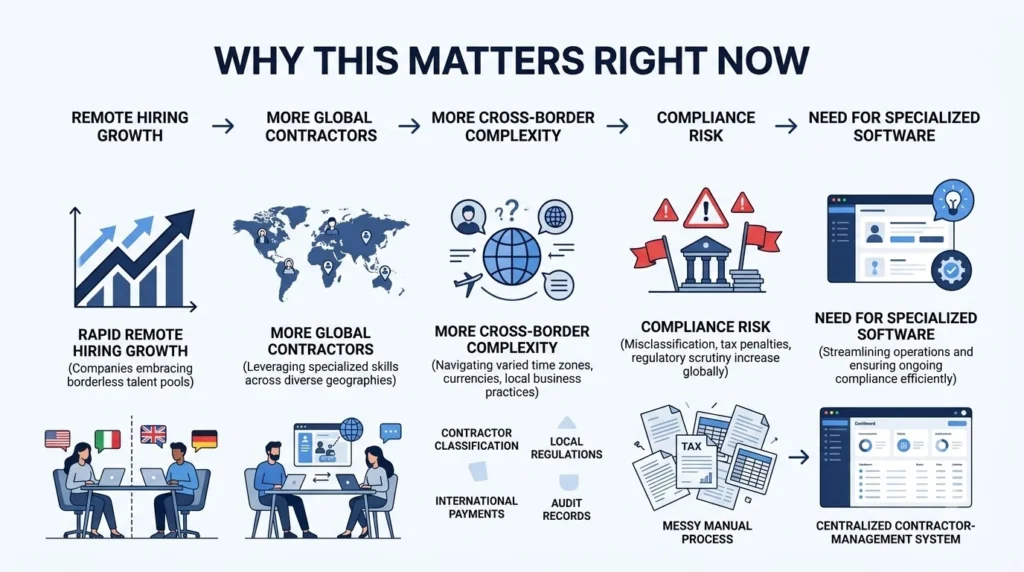
Independent work has become a structural part of the US labor market, not a fringe arrangement. MBO Partners’ State of Independence 2025 report — its 15th consecutive annual edition — counted 72.9 million independent workers, nearly 45% of the labor force. That’s a broad definition covering anyone earning independent income, including occasional and part-time work; a narrower government count from the Bureau of Labor Standard measures only people whose primary occupation is independent work and lands far lower, in the 10–17 million range depending on the exact survey wave. Both numbers are “real” — they’re just measuring different things, which is worth knowing before you compare any two stats you see quoted on this topic.
For agencies specifically, the compliance side is getting more complicated, not less. UK-based teams are navigating IR35 rules on contractor status, and the EU’s Platform Work Directive has a transposition deadline of December 2026, pushing more firms toward platforms that handle classification and localized contracts rather than managing it ad hoc. As remote contractor headcount grows across borders, the manual version of this — spreadsheets, bank transfers, and a folder of W-8BENs — turns into a real compliance and audit risk fast.AI Recruiting and Contractor Management Software for Remote Teams (2026)
AOR vs. COR: The Decision That Actually Matters
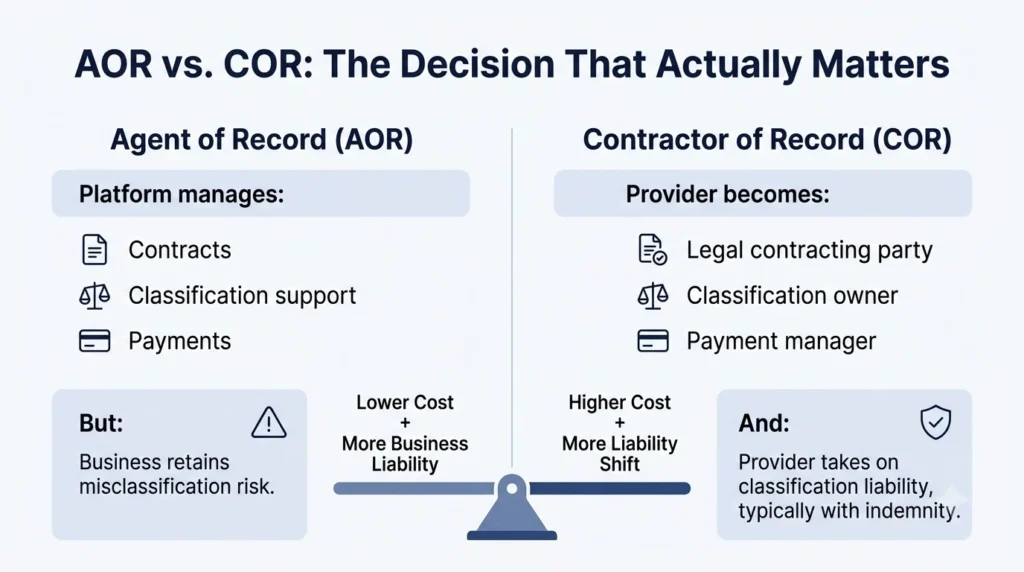
This is the single most important thing to understand before comparing contractor management platforms, and it’s easy to skim past in a feature list.
- Agent of Record (AOR): The platform manages contracts, classification questions, and payments — but you keep the misclassification risk. If a contractor is later found to have been misclassified, your business is on the hook.
- Contractor of Record (COR): The provider becomes the legal contracting party and takes on the classification liability, typically with an indemnity attached — at a meaningfully higher price point.
Platforms in this space commonly price AOR service in the $19–49 per contractor per month range, with COR service running closer to $99–325 per contractor per month once liability actually shifts. That gap is the price of moving real legal risk off your books — worth paying deliberately for a contractor whose classification is genuinely ambiguous, and probably not worth paying for every single low-risk engagement across your whole roster.
What These Tools Actually Do
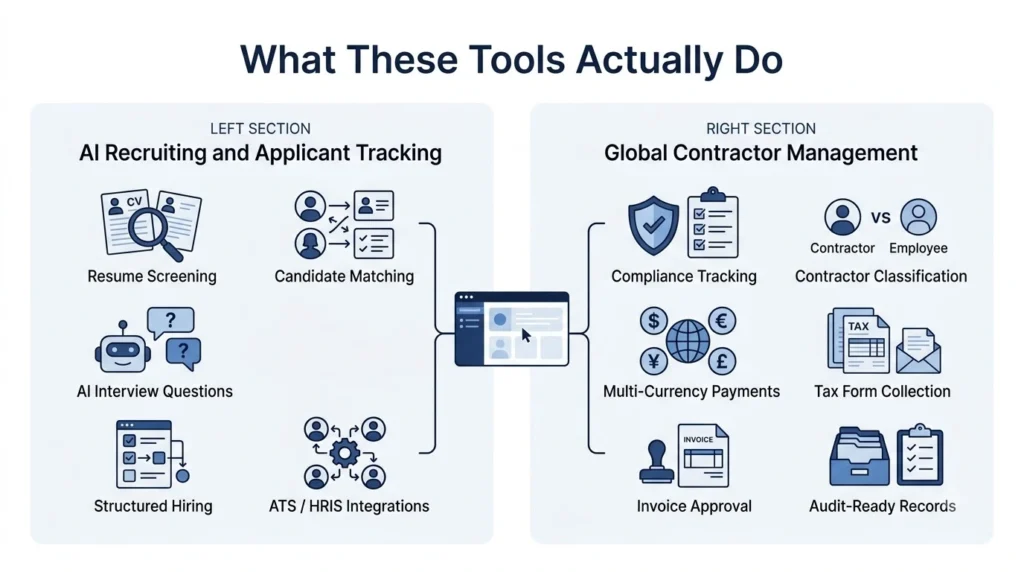
AI recruiting and applicant tracking:
- Automated resume screening and candidate matching — scoring candidates against job criteria and surfacing top matches instead of a recruiter reading every application manually.
- AI-suggested interview questions — generating role-specific questions based on the job description and candidate background.
- Bias-aware structured hiring — scorecards and competency-based filtering designed to reduce inconsistent, ad hoc evaluation between interviewers.
- Integration breadth — connecting to HRIS, background-check, and onboarding tools so a hire doesn’t require re-entering the same data three times.
Global contractor management:
- Compliance tracking and classification tooling — localized contracts and classification questionnaires designed to reduce misclassification exposure across jurisdictions like UK IR35 or California’s ABC test.
- Multi-currency payouts — paying contractors in their local currency without your finance team manually managing FX and wire transfers.
- Tax form collection — automated W-9, W-8BEN, and 1099-NEC collection instead of chasing documents by email.
- Invoice approval workflows and audit-ready records — a single system of record instead of scattered spreadsheets and bank confirmations.
Comparing the Top Platforms
| Platform | Category | Best For | Pricing |
|---|---|---|---|
| Greenhouse | AI recruiting / ATS | Structured, audit-ready hiring at scale | Quote-based; typically enterprise-tier pricing |
| Workable | AI recruiting / ATS | Fast AI sourcing and speed-to-hire for SMB/mid-market | Quote-based; AI features included across tiers |
| Deel | Global contractor management | Payment flexibility, broad country coverage | AOR from ~$49/contractor/mo; COR ~$325/mo |
| Remote | Global contractor management | Compliance-first contractor management with transparent pricing | AOR from ~$29/contractor/mo; COR ~$325/mo |
Worth knowing if you’re comparing more than these four: Worksuite, TFY, and Papaya Global are strong alternatives for enterprise-scale freelancer programs, and UK-focused teams weighing IR35 exposure specifically often also look at Worksome or YunoJuno alongside Deel and Remote.
Choosing by Need
- Separate the recruiting problem from the contractor-management problem. They’re different systems solving different jobs — don’t expect one platform to do both well unless you specifically need that combination.
- Map your contractor roster by risk level before choosing AOR vs. COR. A long-term contractor working exclusively for you, on your schedule, with your equipment looks more like an employee to a regulator than a project-based freelancer does — that’s the kind of relationship where COR’s liability shift is worth the extra cost.
- Check country coverage against your actual contractor locations, not just the total country count a vendor advertises — depth in the countries you actually operate in matters more than breadth you’ll never use.
- Confirm integration with your existing ATS, HRIS, and accounting software before committing, so contractor data doesn’t end up duplicated across three systems.
- Price out your actual contractor volume, since AOR and COR pricing can shift the total cost significantly once you’re managing more than a handful of contractors.
Common Mistakes Agencies Make
- Treating every contractor the same way. A high-risk, long-term contractor relationship and a one-off project freelancer don’t need the same level of protection — paying for COR across your entire roster when only a few relationships are genuinely ambiguous wastes money.
- Assuming AI resume screening removes the need for structured interviews. It narrows the pool faster; it doesn’t replace a consistent, bias-aware interview process.
- Underestimating cross-border tax complexity. W-8BEN and 1099-NEC collection isn’t optional paperwork — get it built into onboarding from day one, not chased down at tax time.
- Picking a platform on country count alone. A vendor advertising “150+ countries” isn’t useful if their actual coverage in the three countries where your contractors live is thin.
also checkout – best AI Churn Prediction Software: The 2026 Guide for SaaS and Agencies
FAQs
What’s the difference between Agent of Record (AOR) and Contractor of Record (COR)? AOR means the platform manages contracts, classification, and payments, but your business keeps the misclassification risk. COR means the provider becomes the legal contracting party and takes on that liability, typically with indemnity, at a meaningfully higher price point.
What’s the best AI recruiting tool for a remote agency? It depends on the need: Greenhouse suits structured, audit-ready hiring with strong scorecards, while Workable leads on fast AI-powered sourcing and speed-to-hire for SMB and mid-market teams. Neither replaces a dedicated contractor management platform for compliance and payments.
Which platforms support both US and UK contractor compliance? Deel and Remote both offer localized contracts and classification tooling across US and UK jurisdictions. UK-focused teams specifically weighing IR35 exposure often also evaluate Worksome or YunoJuno alongside those two.
How much does global contractor management software cost? AOR-tier plans commonly run $19–49 per contractor per month, while COR plans — where the provider takes on classification liability — typically run $99–325 per contractor per month. AI recruiting software (Greenhouse, Workable) is usually quote-based rather than published per-seat pricing.