
AI Contract Management Software: The 2026 Guide for Small Businesses and Agencies
AI Contract Management Software: The 2026 Guide for Small Businesses and Agencies. AI contract management software now drafts first-pass agreements, flags risky clauses against your playbook, and tracks renewal dates automatically — reducing manual review work without removing the need for a lawyer on anything unusual. PandaDoc is the accessible starting point for document creation and e-signature, Juro suits agencies wanting a legal-centric full lifecycle platform, DocuSign IAM fits teams already built around DocuSign, and Ironclad is built for complex, multi-department enterprise workflows.
Table of Contents
Why This Matters Right Now
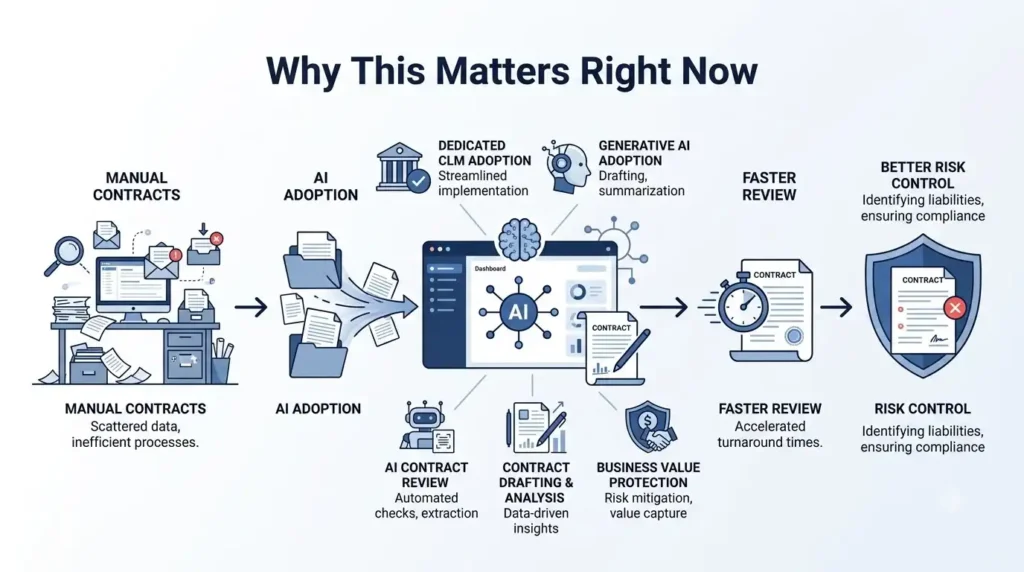
Legal departments are adopting dedicated contract software faster than general AI use alone would suggest. Wolters Kluwer’s 2025 Legisway Benchmark — a survey of more than 700 legal departments across Europe and the US — found 42% now use dedicated contract lifecycle management (CLM) software, up from 33% in 2024, while 56% use generative AI in some form. Only 14% use AI tools built specifically for legal contract management, which is the real gap: plenty of teams are using AI generally, far fewer are using it for the actual contract workflow.
That gap shows up in adoption surveys across markets. A 2026 LegalOn/In-House Connect survey of 452 in-house legal professionals found 52% were either using or evaluating AI for contract review, with active usage nearly quadrupling since 2024 — a meaningful adoption signal, though the sample isn’t a full US/UK census, so treat it as a trend indicator rather than a national rate. In the UK specifically, Thomson Reuters’ 2025 GC Legal Tech Pulse found 44% of corporate legal departments used legal technology frequently or all the time (up from 34% in 2024), while LexisNexis found 61% of UK legal professionals used generative AI for work in 2025 — but only 17% said AI was actually embedded in their strategy and operations. That’s the pattern worth internalizing: usage is common, real integration into how the work actually gets done is still rare.
Contracting is where this concentrates. A 2025 benchmarking study found contract drafting, review, and analysis represented 64% of AI use cases among legal departments already using AI — well ahead of legal research (49%) and document translation (38%). For agencies specifically, the stakes are practical rather than abstract: World Commerce & Contracting estimates poor contract management erodes almost 9% of business value on average, through cost overruns, invoicing errors, delayed delivery, and missed entitlements. That’s a broad cross-industry estimate, not a guaranteed number for any specific agency, but it points at something real — an agency running NDAs, SOWs, and MSAs through email and shared drives without a consistent approval trail is carrying risk it probably isn’t tracking. AI Contract Management Software: The 2026 Guide for Small Businesses and Agencies.
What These Tools Actually Do
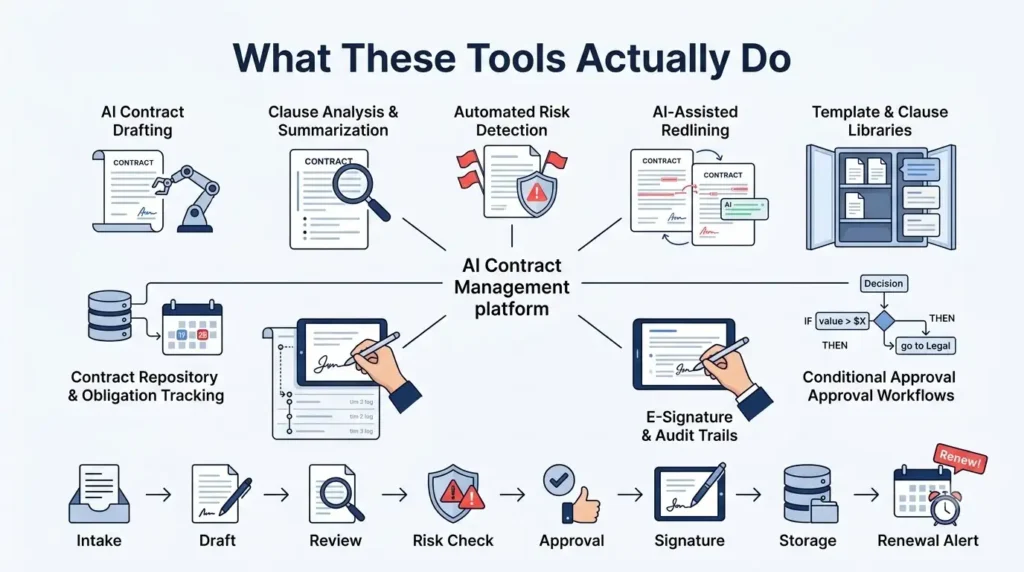
- AI contract drafting — generating a first draft from a short natural-language request, using approved clauses and company rules (governing law, liability caps, payment terms) rather than starting from a blank page.
- Clause analysis and summarization — extracting renewal dates, notice periods, liability caps, and IP provisions into a plain-language summary so a non-lawyer can see the issues without reading every page.
- Automated risk detection — comparing incoming language against your internal playbook and flagging unusual indemnities, unlimited liability, or one-sided termination rights, ideally with the specific clause, an explanation, and a suggested fallback — not just a generic risk score.
- AI-assisted redlining — suggesting edits that bring a counterparty’s paper closer to your approved position, speeding up review of client-provided MSAs and vendor agreements.
- Template and clause libraries — one controlled version of your NDA, MSA, and SOW templates instead of “template drift,” where different employees quietly use outdated language.
- Intake forms and conditional workflows — structured questions (client type, value, data access, risk) that route unusual matters to a director or outside counsel automatically, while routine agreements move fast.
- E-signature with audit trails — signing order, identity verification, and completed-document storage, closing the common gap where a contract gets signed in one system and the final version can’t be found later.
- Repository and obligation tracking — searchable by client, renewal date, and clause type, with alerts before expirations, notice windows, and renewal decisions.
A practical agency workflow this enables: an intake form creates an approved MSA and SOW, routes any exceptions for review, sends the documents for signature, and stores the final agreement against the client record — all without an email chain, and with a full audit trail if a question comes up later.
Comparing the Top Platforms
| Platform | Best Fit | Strengths | Pricing |
|---|---|---|---|
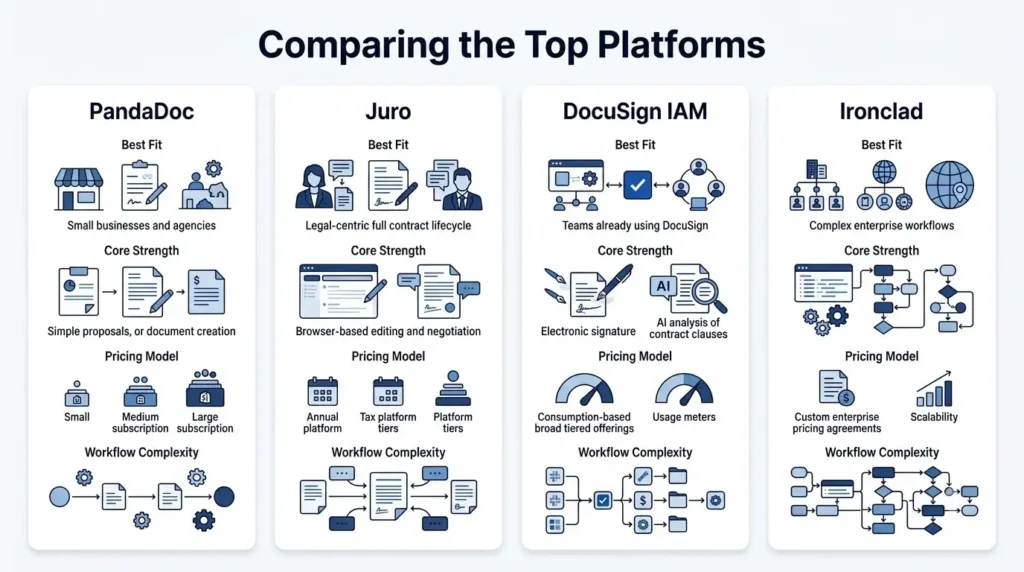
| PandaDoc | Freelancers and small agencies prioritizing documents and e-signature | Accessible, drag-and-drop creation, templates, CRM integrations | Free plan; Starter $19/seat/mo; Business $49/seat/mo; Enterprise custom |
| Juro | Agencies wanting a full legal-centric lifecycle | Browser-based drafting and collaboration, AI risk review, unlimited users/workflows/templates on its plans | Custom, volume- and integration-based pricing |
| DocuSign IAM | Teams already built around DocuSign | Familiar e-signature ecosystem plus an AI-powered agreement repository and no-code workflows | Starter $45/user/mo (100 sends/year); Standard $50/user/mo (3-user min); Professional $80/user/mo (3-user min) |
| Ironclad | Mid-market and enterprise with complex approvals | Strong workflow customization, conditional approvals, cross-functional (legal, sales, finance, HR) support | Custom, sales-led pricing |
The selection logic that actually matters: choose PandaDoc when the real problem is creating, sending, and signing standard agreements — not deep legal review. Choose Juro when you need drafting, negotiation, review, and repository management in one legal-centric system. Choose DocuSign IAM when e-signature is already core to how you operate and you want agreement intelligence layered on top of that. Choose Ironclad when legal operations complexity and cross-functional workflow genuinely justify an enterprise implementation — which is a smaller set of small agencies than the marketing for these platforms might suggest.
One honest note on vendor ROI claims: Ironclad’s own customer-impact materials cite a Forrester-commissioned analysis reporting 314% three-year ROI and a 65% improvement in contract efficiency. That’s a real, methodologically disclosed study — but it’s modeled from five interviewed customer organizations, not an independent guarantee of what you’ll see. Treat any vendor’s headline ROI number the same way: informative, not a promise.
Building Your First Automated Contract Workflow
- Start with one repeatable contract type — NDAs or a standard MSA — rather than trying to automate your entire contract portfolio at once.
- Define your approved clauses and escalation rules before turning on AI review. The tool is only as good as the playbook it’s checking against.
- Run a pilot on historical contracts and measure turnaround time, exception rate, and approval time before rolling it out live.
- Set the escalation threshold clearly — which agreements move fast, which route to a human, and at what value or risk level that changes.
- Require legal review for anything high-value, unusual, regulated, or cross-border, regardless of how confident the AI’s risk assessment looks.
- Audit outputs periodically. A high confidence score from the tool isn’t the same thing as legal correctness — spot-check it on a schedule, not just when something goes wrong.
What AI Can’t Do For You Yet
Be clear about the boundary, because it’s where agencies get into trouble. AI contract tools are genuinely good at triaging routine work and applying an approved playbook consistently — flagging the unusual clause, drafting the standard NDA, tracking the renewal date. They are not a substitute for a lawyer’s judgment on negotiation strategy, jurisdiction-specific law, or a genuinely novel commercial term. The sensible operating model is AI for volume and consistency, a human for exceptions and anything that doesn’t fit the playbook — not “AI reviews everything” as a way to avoid legal spend entirely.
Common Mistakes Agencies Make
- Uploading confidential client contracts to an AI tool without checking the data terms. Confirm encryption, retention policy, and — specifically — whether the vendor trains general models on your data before you upload anything sensitive.
- Treating a high AI confidence score as legal sign-off. It’s a first pass, not a final answer, especially on anything unusual or high-value.
- Skipping the playbook step. An AI review tool with no defined fallback clauses and escalation rules is just an expensive way to read a contract, not actually manage risk.
- Buying more platform than the agency needs. A five-person shop signing standard NDAs and SOWs doesn’t need Ironclad’s enterprise workflow engine — start with what your actual contract volume and complexity justify.
also checkout – best AI Voice Agents for B2B Sales: The 2026 Guide
FAQs
What is AI contract management software? It’s software that uses AI and workflow automation to help draft, review, negotiate, approve, sign, store, and monitor contracts across their full lifecycle — broader than a plain e-signature tool and more controlled than asking a general-purpose chatbot to rewrite an agreement.
Does AI contract review replace a lawyer? No. It can reduce repetitive review work and help prioritize which issues need attention, but it can’t reliably replace professional legal judgment, negotiation strategy, or jurisdiction-specific advice. Use it for triage and standard language, with a lawyer handling exceptions.
What’s the best AI contract management tool for a small business or agency? There’s no universal winner — PandaDoc is the most approachable starting point for document creation and signing, Juro is stronger for legal-centric end-to-end contracting, DocuSign IAM suits teams already invested in DocuSign, and Ironclad fits complex, multi-department enterprise needs.
Is it safe to upload confidential contracts to an AI contract tool? It depends on the provider’s data-processing terms — encryption, access controls, retention policy, and specifically whether they train general AI models on customer data. Get those answers in writing and test permissions before uploading sensitive client agreements.
1 thought on “best AI Contract Management Software: The 2026 Guide for Small Businesses and Agencies”