
Best AI Email Marketing Tools for B2B in 2026: Cold Outreach vs. Lifecycle Email
Best AI Email Marketing Tools for B2B in 2026: Cold Outreach vs. Lifecycle Email. AI email marketing tools for B2B fall into two genuinely different categories that shouldn’t be shopped the same way: cold-outbound platforms like Instantly, Smartlead, and Lemlist for prospecting people who haven’t opted in, and lifecycle platforms like Klaviyo for nurturing contacts who already have. The AI features — drafting, research, segmentation, reply handling — matter less than picking the right category first, since running a cold-outbound tool against an opted-in list (or the reverse) is one of the more expensive mistakes a team can make.
Table of Contents
Why “AI Email Marketing” Means Two Different Things in 2026
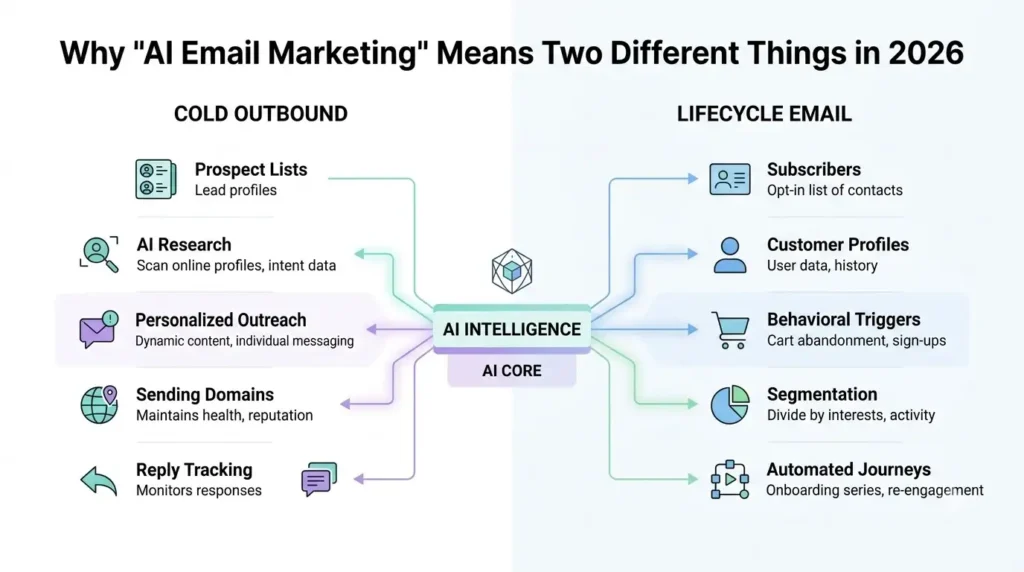
AI adoption in marketing is no longer the interesting question — HubSpot’s 2025 research found 66% of marketers globally already use AI in their role, rising to 74% among American marketers. The interesting question is what they’re getting out of it. Salesforce’s 2026 State of Marketing report found 75% of marketers are using or experimenting with AI, yet 84% of that same group admit their campaigns are still generic. Adoption solved the production-speed problem; it hasn’t solved the relevance problem.
Worth flagging directly: there’s no reliable public survey that isolates AI cold-email adoption specifically by US versus UK market. Anyone citing a precise UK number for this is likely stretching a global or North American figure further than the data supports — the 74% US figure above is the most defensible national number currently available.
The deliverability side of the equation has also gotten stricter. Google’s current bulk-sender rules require anyone sending more than 5,000 messages a day to personal Gmail addresses to authenticate mail with SPF, DKIM, and DMARC, and to make unsubscribing a single click, per Google’s own sender guidelines. Spam-complaint rate is the number that actually gates your reach: the practical target is under 0.1%, and 0.3% is where most senders start seeing real consequences, according to Mailgun’s deliverability research. At the 0.1% line, that’s one complaint per 1,000 emails delivered — a much tighter margin than most senders assume. Average inbox placement sits somewhere around 83–84% industry-wide, with meaningful variance by provider (Gmail runs higher, Outlook/Hotmail noticeably lower), per independent 2025 benchmarking — treat any inbox-placement number, including this one, as directional rather than a guarantee for your specific list.
Personalization is where AI’s real leverage shows up, but the size of the lift varies enormously by use case — one industry roundup of behavioral-personalization case studies found lifts ranging from 2.8x to over 300x versus generic email, which tells you more about how different the underlying campaigns were than it does about what to expect for yours, per MoEngage’s benchmarking. The honest 2026 summary: AI increases production speed, testing volume, and follow-up consistency. It does not guarantee higher conversion without a genuinely good list, a real offer, and human judgment behind the send button. Best AI Email Marketing Tools for B2B in 2026: Cold Outreach vs. Lifecycle Email
What AI Actually Adds to the Email Workflow
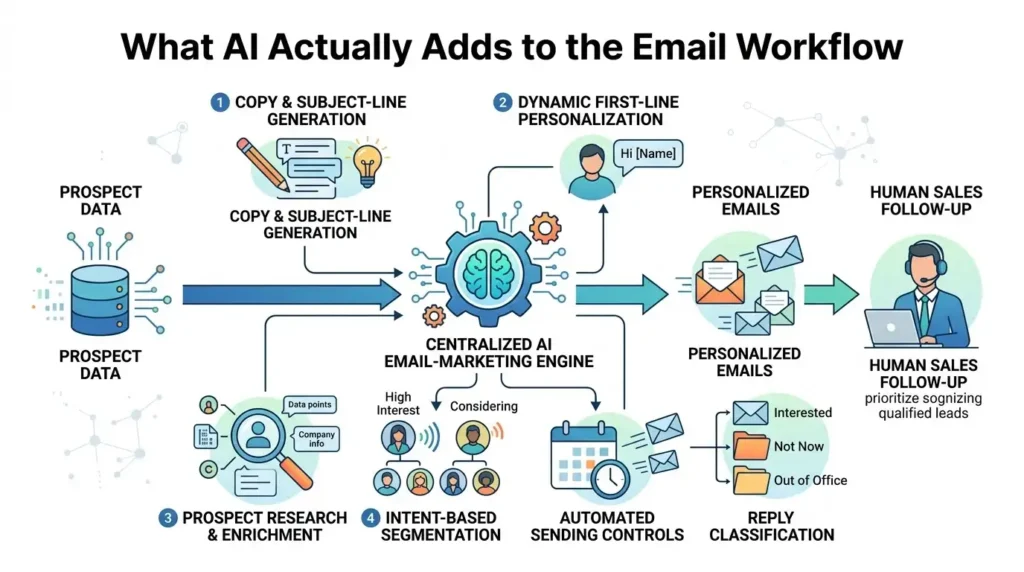
Strip away the marketing language and the useful AI features cluster into a handful of jobs:
- Copy and subject-line generation. First drafts for openers, CTAs, follow-ups, and re-engagement sequences, with tone adapted by persona or seniority — genuinely useful for cutting production time, provided a human still reviews for factual accuracy and brand voice before anything sends.
- Dynamic first-line personalization. AI pulls from company news, job postings, or product pages to write an individualized opening line per prospect. This is also where hallucinated personalization creeps in — a good tool shows you the source it pulled from for each line, not just the line itself.
- Automated prospect research and enrichment. Job title, company size, tech stack, hiring signals, and funding data get attached to a record automatically, which is what makes account-based targeting practical at any real volume.
- Intent-based segmentation and sequencing. Different sequences trigger based on what a prospect actually does — visits pricing, downloads a resource, replies positively — rather than sending everyone the same five-email drip regardless of where they are in the funnel.
- Automated warmup and sending controls. Gradual volume ramps, mailbox rotation, and bounce monitoring reduce the odds of an operational mistake torching a domain. Worth saying plainly: warmup protects a domain’s reputation, it doesn’t make an unwanted message wanted — it isn’t a substitute for a properly consented or well-targeted list.
- Reply classification and routing. Sorting replies into positive, objection, out-of-office, and unsubscribe, then routing anything real to a human — especially valuable for agencies juggling several client inboxes at once.
Cold Outbound vs. Lifecycle Email: Pick the Category Before You Pick the Tool
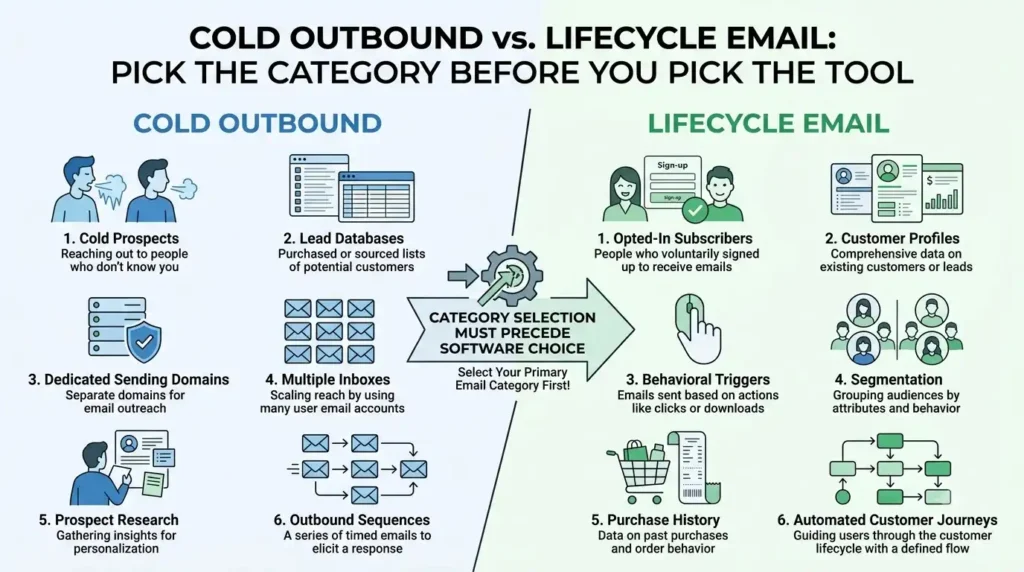
This distinction is the single most useful filter in this whole category, and it’s the one most “best AI email tool” roundups blur together.
Cold outbound (Instantly, Smartlead, Lemlist) is built for reaching people who haven’t given you their email address directly — you’re sourcing or buying contact data, sending from dedicated sending domains, and living or dying by domain reputation and deliverability infrastructure. Lifecycle and newsletter platforms (Klaviyo is the clearest example) are built for contacts who already opted in — customers, subscribers, trial users — and lean on behavioral data, purchase history, and journey automation rather than cold-list infrastructure.
Using a cold-outbound tool’s aggressive sending patterns on an opted-in customer list wastes most of its value. Using a lifecycle platform for genuine cold prospecting usually means fighting the tool’s assumptions the whole way. Decide which motion you’re actually running before you compare features.
The Real 2026 Pricing — And What the Sticker Price Leaves Out
Every platform below publishes a clean starting price. None of them publish the real one.
| Platform | Best For | Real Starting Price (2026) | What the Headline Price Doesn’t Include |
|---|---|---|---|
| Instantly.ai | High-volume cold outreach, agencies running many mailboxes | Growth $47/mo (~$37–40 annual) up to Light Speed $358/mo | The lead database (Instantly Credits) and CRM are now separately billed products — the $47 headline covers sending only |
| Smartlead | Agencies and SDR teams managing large mailbox fleets | $39–$379/mo across four tiers, unlimited mailboxes on every one | Real infrastructure cost — mailboxes, domains, verification credits — commonly runs 3–5x the plan price once you’re sending serious volume |
| Lemlist | Multichannel outreach and heavier creative personalization | $63–$87/seat/month on annual billing (Email Pro to Multichannel Expert) | Prices rose 10–14% from 2025 levels for new customers; extra mailboxes run $9 each beyond the included allotment, and enrichment now runs on pay-per-use credits |
| Klaviyo | Opted-in ecommerce and lifecycle email — not cold outreach | Free to 250 profiles; roughly $20/mo at 500 profiles, scaling from there | Billing shifted to active (engaged) profiles in 2025 rather than raw list size, so list hygiene now directly affects your invoice, and SMS/push are billed separately |
The pattern across all three cold-outbound platforms is the same: the number on the pricing page is the sending engine, not the operation. Budget for lead data, mailbox infrastructure, and verification as separate line items before you commit to a plan based on the sticker price alone — and since these numbers shift often, treat any price here as “at time of writing” and confirm on the vendor’s live page before you buy.
The Compliance Layer: CAN-SPAM, PECR, and CASL Aren’t the Same Law
This is the part a tool’s marketing page will never fully explain, and it’s genuinely different by country.
United States — CAN-SPAM. This is an opt-out regime, not an opt-in one: you don’t need prior consent to send commercial email, but you do need accurate header information, a non-deceptive subject line, a valid physical postal address, and a working opt-out mechanism that you honor promptly, per the FTC’s compliance guide. This is the most permissive of the three regimes, which is part of why so many cold-email platforms are built around US-style compliance by default.
United Kingdom — PECR. This is where a lot of B2B teams get the rule half-right. PECR’s consent requirement for marketing email doesn’t apply to “corporate subscribers” — you can email a generic address like sales@company.com without PECR consent, per the ICO’s own guidance. But most real B2B outreach targets a named individual, and a named person’s business email address can still count as a personal, individually-protected “subscriber” — meaning PECR’s consent rules, and UK GDPR’s lawful-basis requirement, can still apply even though you’re technically emailing “a business.” Sole traders and certain partnership structures are treated as individual subscribers outright, with no corporate exemption at all. “It’s B2B so I don’t need consent in the UK” is a common oversimplification, not a safe legal position.
Canada — CASL. The strictest of the three: commercial electronic messages generally require express or implied consent, clear sender identification, and a working unsubscribe mechanism, with real penalties attached, per Canada’s CRTC guidance.
The through-line across all three: a platform’s SPF/DKIM/DMARC checks, suppression lists, and unsubscribe automation reduce operational risk, but the legal responsibility for whether you had the right to email someone in the first place sits with the sender — not with Instantly, Smartlead, Lemlist, or Klaviyo.
Step-by-Step: Launching an AI-Assisted Cold Email Campaign Without Burning Your Domain
- Send from a dedicated domain, never your primary company domain. A deliverability mistake on a throwaway domain is an inconvenience; the same mistake on your main domain can take your regular business email down with it.
- Warm up every new inbox gradually before pointing real campaign volume at it — this is table stakes on all three cold-outbound platforms above.
- Verify every address before upload. A bounce rate above a few percent is the fastest way to damage a new domain’s reputation, and it happens before you even get to the content question.
- Set up SPF, DKIM, and DMARC before your first send, not after your open rate mysteriously drops.
- Write one real, source-backed personalization point per prospect rather than relying on a first-name merge tag — and check whether your tool shows the evidence it used, not just the generated line.
- Cap daily volume per inbox and watch your spam-complaint rate against the 0.1% benchmark, not just your open and reply rates.
- Route every positive reply to a human the same day. The AI’s job here is qualification and first response, not closing.
- Confirm your consent basis for the specific list and region before scaling volume — a list that’s fine to email in the US may not be fine to email in the UK or Canada without changes.
Which Tool Fits Which Situation
- Running high-volume outbound across dozens of mailboxes — Instantly’s unlimited-account model is built for exactly this, provided you budget the lead-data and CRM add-ons separately from the headline price.
- Agency managing multiple clients who each need their own branded reporting — Smartlead’s white-label portals at the Unlimited tiers are a genuine differentiator most competitors don’t match at the same price point.
- Outreach depends on real creative personalization or multichannel touches (email plus LinkedIn or calling) — Lemlist earns its higher per-seat price here, if the campaign genuinely needs that depth.
- You already have an opted-in customer or subscriber list, especially in ecommerce — Klaviyo is built for this job specifically, and trying to force a cold-outbound tool to do it is fighting the product.
Bottom Line
The AI in these tools genuinely saves time on research, drafting, and reply triage, and it can meaningfully lift relevance over generic blasts. It does not replace a clean list, a real offer, a properly configured sending domain, or a human checking that the consent basis matches the country you’re emailing into. Pick the category — cold outbound or lifecycle — before you pick the platform, budget for the infrastructure the sticker price doesn’t show, and treat compliance as a per-region question, not a single global checkbox.
also checkout – Best AI Landing Page Builders for Conversion Optimization in 2026
FAQs
What is an AI email marketing tool for B2B?
It’s software that uses machine learning or generative AI to help with prospect research, segmentation, copywriting, sequencing, send-time decisions, reply classification, and campaign analysis — reducing the manual work in each step without replacing the strategy or judgment behind the campaign.
What’s the best AI tool for personalized cold email?
It depends on the job: Instantly or Smartlead for scalable, mailbox-based outbound at volume, Lemlist when the campaign leans on deep creative personalization or multiple channels, and Klaviyo when you’re working an opted-in list rather than cold prospecting.
Can AI email tools guarantee better deliverability?
They reduce operational errors — authentication checks, throttling, bounce prevention, suppression-list management — but none of them can guarantee inbox placement if the underlying list is poor, the content is unwanted, or the sending domain already has a damaged reputation. Deliverability tooling manages risk; it doesn’t erase it.
Is AI-generated cold email legal in the US, UK, and Canada?
Generating the copy with AI isn’t the legal issue — the sender’s obligations are. The US (CAN-SPAM) is opt-out and relatively permissive; the UK (PECR plus UK GDPR) restricts emailing named individuals more than most B2B teams assume, even though generic corporate addresses are exempt; and Canada (CASL) is consent-based and the strictest of the three. Each needs to be assessed separately rather than assumed from the others.
1 thought on “Best AI Email Marketing Tools for B2B in 2026: Cold Outreach vs. Lifecycle Email”