
best AI Video Repurposing Tools for Agencies: The 2026 Guide
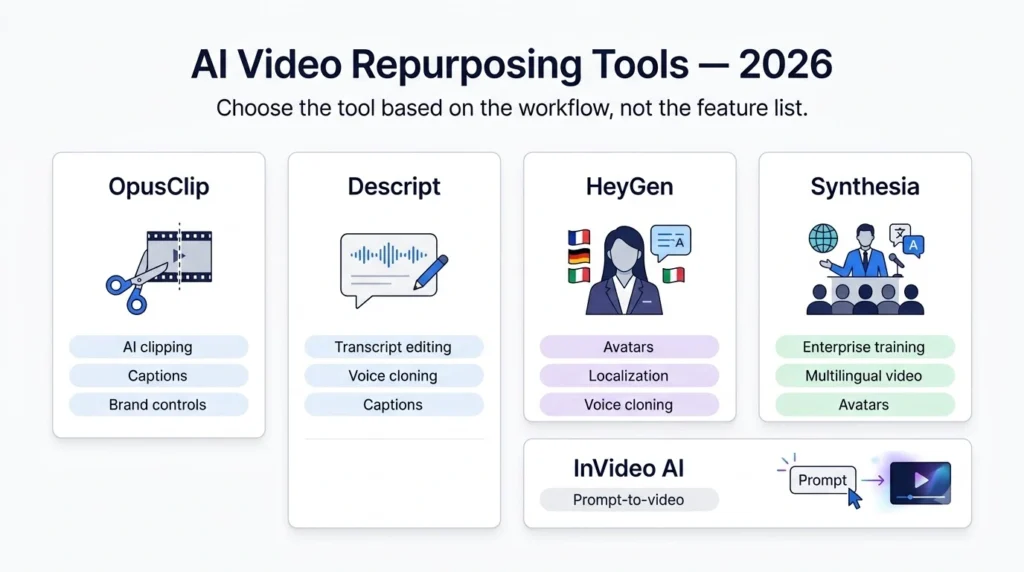
best AI Video Repurposing Tools for Agencies: The 2026 Guide. The agency video market has shifted from one-off production to AI-assisted content factories, where a single webinar, podcast, or product demo becomes dozens of platform-specific assets. The right tool depends on the job: OpusClip leads for repurposing long-form content into clips, HeyGen and Synthesia for avatar-led localization, Descript for transcript-based editing, and InVideo AI for prompt-to-video production.
Table of Contents
Why This Matters Right Now
Video isn’t a channel agencies debate anymore — it’s table stakes, and AI is now how most teams keep up with the output demand. Wyzowl’s 2026 State of Video Marketing survey found 91% of businesses use video for marketing (tied for an all-time high), with 93% of video marketers calling it important to their overall strategy and social media video the single most common use case at 69%. The AI-specific number is the one moving fastest: 63% of video marketers had used AI tools to create or edit marketing video, up from 51% the year before — a 12-point jump in a single year, the fastest-growing trend in Wyzowl’s survey. Worth knowing if you see a different AI-adoption figure elsewhere: numbers ranging from 41% to 84% aren’t conflicting data, they reflect different survey populations and different definitions of “using AI in video,” not disagreement about the trend itself.
US advertisers are moving even faster. The IAB’s 2025 Digital Video Ad Spend & Strategy research found half of advertisers already using generative AI to build video ads, with 86% using or planning to use it for video-ad creative, and buyers expecting AI-generated creative to reach 40% of all ads by 2026 — most commonly for producing audience-specific versions, different visual styles, and improved contextual relevance from one master asset, exactly the workflow agencies run for multi-platform campaigns. The money backs this up: IAB and PwC reported US digital video advertising hit $62.1 billion in 2024, up 19.2% year over year, with IAB separately projecting $72 billion for 2025.
For UK agencies, the consumption data explains why vertical, short-form output matters so much. Ofcom’s Online Nation report found UK adults spending an average of 4 hours 20 minutes online daily, with YouTube reaching 94% of UK online adults and 74% of 18–24-year-olds visiting TikTok, averaging 64 minutes a day there. Smartphones accounted for 75% of that daily online time — which is the practical reason a workflow that can’t reliably turn a horizontal interview into clean 9:16 video without losing the speaker isn’t really viable for a UK-focused agency anymore.best AI Video Repurposing Tools for Agencies: The 2026 Guide
What These Tools Actually Do
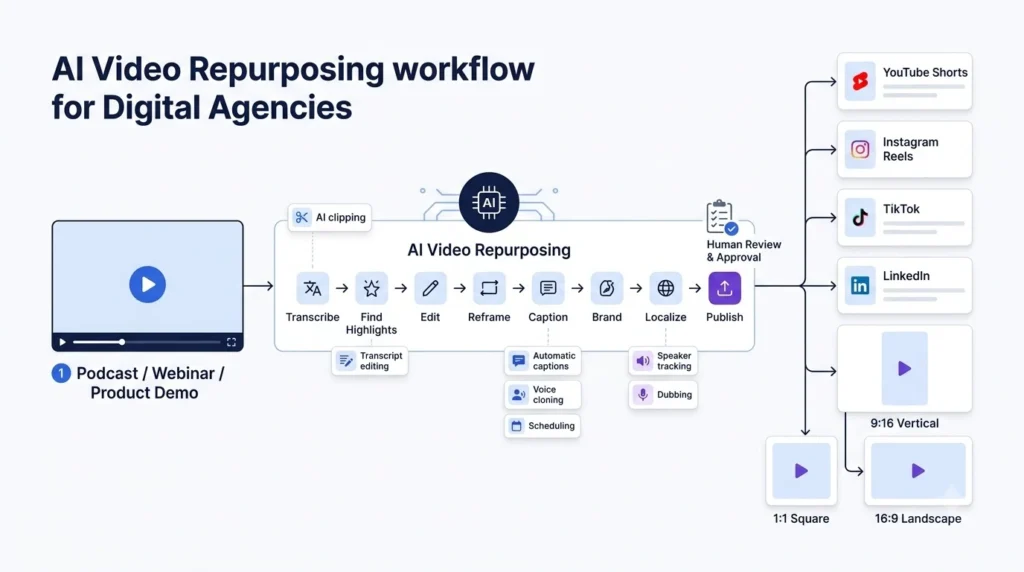
- Long-form-to-short-form clipping — AI scans webinars, podcasts, and interviews to identify strong moments and generate clips automatically, so an editor isn’t watching a full hour-long recording to find the five minutes worth posting.
- Transcript-based editing — cutting video by editing the transcript itself (delete a sentence, cut the clip), which lets non-specialist team members make rough cuts without learning a traditional timeline editor.
- Automatic captioning and styling — timed subtitles with branded fonts and colors applied automatically, important given how much video gets watched with the sound off.
- AI reframing and subject tracking — converting a landscape recording into 9:16, 1:1, or 16:9 while keeping the speaker or product centered, instead of manually keyframing every format.
- Prompt-to-video generation — producing a full draft (script, visuals, voiceover, music) from a text prompt, useful for a first pass before investing in filming or animation.
- AI avatars and voice cloning — presenter-led video without booking a presenter, particularly valuable for product demos, training, and localized campaigns run at volume.
- Localization and dubbing — translating scripts, captions, and presenter speech while preserving timing, though idioms, regulated claims, and brand-specific language still need human proofreading.
- Brand kits and multi-client workspaces — reusable intros, caption styles, and locked brand assets so agency output stays consistent without every editor improvising branding for every client.
A practical agency workflow this enables: record one podcast or webinar, transcribe and clean the master, use AI to surface 10–20 candidate clips, have a human pick the best five to eight, reframe each for vertical and square, add captions and brand elements, write platform-specific titles, dub the priority assets, then publish and feed performance data back into the next editorial cycle.
Comparing the Top Tools
| Tool | Best Fit | Strengths | Watch Out For |
|---|---|---|---|
| OpusClip | Repurposing podcasts, webinars, and long-form content at volume | Automated clipping, highlight selection, captions, speaker tracking, scheduling, and analytics in one workflow | Primarily a repurposing platform, not a cinematic generator — AI-selected “viral” moments still need editorial review, especially for B2B or regulated clients |
| Descript | Podcast, interview, and talking-head workflows needing precise editing | Transcript-based editing, filler-word removal, brand controls, collaboration, enterprise security options | Less specialized than OpusClip for automated viral-clip discovery; AI-credit limits need modeling for high-volume teams |
| HeyGen | AI presenters, product explainers, and multilingual UGC-style content | Avatars, voice cloning, text/image/audio-to-video, 175+ languages and dialects | Avatar content can feel generic with weak scripting — verify consent, likeness rights, and voice-cloning permissions before using |
| Synthesia | Enterprise training, onboarding, and localized business communication | 240+ avatar options, 160+ languages, custom avatars, organizational publishing workflows | Better suited to structured presenter-led content than fast-paced social repurposing; minute-based enterprise pricing adds up at volume |
| InVideo AI | Prompt-to-video drafts and rapid creative testing | Generates scripts, visuals, voiceover, and music from a prompt; includes stock media library | Output quality depends heavily on prompting and source selection — verify media licensing and voice rights before client delivery |
Choosing by use case, in short: pick OpusClip when you already have valuable long-form footage and need high-volume social derivatives; Descript when transcript accuracy and collaborative review matter most; HeyGen when a client needs fast presenter-led or multilingual content without repeated filming; Synthesia when governance and enterprise training matter more than trend-driven short-form; and InVideo AI when you need fast draft concepts before committing production budget.
What to Check Before You Buy
- Scale economics — processing minutes, AI credits, storage, and seat limits, since overage pricing is where agency budgets get surprised.
- Client operations — multi-brand workspaces, permissions, approval workflows, and whether the tool can genuinely keep client assets separate, not just visually organized.
- Governance — copyright and stock-media licensing, data retention, model-training opt-outs, and explicit consent processes for any cloned voice or avatar likeness.
- Human override — the ability to inspect transcripts, adjust cuts, correct captions, and override AI-selected moments, not just accept whatever the algorithm picks.
- Distribution — whether the platform actually publishes to your target platforms or just exports files you still have to upload manually.
Common Mistakes Agencies Make
- Trusting AI-selected “highlights” without review. Automated clip selection is a strong first pass, not a final decision — especially for B2B or regulated clients where context and accuracy matter more than raw engagement potential.
- Skipping consent and rights checks on avatars and voice clones. This is a real legal and brand-safety issue, not a formality — confirm licensing before a cloned voice or likeness goes into a client campaign.
- Treating localization as a translation problem only. Idioms, regulated claims, and brand-specific language need human proofreading even after AI dubbing gets the timing right.
- Optimizing for clip volume instead of approved-asset throughput. The number of clips generated matters less than how many actually go live and perform — track cost per approved asset, not just output count.
also checkout – best AI Agent Workflow Automation Platforms: The 2026 Guide
FAQs
What’s the best AI video repurposing tool for agencies? It depends on the workflow: OpusClip is the strongest starting point for turning long-form content into short-form clips at volume, Descript fits teams that need transcript-precise editing and collaboration, and HeyGen or Synthesia lead for avatar-based and multilingual content.
Can AI turn a podcast or webinar into TikTok, Reels, and YouTube Shorts automatically? Yes — AI can transcribe the recording, identify candidate highlights, generate short clips, reframe them vertically, and add captions. Human review is still needed for context, factual accuracy, pacing, and brand suitability before publishing.
Is OpusClip or Descript better for an agency? OpusClip is generally more specialized for automated repurposing and platform-ready clipping at volume. Descript is the stronger pick when the priority is precise transcript editing, podcast production, and collaborative review rather than automated highlight discovery.
Are AI avatar videos effective for client marketing content? They work well for product education, onboarding, training, and multilingual communication where consistency matters more than a visibly human presenter. They’re a weaker fit for campaigns that depend on authentic customer testimony or emotionally nuanced storytelling, where audiences tend to notice synthetic delivery.
The agency video market has shifted from one-off production to AI-assisted content factories, where a single webinar, podcast, or product demo becomes dozens of platform-specific assets. The right tool depends on the job: OpusClip leads for repurposing long-form content into clips, HeyGen and Synthesia for avatar-led localization, Descript for transcript-based editing, and InVideo AI for prompt-to-video production.
Why This Matters Right Now
Video isn’t a channel agencies debate anymore — it’s table stakes, and AI is now how most teams keep up with the output demand. Wyzowl’s 2026 State of Video Marketing survey found 91% of businesses use video for marketing (tied for an all-time high), with 93% of video marketers calling it important to their overall strategy and social media video the single most common use case at 69%. The AI-specific number is the one moving fastest: 63% of video marketers had used AI tools to create or edit marketing video, up from 51% the year before — a 12-point jump in a single year, the fastest-growing trend in Wyzowl’s survey. Worth knowing if you see a different AI-adoption figure elsewhere: numbers ranging from 41% to 84% aren’t conflicting data, they reflect different survey populations and different definitions of “using AI in video,” not disagreement about the trend itself.
US advertisers are moving even faster. The IAB’s 2025 Digital Video Ad Spend & Strategy research found half of advertisers already using generative AI to build video ads, with 86% using or planning to use it for video-ad creative, and buyers expecting AI-generated creative to reach 40% of all ads by 2026 — most commonly for producing audience-specific versions, different visual styles, and improved contextual relevance from one master asset, exactly the workflow agencies run for multi-platform campaigns. The money backs this up: IAB and PwC reported US digital video advertising hit $62.1 billion in 2024, up 19.2% year over year, with IAB separately projecting $72 billion for 2025.
For UK agencies, the consumption data explains why vertical, short-form output matters so much. Ofcom’s Online Nation report found UK adults spending an average of 4 hours 20 minutes online daily, with YouTube reaching 94% of UK online adults and 74% of 18–24-year-olds visiting TikTok, averaging 64 minutes a day there. Smartphones accounted for 75% of that daily online time — which is the practical reason a workflow that can’t reliably turn a horizontal interview into clean 9:16 video without losing the speaker isn’t really viable for a UK-focused agency anymore.
What These Tools Actually Do
- Long-form-to-short-form clipping — AI scans webinars, podcasts, and interviews to identify strong moments and generate clips automatically, so an editor isn’t watching a full hour-long recording to find the five minutes worth posting.
- Transcript-based editing — cutting video by editing the transcript itself (delete a sentence, cut the clip), which lets non-specialist team members make rough cuts without learning a traditional timeline editor.
- Automatic captioning and styling — timed subtitles with branded fonts and colors applied automatically, important given how much video gets watched with the sound off.
- AI reframing and subject tracking — converting a landscape recording into 9:16, 1:1, or 16:9 while keeping the speaker or product centered, instead of manually keyframing every format.
- Prompt-to-video generation — producing a full draft (script, visuals, voiceover, music) from a text prompt, useful for a first pass before investing in filming or animation.
- AI avatars and voice cloning — presenter-led video without booking a presenter, particularly valuable for product demos, training, and localized campaigns run at volume.
- Localization and dubbing — translating scripts, captions, and presenter speech while preserving timing, though idioms, regulated claims, and brand-specific language still need human proofreading.
- Brand kits and multi-client workspaces — reusable intros, caption styles, and locked brand assets so agency output stays consistent without every editor improvising branding for every client.
A practical agency workflow this enables: record one podcast or webinar, transcribe and clean the master, use AI to surface 10–20 candidate clips, have a human pick the best five to eight, reframe each for vertical and square, add captions and brand elements, write platform-specific titles, dub the priority assets, then publish and feed performance data back into the next editorial cycle.
Comparing the Top Tools
| Tool | Best Fit | Strengths | Watch Out For |
|---|---|---|---|
| OpusClip | Repurposing podcasts, webinars, and long-form content at volume | Automated clipping, highlight selection, captions, speaker tracking, scheduling, and analytics in one workflow | Primarily a repurposing platform, not a cinematic generator — AI-selected “viral” moments still need editorial review, especially for B2B or regulated clients |
| Descript | Podcast, interview, and talking-head workflows needing precise editing | Transcript-based editing, filler-word removal, brand controls, collaboration, enterprise security options | Less specialized than OpusClip for automated viral-clip discovery; AI-credit limits need modeling for high-volume teams |
| HeyGen | AI presenters, product explainers, and multilingual UGC-style content | Avatars, voice cloning, text/image/audio-to-video, 175+ languages and dialects | Avatar content can feel generic with weak scripting — verify consent, likeness rights, and voice-cloning permissions before using |
| Synthesia | Enterprise training, onboarding, and localized business communication | 240+ avatar options, 160+ languages, custom avatars, organizational publishing workflows | Better suited to structured presenter-led content than fast-paced social repurposing; minute-based enterprise pricing adds up at volume |
| InVideo AI | Prompt-to-video drafts and rapid creative testing | Generates scripts, visuals, voiceover, and music from a prompt; includes stock media library | Output quality depends heavily on prompting and source selection — verify media licensing and voice rights before client delivery |
Choosing by use case, in short: pick OpusClip when you already have valuable long-form footage and need high-volume social derivatives; Descript when transcript accuracy and collaborative review matter most; HeyGen when a client needs fast presenter-led or multilingual content without repeated filming; Synthesia when governance and enterprise training matter more than trend-driven short-form; and InVideo AI when you need fast draft concepts before committing production budget.
What to Check Before You Buy
- Scale economics — processing minutes, AI credits, storage, and seat limits, since overage pricing is where agency budgets get surprised.
- Client operations — multi-brand workspaces, permissions, approval workflows, and whether the tool can genuinely keep client assets separate, not just visually organized.
- Governance — copyright and stock-media licensing, data retention, model-training opt-outs, and explicit consent processes for any cloned voice or avatar likeness.
- Human override — the ability to inspect transcripts, adjust cuts, correct captions, and override AI-selected moments, not just accept whatever the algorithm picks.
- Distribution — whether the platform actually publishes to your target platforms or just exports files you still have to upload manually.
Common Mistakes Agencies Make
- Trusting AI-selected “highlights” without review. Automated clip selection is a strong first pass, not a final decision — especially for B2B or regulated clients where context and accuracy matter more than raw engagement potential.
- Skipping consent and rights checks on avatars and voice clones. This is a real legal and brand-safety issue, not a formality — confirm licensing before a cloned voice or likeness goes into a client campaign.
- Treating localization as a translation problem only. Idioms, regulated claims, and brand-specific language need human proofreading even after AI dubbing gets the timing right.
- Optimizing for clip volume instead of approved-asset throughput. The number of clips generated matters less than how many actually go live and perform — track cost per approved asset, not just output count.
FAQs
What’s the best AI video repurposing tool for agencies? It depends on the workflow: OpusClip is the strongest starting point for turning long-form content into short-form clips at volume, Descript fits teams that need transcript-precise editing and collaboration, and HeyGen or Synthesia lead for avatar-based and multilingual content.
Can AI turn a podcast or webinar into TikTok, Reels, and YouTube Shorts automatically? Yes — AI can transcribe the recording, identify candidate highlights, generate short clips, reframe them vertically, and add captions. Human review is still needed for context, factual accuracy, pacing, and brand suitability before publishing.
Is OpusClip or Descript better for an agency? OpusClip is generally more specialized for automated repurposing and platform-ready clipping at volume. Descript is the stronger pick when the priority is precise transcript editing, podcast production, and collaborative review rather than automated highlight discovery.
Are AI avatar videos effective for client marketing content? They work well for product education, onboarding, training, and multilingual communication where consistency matters more than a visibly human presenter. They’re a weaker fit for campaigns that depend on authentic customer testimony or emotionally nuanced storytelling, where audiences tend to notice synthetic delivery.