
AI Financial Dashboards for Digital Agencies: The 2026 Guide
AI Financial Dashboards for Digital Agencies: The 2026 Guide. AI financial dashboards for digital agencies now do more than visualize numbers — the strongest ones consolidate accounting, invoicing, time-tracking, and CRM data automatically, then explain in plain language why a client’s margin dropped or when cash might run short. There’s rarely one single tool that does it all: most agencies end up pairing an accounting platform (QuickBooks or Xero) as the source of truth with a forecasting layer like Float and a client-facing dashboard like Databox or AgencyAnalytics.
Table of Contents
Why This Matters Right Now
Adoption data for this specific use case is scattered across several surveys, and it’s worth reading the actual scope of each rather than taking one headline number at face value. The US Census Bureau’s Business Trends and Outlook Survey recorded business AI usage around 17–20% between December 2025 and May 2026, with another 20–23% expecting to adopt within six months — a more conservative, “production use” measure than broader consumer-style surveys. In the UK, the Office for National Statistics found AI use among businesses with 10+ employees rose from about 12% in late 2023 to around 35% by June 2026 — and information and communication businesses, the category covering most digital agencies, reported the highest adoption of any sector at 58%.
On the accounting side specifically, a Xero-commissioned 2025 survey of 515 UK accountants and bookkeepers found 98% now use AI in some way for day-to-day work, with 47% using it at least weekly — a meaningful signal that agencies increasingly have finance partners already comfortable working with automated data flows, not just agencies adopting tools on their own.
Cash pressure is the practical reason this category exists. In the US, 56% of small businesses report unpaid invoices, averaging roughly $17,500 outstanding, with nearly half of those more than 30 days overdue. In the UK, Sage’s 2025 research found 44% of small-business invoices were paid late, with £112 billion tied up in late payments industry-wide. For an agency juggling retainers, contractor payments, and media budgets across multiple clients, that’s exactly the kind of exposure automated receivables monitoring and cash forecasting are built to catch early.AI Financial Dashboards for Digital Agencies: The 2026 Guide
What These Dashboards Actually Do
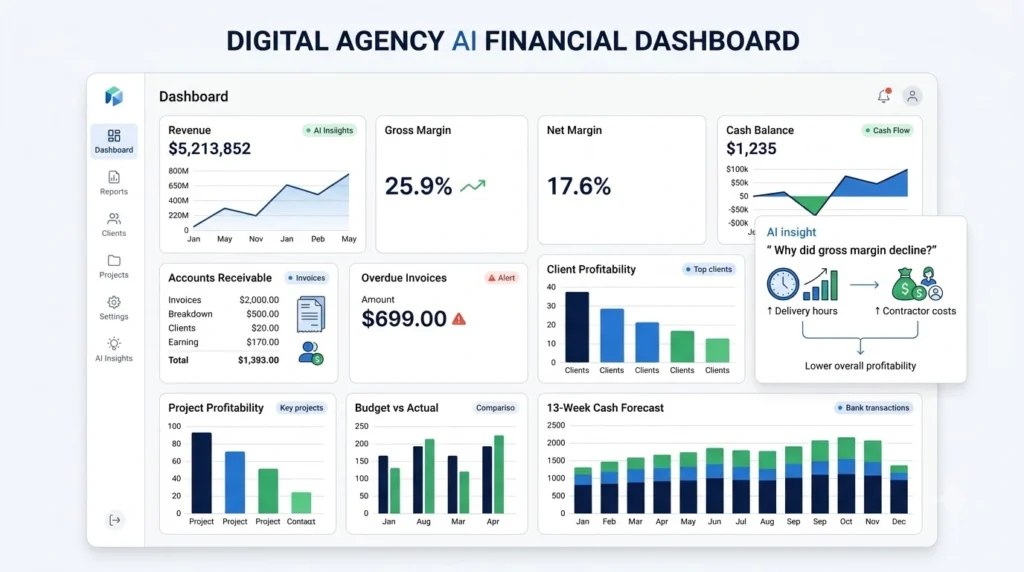
- Automated metric syncing — connecting QuickBooks, Xero, Stripe, banks, payroll, CRM, project-management, and time-tracking tools so revenue, expenses, and cash balances refresh without manual export-and-copy work.
- Real-time financial visibility — a daily view of whether the agency can cover payroll, contractor payments, and upcoming supplier bills, rather than waiting for month-end.
- Rolling cash-flow forecasting — 13-week or 90-day projections built from historical transactions, open invoices, and planned bills, flagging the date cash might fall below a set threshold.
- Client and project profitability — combining billed revenue with contractor costs, tracked delivery hours, and software allocations to show which clients are actually profitable, not just which generate the most revenue.
- Budget-versus-actual analysis — flagging overspending on contractors, paid media, or software before it shows up as a surprise at month-end.
- AI-generated explanations — asking “why did gross margin decline this month” and getting an answer tied to the underlying transactions, not just a chart.
- Anomaly detection and alerts — a retainer’s hours exceeding its delivery budget, or a client invoice going overdue, surfaced through Slack, Teams, or email instead of discovered during reconciliation.
- Automated reporting packs — weekly cash reports, monthly management accounts, and client profitability reports generated with agency branding rather than rebuilt by hand each cycle.
A representative example of how this plays out: a UK performance agency connects Xero, Harvest, and Stripe to its CRM. The dashboard flags that a large retainer is only 42% profitable once delivery hours and contractor costs are factored in — and an AI-generated explanation attributes the gap to unbilled revisions and excess paid-media management time. The agency can then reprice the retainer, tighten scope, or reallocate delivery resources, instead of discovering the problem at year-end.
Comparing the Top Tools
| Tool | Best Fit | Strengths | Watch Out For |
|---|---|---|---|
| Databox | Agencies wanting KPI dashboards plus AI analysis | Real-time dashboards, automated reports, Genie AI Analyst for plain-language queries | Stronger for cross-functional KPI reporting than formal bookkeeping or accounting controls |
| AgencyAnalytics | Marketing and SEO agencies producing client-facing reports | Agency-branded reports, campaign integrations, AI widgets and Ask AI | Primarily marketing-performance reporting — still need QuickBooks, Xero, or Float for real cash-flow forecasting |
| Float | Agencies that need cash-flow planning specifically | Connects to Xero and QuickBooks, rolling forecasts, budget-vs-actual, scenario planning | Built for financial planning, not client-facing marketing dashboards |
| QuickBooks / Xero | The accounting foundation underneath everything else | Core accounting, invoicing, bank-linked data, AI-assisted forecasting on eligible plans | Usually needs an add-on or integration for project profitability and white-labeled client reporting |
One name worth flagging as no longer an option: Finmark, the FP&A tool BILL acquired in 2022, was sunset as a standalone product on April 1, 2026 — the site now redirects to BILL’s own Cash Flow Forecasting product. If you see it recommended elsewhere, that recommendation is out of date.
Beyond this core four, worth knowing about depending on your specific need: Looker Studio, Supermetrics, or Klipfolio for data visualization; Causal, Jirav, or Fathom for FP&A and management accounts; and Syft for accountant-facing reporting.
Building Your Stack by Agency Type
- Small agency: QuickBooks or Xero plus a lightweight dashboard — you likely don’t need a dedicated forecasting tool yet.
- Marketing-reporting agency: AgencyAnalytics or Databox for client-facing dashboards, paired with an accounting platform for the numbers underneath.
- Growing agency with cash volatility: QuickBooks or Xero plus Float, once cash timing — not just cash amount — becomes the thing keeping you up at night.
- Multi-entity or finance-mature agency: A full accounting platform plus dedicated FP&A software, a formal month-end close process, and role-based reporting access.
The pattern worth internalizing: the strongest setup is rarely one “AI finance dashboard” doing everything. It’s usually an accounting system as the source of truth, a forecasting layer for planning, and a dashboard for stakeholder communication — three different jobs, not one tool wearing three hats.
What to Track First: 5 Steps
- Connect your accounting platform and bank feeds before anything else — every other metric depends on this data being current and accurate.
- Add time-tracking and project data next, so you can calculate real project and client profitability instead of just top-line revenue.
- Set up cash-flow forecasting once your books are reconciled, not before — a forecast built on messy data will confidently give you the wrong number.
- Define client profitability before building alerts. You need a consistent client and project ID, mapped revenue and direct costs, before margin alerts mean anything.
- Add anomaly alerts last, once you know what “normal” looks like for your agency — an alert threshold set too early just generates noise.
Common Mistakes Agencies Make
- Treating revenue as the profitability signal. A high-revenue client with excessive delivery hours or scope creep can be your least profitable account — track contribution margin, not just billings.
- Building a client-facing dashboard before internal reporting is solid. Impressive external reports don’t fix messy internal numbers underneath them.
- Skipping the accounting foundation. A dashboard layered on inconsistent bookkeeping just makes bad numbers look more confident.
- Recommending or relying on discontinued tools. Check that any tool in your stack — or in an article you’re reading — is still actively supported before you build a workflow around it.
also checkout – AI Financial Tools: A Data Privacy and Security Guide for 2026
FAQs
How can a digital agency automate financial reporting with AI dashboards? Connect your accounting, invoicing, banking, payroll, time-tracking, and CRM systems first, standardize your metric definitions, then let the dashboard handle calculations, alerts, and forecasts automatically instead of rebuilding reports by hand each month.
What should an AI financial dashboard for a digital agency actually track? Revenue, gross and net margin, cash balance, accounts receivable and payable, overdue invoices, utilization, project and client profitability, contractor costs, and budget variance — the combination that shows not just what came in, but what it cost to deliver.
What’s the best financial reporting software for a digital agency? There’s no single winner — QuickBooks or Xero is usually the accounting foundation, Float is stronger for cash-flow planning specifically, and Databox or AgencyAnalytics are better suited to dashboarding and client-facing reporting. The right pick depends on whether your main gap is bookkeeping, forecasting, or client communication.
Are AI-generated financial reports accurate enough to make decisions on? For operational decisions, yes, as long as the underlying data is reconciled and your metric definitions are consistent. They shouldn’t replace accountant review for tax filings, statutory accounts, payroll, or other regulated reporting.