
Best AI Cold Email Tools for Agencies in 2026
Best AI Cold Email Tools for Agencies in 2026. The best AI cold email tools for agencies in 2026 are Instantly and Smartlead for unlimited-inbox, flat-fee scaling across clients, Lemlist for creative multichannel personalization, and Apollo.io if you want a contact database bundled with sending. Whichever you pick, budget past the advertised seat price — every platform here layers real costs on top of the number on the pricing page, whether that’s lead credits, a metered warmup network, or Apollo’s two-pool credit system.
Table of Contents
Why Cold Email Still Works, Just Not the Old Way
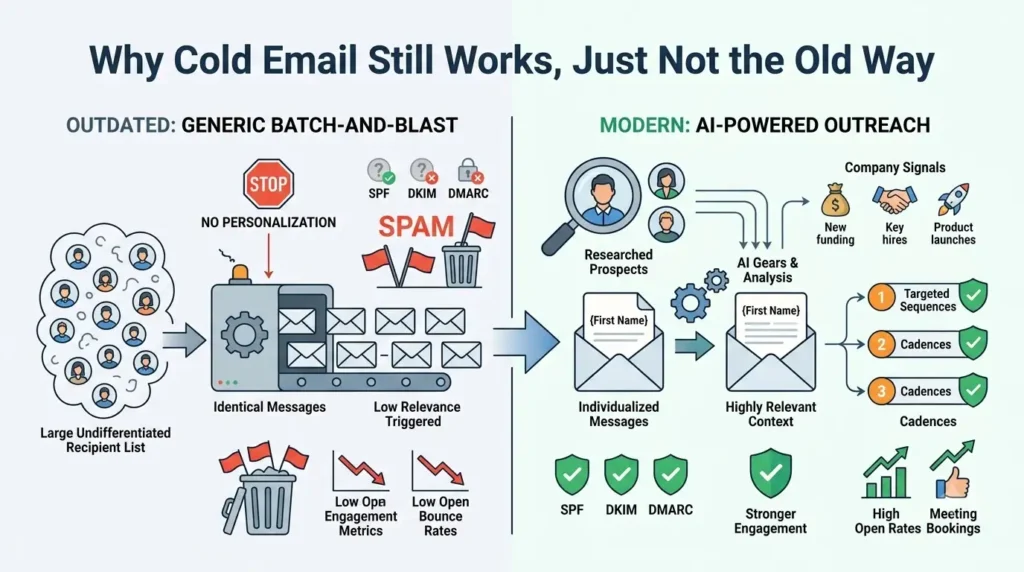
Generic batch-and-blast campaigns are functionally dead — reply rates on templated sends have collapsed into the low single digits, while AI-personalized, signal-based outreach (real company news, tech stack, hiring activity, not just a first-name merge tag) routinely lands in the high single digits to high teens, and stronger, human-reviewed campaigns can push past that. Treat any specific percentage you see quoted in this space, including the ones above, as directional — the agencies citing them are almost always also selling the tool that produced them.Best AI Cold Email Tools for Agencies in 2026.
Deliverability rules are the bigger structural shift. Google, Yahoo, and Microsoft now enforce SPF/DKIM/DMARC authentication, one-click unsubscribe, and a spam-complaint ceiling around 0.3% (with 0.1% as the safer practical target) before mail even reaches an inbox — non-compliant senders increasingly get hard-rejected, not just spam-foldered. That’s why domain rotation, mailbox warmup, and AI-generated subject-line variants have gone from optional to close to mandatory for any agency sending real volume.
What These Tools Actually Automate
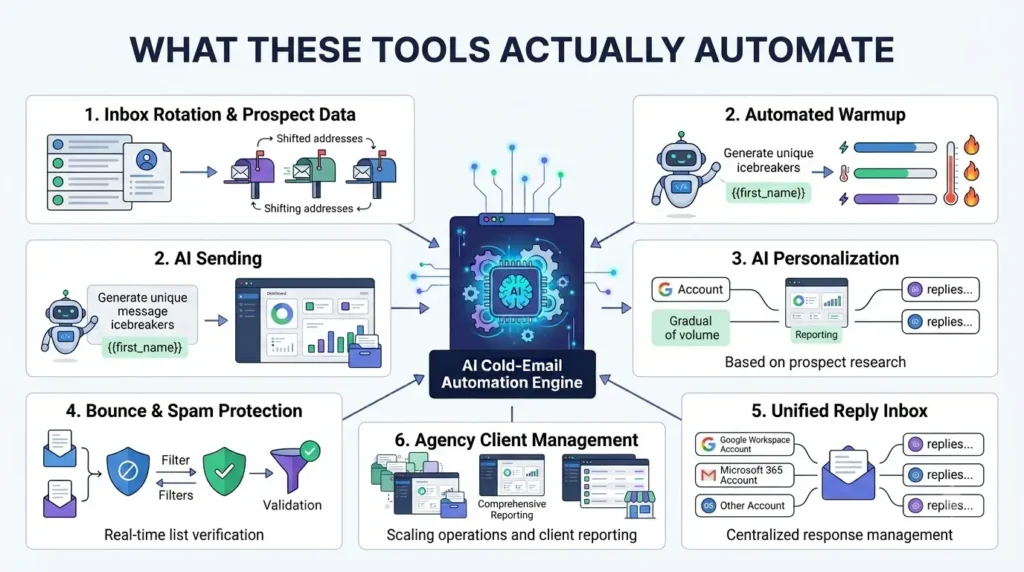
- Inbox rotation across dozens or hundreds of mailboxes, spreading volume so one throttled domain doesn’t take a whole campaign down with it.
- Automated warmup networks that simulate real conversations to build sender reputation before a domain goes live.
- AI-written first lines and subject/body variants pulled from real signals — funding, hiring, tech stack — rather than generic templates.
- Bounce and spam protection: verification, suppression lists, and throttling that scales back automatically when reputation signals dip.
- A unified reply inbox with AI sentiment tagging (interested, not now, out of office) so account managers can triage across every client from one screen.
- Agency features: white-label client portals, automated DNS setup, and per-client reporting dashboards — though these vary a lot by platform.
The Real Cost Behind Each Platform
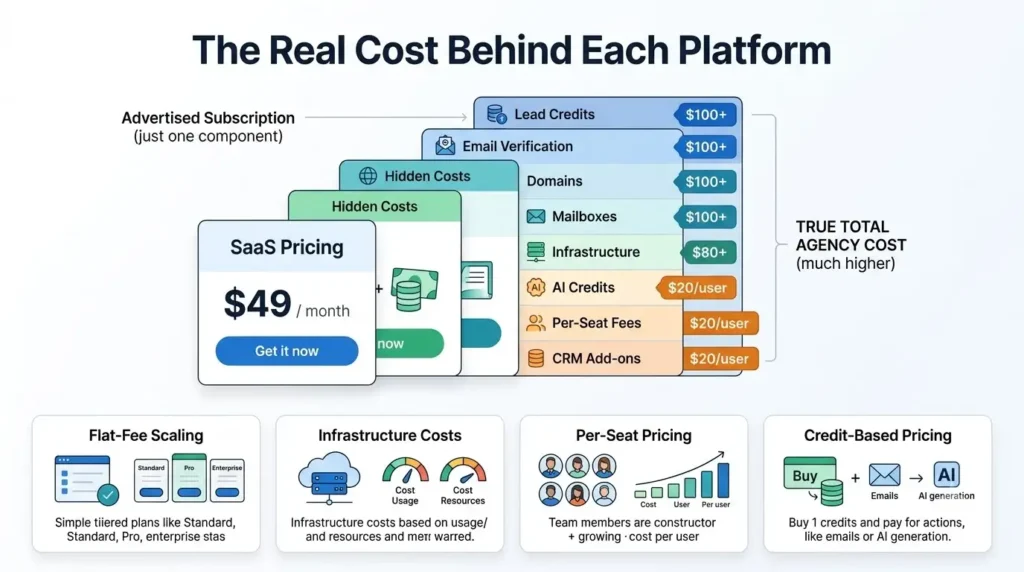
Instantly and Smartlead both advertise unlimited mailboxes on a flat monthly fee, which is genuinely attractive for an agency running many client domains. The catch: Instantly’s lead database and CRM features bill as separate add-ons beyond the base sending plan, and Smartlead’s real infrastructure cost — mailboxes, domains, verification — commonly runs three to five times the plan price once you’re sending serious volume.
Lemlist raised its list prices 10–14% over the past year; new customers now start around $63–87/seat/month rather than the older sub-$60 figures still floating around in older comparisons. Its AI assistant (Aimee) and image/video personalization are genuinely strong, but per-seat pricing multiplies fast for a multi-client agency team.
Apollo.io looks like the simplest pricing on paper — Free, then roughly $49 (Basic), $79 (Professional), $119/user/month (Organization) on annual billing. In practice it’s the most complex of the four: Apollo runs two separate credit pools, one for phone/mobile data reveals and one for email reveals and exports, and nearly every independent breakdown of Apollo’s 2026 pricing reports real-world costs landing at two to five times the advertised seat price once a team’s actual usage hits those credit limits. A five-person team on Professional has been reported spending $600–800/month against an advertised $395 — worth modeling your own reveal and export volume before you commit to a plan.
2026 Pricing at a Glance
| Tool | Best For | Advertised Starting Price | The Real Driver |
|---|---|---|---|
| Instantly.ai | Agencies wanting flat-fee, unlimited-inbox scaling | ~$37–47/mo (Growth) | Lead database and CRM are separately billed add-ons |
| Smartlead | Agencies needing unlimited inboxes plus white-label client portals | ~$32.50–39/mo (Basic) | Real infrastructure cost often runs 3–5x the plan price at volume |
| Lemlist | Creative, multichannel personalization (email, LinkedIn, video) | ~$63–87/seat/mo (up 10–14% from 2025) | Per-seat pricing multiplies fast across a multi-client team |
| Apollo.io | Teams wanting a contact database bundled with sending | Free–$119/user/mo | Two-pool credit system (mobile + data) commonly pushes real cost 2–5x the sticker price |
Building a Deliverability-Safe Outreach Motion
- Authenticate every sending domain with SPF, DKIM, and DMARC before your first send — not after deliverability drops.
- Run new domains through a warmup pool for at least two to three weeks before pointing real campaign volume at them.
- Keep spam complaints under 0.1%, well below the 0.3% danger zone, by watching the metric weekly, not just after a campaign underperforms.
- Write one real, source-backed personalization point per prospect — funding news, a job change, a specific pain point — rather than relying on a first-name merge tag.
- Rotate across multiple authenticated domains once volume grows, so one throttled or blocklisted domain doesn’t take your whole pipeline down.
- Model your actual credit or infrastructure usage against the plan you’re pricing, especially on Apollo or Smartlead, before annual billing locks you in.
Matching the Tool to Your Agency
- Running many client domains on a tight budget — Instantly or Smartlead’s flat-fee, unlimited-mailbox model wins; just price the add-ons before you commit.
- Outreach depends on real creative personalization or multiple channels — Lemlist earns its higher per-seat cost here.
- Want prospecting data and sending in one platform — Apollo.io works, provided you model credit consumption realistically rather than budgeting off the seat price alone.
- Managing 10+ client accounts and need white-label reporting — Smartlead’s agency-first portals are the clearest differentiator at this price point.
The Short Version
Cold email isn’t dead, but the generic version of it is. Win with real personalization and strict deliverability hygiene, and price every platform by its real cost — credits, add-ons, infrastructure — not the number on the homepage.
also checkout – Best AI Email Marketing Tools for B2B in 2026: Cold Outreach vs. Lifecycle Email
FAQs
What’s the best AI cold email tool for agencies in 2026?
It depends on the job: Instantly or Smartlead for flat-fee scaling across many client domains, Lemlist for creative multichannel personalization, and Apollo.io when you need a contact database bundled with sending.
How do I fix cold email deliverability in 2026?
Authenticate with SPF, DKIM, and DMARC, enable one-click unsubscribe, keep spam complaints under 0.1%, warm up every new domain before real volume, and rotate sending across multiple authenticated domains.
Do AI-personalized cold emails actually get more replies?
Directionally, yes — signal-based personalization consistently outperforms generic templates in every industry report on this. Treat the specific percentages you see quoted as directional rather than exact, since most come from vendors selling the personalization tool.
How many email accounts does an agency need for cold outreach?
Enough to distribute volume across multiple authenticated domains so one throttled domain doesn’t take the whole campaign down — most platforms here support unlimited or near-unlimited mailbox rotation for exactly this reason.