
AI Meeting Assistants: The 2026 Guide
AI Meeting Assistants: The 2026 Guide. AI meeting assistants now transcribe calls, summarize decisions, and push action items straight into Slack or your CRM — cutting the manual note-taking that eats into focus and billable time. Before you pick one, know this: Otter.ai and Fireflies.ai are both facing active federal class-action lawsuits over recording non-users without consent, and legal analysis is clear that the business enabling the bot can share the exposure — not just the vendor.
Table of Contents
The Consent Question Changes How You Should Deploy These Tools
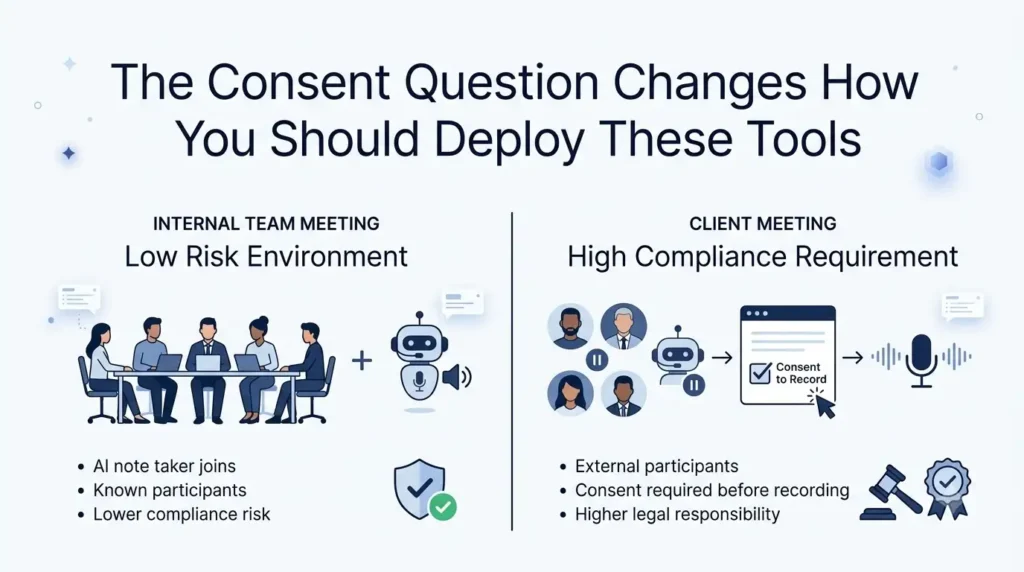
This needs to come before the feature comparison, because it affects which tool is actually the right choice for a client-facing agency, not just which one has the best summaries.
Since late 2025, both Otter.ai and Fireflies.ai have faced multiple federal lawsuits, now largely consolidated, alleging their AI bots join meetings and record participants — including people who never signed up for the service and never consented — in violation of wiretap laws (the federal ECPA, California’s CIPA) and, in Fireflies’ case, Illinois’ Biometric Information Privacy Act (BIPA). The BIPA claim is the sharper one: Fireflies’ speaker-recognition feature generates a “voiceprint,” which Illinois law treats as a biometric identifier requiring written consent and a public retention policy before it’s collected — and the plaintiff in the lead case never had a Fireflies account at all. She was simply a participant in a meeting where someone else had turned the bot on.
That last detail is the part every agency owner needs to sit with: the liability risk in these cases attaches to whoever enabled the recording, not just to the vendor. Legal commentary on this litigation has been explicit that a host — an employer, an agency, a partner organization — who configures an AI notetaker to auto-join is the one who “brought biometric collection into the room.” Damages under these statutes don’t require proving actual harm and stack per person, per violation: BIPA alone runs $1,000 for a negligent violation and $5,000 for an intentional one, which adds up fast across a client roster. This litigation is active, not settled — there was a hearing in the consolidated Otter case in May 2026 — so the compliance picture here is still moving.
What this means practically: if you’re recording internal team meetings where everyone already knows the tool is in use, the risk is lower. If you’re recording client calls, prospect calls, or any meeting with external participants who haven’t explicitly agreed to AI recording and voice analysis, get clear, documented consent before the bot joins — a verbal disclosure at the start of the call isn’t the same as documented consent, and several of the states involved in this litigation (Illinois, California) require the stronger standard. Bot-less tools that capture audio locally rather than joining as a visible participant reduce some friction but don’t eliminate the underlying consent question — the legal issue is about recording and biometric processing, not really about whether a bot icon shows up on screen.AI Meeting Assistants: The 2026 Guide
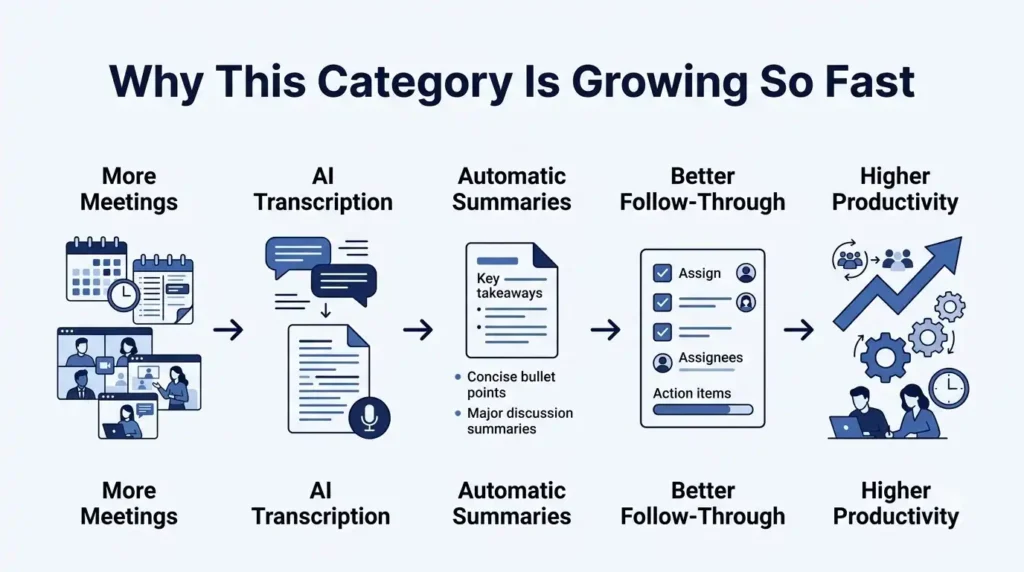
Why This Category Is Growing So Fast
Grand View Research puts the global AI meeting assistant market at $3.47 billion in 2025, projected to reach $21.48 billion by 2033 at a 25.8% CAGR — a genuinely fast-growing category, though it’s worth knowing that other research firms scope this market differently and land anywhere from roughly $1.2 billion to $3.5 billion for the same year, so treat any single precise figure as one estimate among several rather than a settled number.
The demand driver is simple: meeting load has gone up, and remote and hybrid teams are absorbing a lot of it in back-to-back calls with no time built in for notes. The realistic value proposition isn’t a specific number of hours saved — vendor claims here vary widely and should be tested against your own team’s actual meeting load — but the directional benefit is well-supported: less time spent writing recaps after a call, and more consistent follow-through on decisions and action items that would otherwise live only in someone’s memory.
What These Tools Actually Do
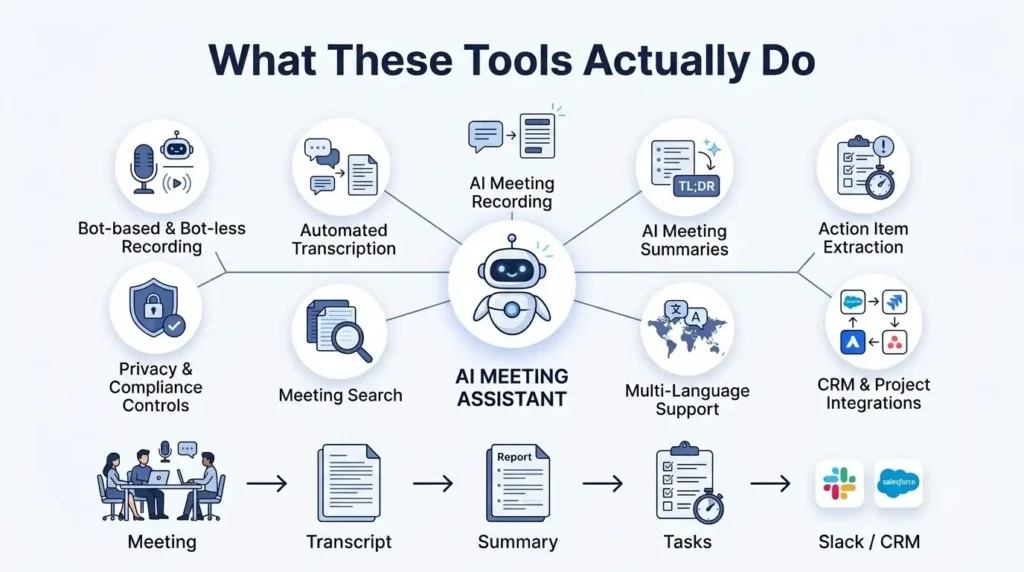
- Bot-based or bot-less recording — some tools (Fireflies, Otter, Read.ai) join as a visible meeting participant; others (Granola, Fellow) capture system audio locally without a visible bot, which reduces friction in client-facing calls but doesn’t remove the underlying consent obligation discussed above.
- Automated transcription and summaries — real-time or post-meeting transcripts with AI-generated recaps, cutting the time spent writing up notes after every call.
- Action-item extraction — automatically identifying decisions, owners, and deadlines, and pushing them into Slack, Asana, Jira, or a CRM instead of leaving them buried in a transcript nobody rereads.
- Multi-language support — live captions and translation, useful for agencies running calls across US, UK, and international clients.
- Sentiment and engagement analytics — tools like Read.ai score talk-time balance and engagement, useful for coaching but worth being transparent with your team about if you’re tracking it.
- CRM and PM integrations — native sync with Salesforce, HubSpot, Slack, and project tools, or broader connectivity through Zapier or Make.
- Searchable meeting archives — asking a cross-meeting question like “what did the client say about the Q3 budget” instead of re-watching a recording.
- Privacy and compliance controls — consent disclosures, retention windows, encryption, and summary-only modes that discard the raw recording — worth prioritizing given everything above.
Comparing the Top Tools
| Tool | Best For | Free Tier | Paid From | Consent Risk Profile |
|---|---|---|---|---|
| Fathom | Individuals and Zoom-heavy teams wanting a generous free option | Unlimited recordings and transcripts | $15–20/user/mo (teams) | Bot-based — apply the same consent practices as any recording tool |
| Fireflies.ai | Sales teams needing deep CRM automation | Limited (400 min storage, 20 AI credits) | $10/user/mo | Bot-based with voice-recognition/speaker ID — currently facing active BIPA litigation; review its consent and retention settings closely |
| Otter.ai | Real-time collaboration and live captions | 300 min/mo, 30 min/conversation cap | $8.33–16.99/user/mo | Bot-based — currently facing consolidated federal privacy litigation over non-user recording; has a bot-less desktop option worth evaluating |
| Read.ai | Managers tracking meeting quality and engagement | 5 meetings/mo, limited features | $15–19.75/user/mo | Bot-based, adds engagement/sentiment tracking — get explicit consent given the additional analytics layer |
| tl;dv | Teams wanting unlimited free transcripts | Unlimited transcripts | GDPR/SOC2-oriented paid tiers | Bot-based; markets compliance features directly |
| Granola / Fellow | Client-facing teams wanting lower call friction | Varies by product | Varies by product | Bot-less, local capture — reduces the “visible bot” friction, though the underlying recording-consent question still applies |
How to Use These Tools Without the Legal Exposure
- Get documented consent before you record external participants, not just internal team meetings — a verbal mention at the top of the call isn’t the same as documented, opt-in consent in states with stronger requirements.
- Check your state’s consent rules specifically. Illinois and California are the two most active right now given BIPA and CIPA, but don’t assume other states are risk-free — this area is expanding.
- Review each vendor’s retention and biometric-processing policy before rolling a tool out agency-wide — specifically whether speaker-recognition features generate and store voiceprints, and for how long.
- Default to disclosure, even for bot-less tools. The legal question is about recording and data processing, not whether a bot icon is visible — don’t treat local capture as a compliance shortcut.
- Put your consent process in writing as part of your client onboarding, so it’s consistent across every account manager rather than left to individual judgment call by call.
Common Mistakes Agencies Make
- Assuming a bot-less tool solves the consent problem. It reduces friction, not the underlying legal question — get consent regardless of whether the recording tool is visible on the call.
- Treating a verbal mention as sufficient consent. In states with stronger requirements, documented opt-in consent is a meaningfully different standard.
- Not knowing what a vendor’s speaker-recognition feature actually does. If it’s generating a “voiceprint” to identify speakers, that’s biometric processing under some state laws — know this before you turn the feature on for client calls.
- Assuming this only exposes the vendor. Current litigation and legal commentary both point toward liability reaching the organization that enabled the tool — this is your risk to manage, not something you can fully outsource to the software provider.
also checkout – best AI Recruiting and Contractor Management Software for Remote Teams (2026)
FAQs
Are AI meeting notes legal to record without consent? It depends on the state and who’s participating. Some states allow one-party consent (only one person on the call needs to know it’s recorded), while others, including California and Illinois, require all-party consent — and Illinois separately regulates the “voiceprints” some tools generate to identify speakers. Get documented consent from external participants regardless of which state you’re in.
Is Otter.ai or Fireflies.ai currently facing lawsuits? Yes. Both are facing active federal litigation as of 2026 — Otter.ai faces a consolidated class action alleging it records meeting participants without consent, and Fireflies.ai faces a related case specifically under Illinois’ Biometric Information Privacy Act for generating voiceprints without consent. Both cases are ongoing, not resolved.
Which AI meeting assistant is best for a small agency? It depends on priorities: Fathom has the most generous free tier for individuals, Fireflies suits sales teams needing deep CRM automation, Otter is strong for real-time collaboration, and bot-less tools like Granola or Fellow reduce friction on client calls. Given the active litigation discussed above, weigh each vendor’s consent and retention practices as seriously as its feature set.
Can AI meeting transcripts be used as evidence in legal disputes? Potentially, yes — a timestamped, stored transcript can qualify as electronically stored information (ESI) subject to discovery in litigation. That’s a reason to have a clear, consistent policy on what gets recorded, retained, and for how long, rather than an ad hoc approach that varies by team or account manager.