
Best AI Voice Agents for Sales Teams in 2026: Pricing, Compliance, and What Actually Works
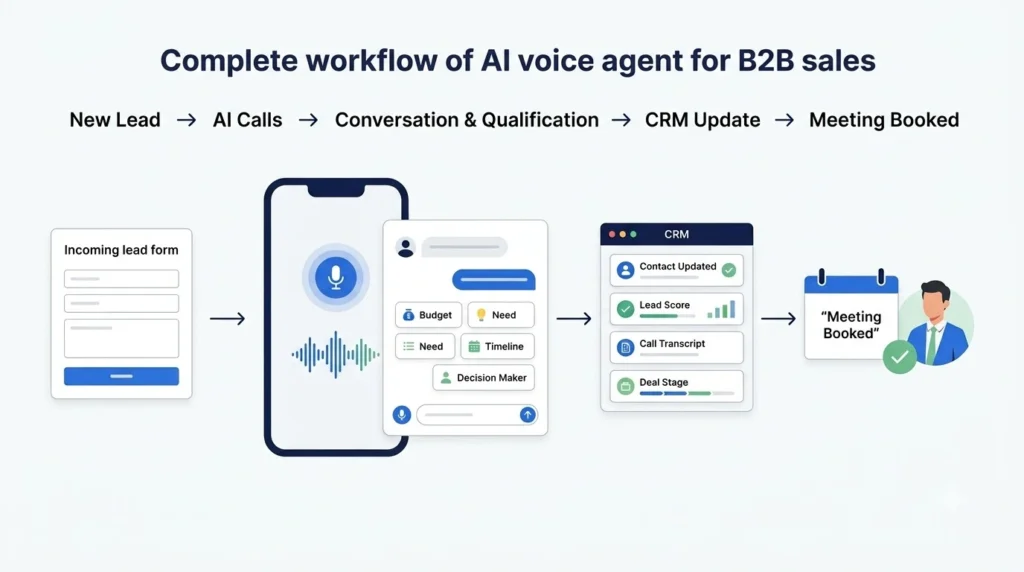
Best AI Voice Agents for Sales Teams in 2026: Pricing, Compliance, and What Actually Works. AI voice agents for sales use real-time speech AI to make and answer calls — qualifying inbound leads within a minute of form fill, running outbound campaigns at a fraction of human SDR cost, and logging every conversation straight into your CRM. The right platform depends far more on your use case and your TCPA compliance setup than on feature lists alone, since a non-compliant AI calling campaign can carry federal penalties running into the millions.
Table of Contents
Why AI Voice Agents Are Suddenly Everywhere in B2B Sales
Investment in voice AI climbed sharply between 2022 and 2024, and the technology finally crossed a real threshold: response latency dropped under the 250–400ms range where most people stop consciously noticing a delay, and cost per conversation fell well below what a human rep costs to run the same call, according to Darwin AI‘s look at the shift. Laxis puts the adoption curve at roughly 75% of B2B sales organizations expected to run some form of AI-driven sales development by the end of 2026, with about half of enterprises already live in production rather than still piloting.
The vendor-reported performance numbers are eye-catching — platforms in this category claim an AI agent can work through 1,000+ contacts a day against 50–80 for a human rep, and book several times more meetings per day in the process. Worth reading those figures the way you’d read any vendor’s own math: directionally believable, but built on that vendor’s assumptions about list quality and script performance, not a guarantee for your list. The more useful number buried in the same research is the honest one: human reps still convert a booked meeting into a real opportunity at a noticeably higher rate than AI-originated meetings do. Volume and conversion are different jobs, and the platforms in this category are much better at the first one. Best AI Voice Agents for Sales Teams in 2026: Pricing, Compliance, and What Actually Works
The Part Most “Best AI Voice Agent” Articles Skip: TCPA Compliance
This is the section to read before you get excited about any vendor’s demo, because it changes which use case is even worth pursuing.
Since a February 2024 FCC ruling, calls made with an AI-generated voice are legally treated as an “artificial or prerecorded voice” call — the exact same category as a traditional robocall — regardless of how natural the voice sounds or how conversational the AI is, per the FCC’s own ruling. That single classification carries real weight: outbound marketing calls to a cell phone generally require prior express written consent before you dial, not just an existing business relationship or an implied opt-in.
The financial exposure is not theoretical. TCPA violations carry statutory penalties of $500 to $1,500 per call with no overall cap — which means a single non-compliant 10,000-call campaign carries potential exposure in the millions of dollars, and the burden of proving valid consent sits with the calling business, not with whichever AI voice vendor you bought the software from. A federal appeals court did vacate a stricter “one-to-one consent” rule in early 2025, so bundled lead-generation consent is workable again at the federal level — but several states, including Colorado’s newer AI-specific rules, layer additional obligations on top, so a federally-compliant campaign isn’t automatically compliant everywhere you might dial.
None of this means AI voice calling is off-limits — inbound speed-to-lead (calling someone who just filled out your own form) and reactivating your own dormant database sit on much firmer consent ground than cold outbound to numbers you don’t have a relationship with. It does mean:
- Get real legal review of your specific list and consent chain before you scale volume, not after your first complaint.
- Don’t take a vendor’s “TCPA-compliant” marketing claim at face value — the consent obligation is yours, and you should be able to explain exactly where your list’s consent came from.
- Check state-specific rules if you’re calling across state lines, since several states now go further than the federal baseline.
What These Platforms Actually Do
Once you’re clear on where you can legally point this technology, the feature set across most platforms in the category looks similar:
- Low-latency, natural turn-taking. The best platforms hold first-response latency under 800ms, which is roughly the line where callers stop noticing they’re mid-conversation with software instead of a person.
- Objection handling with real memory. Better agents track what was said earlier in a 10–40 minute call and reference it later, rather than restarting context every turn.
- Two-way CRM sync. This is the feature most comparison articles undersell and most failed deployments skip — an agent that can’t write contacts, deal stages, and call transcripts back into your CRM in real time quietly stops getting used within a few weeks.
- Sentiment-aware tone shifts. More advanced NLP reads pitch and pacing to catch frustration and adjusts the agent’s approach mid-call.
- Batch and concurrent calling. Serious outbound use cases need real concurrency — dozens to low hundreds of simultaneous calls, not one call at a time.
- Multi-language support. Several platforms now cover 30+ languages, useful for global teams that would otherwise need to hire regionally.
The clearest use cases where this genuinely solves a problem rather than adding a gimmick: inbound speed-to-lead (calling a fresh form-fill within 30–60 seconds meaningfully lifts show rates), your own dormant-database reactivation (cheap to run, and the consent question is easier since these are past leads), meeting-confirmation calls that cut no-shows, and after-hours lead capture for anything that comes in outside business hours. Best AI Voice Agents for Sales Teams in 2026: Pricing, Compliance, and What Actually Works
The Real 2026 Comparison — Read the Fine Print, Not Just the Headline Rate
One thing worth knowing before you trust any “best AI voice agent” ranking, including parts of this one: several of the platforms below publish their own comparison content rating themselves against competitors, and it’s common practice across this category, not unique to any single vendor. Cross-check specific claims against G2, Trustpilot, and more than one source before you commit budget.
| Platform | Best Fit | Real 2026 Pricing | Independently-Reported Latency | Honest Caveat |
|---|---|---|---|---|
| Retell AI | Teams that want a fast, managed setup for inbound or outbound without heavy engineering lift | $0.07–$0.18/min pay-as-you-go, $10 free credit, custom enterprise tiers | ~600ms in independent benchmarks — consistently the fastest of the mainstream platforms | Deepest CRM integrations of the group, but its own blog is also the most-cited source in this category’s comparison content — read its self-comparisons with that in mind |
| Vapi | Engineering-led teams that want full control over the model, voice, and telephony stack | ~$0.05/min platform fee plus separate LLM, voice, and telephony costs — realistically $0.25–$0.33/min all-in | ~700–800ms | Maximum flexibility, but you’re stitching together and maintaining several vendor relationships yourself, and a HIPAA add-on costs extra |
| Bland AI | High-volume outbound campaigns where a predictable per-minute rate matters more than polish | Roughly $0.07–$0.25/min depending on plan and bundling | ~800–900ms, with some independent reports of latency drift under heavy load | Strong for deterministic, scripted outbound flows (Pathways); self-serve support gets mixed reviews in recent G2 and Trustpilot feedback |
| Synthflow AI | Non-technical teams and agencies that want a working agent without a developer | Subscription tiers roughly $450–$1,400/month for 2,000–6,000 minutes, or metered around $0.13–$0.20/min | ~1,000ms — the slowest of this group | Genuinely fast to set up (same-day is realistic), but struggles more than the code-first platforms once a prospect goes off-script |
| Regal | B2C sales in high-consideration verticals — insurance, lending, healthcare, real estate — at real volume | Custom/enterprise pricing, not publicly listed | Not independently benchmarked in this research | Backed by $40M+ from Emergence Capital and built specifically around compliance guardrails; worth a serious look if consent/TCPA tooling matters as much to you as the AI itself |
| Close (Chloe) | Small sales teams already on, or willing to move to, Close CRM | Close CRM from $9/seat/month; Chloe shipped to general availability in June 2026 and is included, not a separate line item | Not independently benchmarked in this research | Genuinely zero integration lag since it’s native to the CRM, but it only works inside Close, and it’s currently U.S./Canada calling only |
One name you’ll see everywhere in this category, and why it’s not on the list above: Air.ai markets itself as an enterprise voice AI platform with a $25,000–$100,000 upfront license. In August 2025, the FTC sued Air AI Technologies and its owners over deceptive earnings claims and refund guarantees made to small businesses; the case settled in March 2026 with the company and owners banned from marketing business opportunities and an $18 million judgment. The FTC’s own complaint described the software itself as unreliable, and independent review sites put its Trustpilot rating around 1.2–1.5 out of 5. If it comes up in your own research, treat the marketing claims with real skepticism and ask for a live, unscripted test call before any commitment — not just a recorded demo.
Step-by-Step: Rolling Out an AI Voice Agent Without Creating Legal or Brand Risk
- Confirm the consent status of your list before you dial anything. Know exactly where each contact’s consent came from and whether it covers AI-generated calls specifically.
- Start with the lowest-risk use case. Inbound speed-to-lead and your own dormant-database reactivation sit on firmer legal ground than cold outbound to consumer cell numbers.
- Require real two-way CRM write-back before you sign anything. This is the single biggest predictor of whether the deployment is still being used in three months.
- Test with your own script and your own objections, not the vendor’s demo. A polished canned demo tells you little about how the agent handles your actual prospects.
- Keep DNC and opt-out handling under your own control, even if a vendor claims to manage it — you carry the compliance burden either way.
- Prove the model on a small, well-consented segment before scaling volume. Concurrency and batch calling are easy to turn on; they’re expensive to turn off after a bad campaign.
- Put a legal/compliance check on the calendar before you scale, not after a complaint arrives. A short review up front is cheaper than any single TCPA claim.
Which Platform Fits Which Team
- Want the fastest path to a solid inbound or outbound agent without an engineering team — Retell AI’s managed setup and latency lead make it the least fussy starting point.
- Have engineers and want full control over every layer — Vapi’s model-agnostic stack rewards teams willing to own the integration work.
- Running genuinely high-volume outbound campaigns — Bland AI’s per-minute economics are hard to beat at scale, if you can live with a self-serve support experience.
- No developer on staff and need something live this week — Synthflow’s no-code builder gets a working agent up fastest, with a real accuracy trade-off on longer or off-script calls.
- Selling regulated, high-consideration products to consumers — Regal’s compliance-first design and funding make it worth a serious enterprise look.
- Small team already happy with Close CRM — Chloe removes the integration question entirely, at the cost of being locked into that CRM.
Bottom Line
The technology genuinely works for what it’s good at: fast inbound response, database reactivation, and high-volume outbound where a human team would burn out. Where teams get burned isn’t the AI — it’s skipping the consent and CRM-integration homework before scaling, or trusting a glossy demo from a vendor whose own regulatory record should have been the first thing chalsoecked. Do the compliance work first, pilot small, and pick the platform that matches your actual call volume and technical bandwidth rather than the one with the flashiest benchmark.
also checkout – great AI Personal Finance Management Tools: The 2026 Guide
FAQs
How many calls can an AI voice agent make per day?
Platform vendors advertise 1,000+ contacts per day per agent, based on concurrent-call capacity and average call length — for example, 20 concurrent lines at a 3-minute average call works out to roughly 9,600 calls in 24 hours in theory. Real-world throughput depends heavily on your list quality, calling-hour restrictions, and how many calls actually connect, so treat vendor capacity numbers as a ceiling, not a guarantee.
Are AI cold calls TCPA-compliant?
Compliance depends entirely on your consent chain and configuration, not on the platform you choose. Since the FCC’s February 2024 ruling, AI-generated voice calls are regulated exactly like traditional robocalls, and marketing calls generally need prior express written consent before you dial. No vendor’s compliance features remove your obligation to verify where that consent came from.
What does an AI voice agent actually cost per qualified lead?
Vendor-published math (built on their own pricing and assumed qualification rates) puts AI cost per qualified lead in the low single digits, well below typical human-SDR costs — but that figure is only as good as your actual connect and qualification rates, which vary a lot by list, script, and industry. Run your own numbers on a small pilot before trusting any published comparison.
Can AI voice agents handle complex, layered objections?
Reasonably well on 3–4 objections they’ve been trained on, much less reliably on stacked objections a real prospect throws out in one breath — “we already have a vendor, our contract runs six more months, and budget’s frozen anyway” is still a common failure point. Best practice across the category is to have the agent qualify and warm-transfer to a human once a call moves past initial screening.