
AI Agent Workflow Automation Platforms: The 2026 Guide
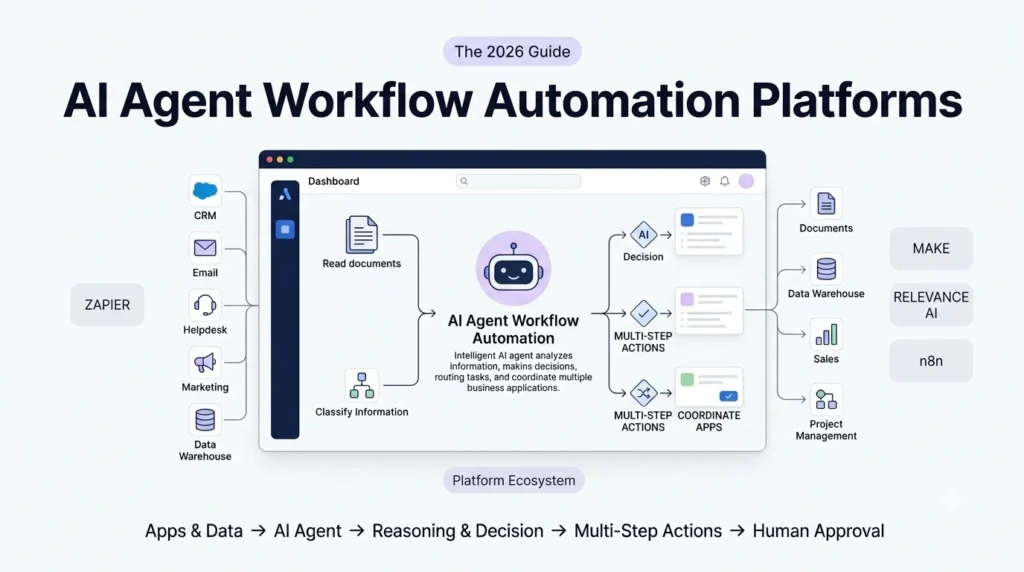
AI Agent Workflow Automation Platforms: The 2026 Guide. AI agent workflow automation platforms have moved past simple trigger-action “Zaps” into tools that can reason through multi-step tasks, read live documents, and make routing decisions — with a human approving the risky steps. Zapier remains the default for broad app coverage with agents layered on top, Make offers the most visual control over complex branching logic, Relevance AI is built agent-first specifically for GTM and RevOps teams, and n8n is the strongest choice for technical teams that want to self-host.
Table of Contents
What Changed: From Zaps to Agents
The old model was a linear pipeline: trigger happens, action runs, done. It broke the moment an edge case didn’t match the pattern — an email that didn’t fit the expected format, a lead that needed judgment instead of a rule. The 2026 shift is agents that reason through the exception instead of failing silently: reading a document, classifying what it actually contains, deciding on a next step, and looping in a human before anything consequential happens. That’s a meaningfully different build target than “connect app A to app B,” and it’s changed what buyers should actually be comparing these platforms on.
Why This Matters Right Now
Businesses are running more SaaS tools than ever, and every new tool is another integration to maintain by hand unless something automates it. That’s the practical pressure behind this whole category: as CRMs, helpdesks, ad platforms, and data warehouses multiply, the cost of manual integration work compounds, and it shows up first as the “why do I have three people copying data between systems” problem most growing teams eventually hit. AI agents are the response to a specific limitation of the old automation model — they handle the cases a rigid trigger-action flow couldn’t, using reasoning and conditional logic instead of a rule written for every possible scenario in advance. AI Agent Workflow Automation Platforms: The 2026 Guide
Comparing the Top Platforms
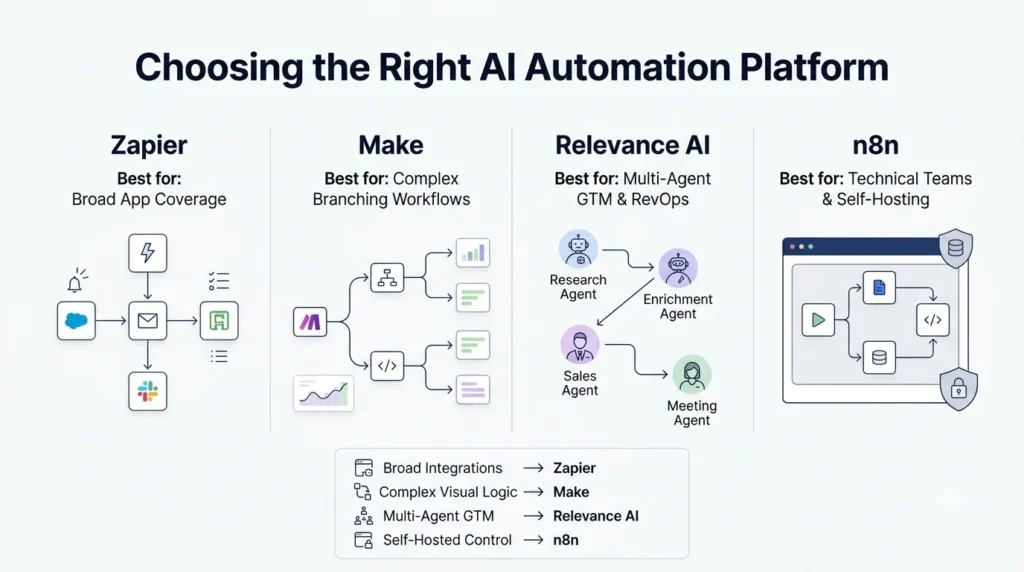
| Platform | Best For | Strengths | Watch Out For |
|---|---|---|---|
| Zapier | Broad app coverage with agents layered on top | 7,000+ integrations, Zapier Central/Agents can read connected docs and take multi-step action, strong admin governance | Higher cost at volume; agent features often carry separate billing from core automation |
| Make | Complex branching logic, visual control | Graph-based canvas handles multi-path routing natively; AI Agents and an MCP server for connecting AI tools | Credit-based pricing counts internal steps, not just the final action — model your actual workflow before comparing sticker price |
| Relevance AI | GTM and RevOps teams building multi-agent workflows | Purpose-built “AI workforce” model (cooperating narrow agents), SOC 2 Type II and GDPR-certified, 1,000+ integrations including Salesforce, HubSpot, Gong, Apollo | Steeper learning curve than a plug-and-play tool; Actions-plus-Vendor-Credits pricing needs a real pilot to forecast — overage bills can run well past the sticker price |
| n8n | Technical teams wanting self-hosted control | Free unlimited executions if self-hosted, native LangChain/AI Agent Tool Node, full data sovereignty | Smaller native integration library than Zapier or Make; self-hosting means owning your own infrastructure and security |
On Relevance AI specifically, since it’s the newest name here for most readers: it sits between a developer framework like n8n and a plug-and-play tool like Zapier — you’re building agents from components (Research and Enricher, Outbound Prospector, Meeting Scheduler are common starting templates) rather than getting a finished product on day one. That’s the right tradeoff for a RevOps team that wants to design its own multi-agent handoffs — marketing’s research agent passing structured data to sales’ outreach agent, for instance — but it’s the wrong tool if you want something producing results with nobody available to build and maintain it.
Choosing Based on What You’re Actually Building
- Start with the failure mode of your current process, not the platform’s feature list. A process that breaks on edge cases needs reasoning; a process that just needs data moved needs a simple trigger-action flow, and paying for an agent platform to do that job is overkill.
- If you’re mostly connecting existing SaaS tools, default to Zapier or Make — agent capability matters less than integration breadth and setup speed for this job.
- If you’re building a genuine multi-agent workflow — several specialized agents handing work to each other — Relevance AI is purpose-built for that in a way the others aren’t.
- If data sovereignty or self-hosting is a real requirement, n8n is the only platform here that lets you own the infrastructure without paying per execution.
- Pilot before you commit to a credit- or action-based pricing plan. Both Make and Relevance AI count usage in ways that don’t map cleanly onto a flat monthly number — run your actual workflow volume through the free tier before sizing a paid plan.
Common Mistakes Teams Make
- Buying an agent platform for a job that’s really just data movement. Reasoning capability you don’t need is cost and complexity without payoff.
- Sizing a plan off the sticker price instead of a usage pilot. Credit- and action-based pricing models can produce a monthly bill several times the advertised plan cost once real volume hits — this has burned teams on more than one platform in this category.
- Letting an agent take consequential action with no approval step. Reading a document and drafting a response is low-risk; sending it, updating a CRM record, or triggering a payment deserves a human in the loop, at least until the workflow has a track record.
- Assuming more integrations always wins. A platform with fewer, deeper integrations into your actual stack (Salesforce, HubSpot, Gong) can outperform one with a bigger catalog you’ll never touch.
also checkout – Best AI Voice Agents for Sales Teams in 2026: Pricing, Compliance, and What Actually Works
FAQs
What’s the difference between a workflow automation tool and an AI agent platform? A workflow automation tool executes fixed steps triggered by a specific event — if X happens, do Y. An AI agent platform adds reasoning: it can read a situation, decide on a response among several options, and take multi-step action, ideally with a human approving anything consequential before it executes.
Is Zapier or Relevance AI better for building AI agents? Zapier layers agent capability (Central/Agents) on top of its existing broad automation platform, which suits teams that want agents alongside conventional app-to-app automation. Relevance AI is built agent-first specifically for multi-agent GTM and RevOps workflows, which suits a team designing several specialized agents that hand off work to each other.
Is n8n cheaper than Zapier or Make for high-volume automation? It can be significantly cheaper if you self-host, since execution is free — but that shifts the cost to your own infrastructure and security work instead of a subscription. For teams without the technical capacity to manage that, n8n Cloud’s pricing is more comparable to the other platforms.
How do I avoid surprise bills on credit- or action-based automation pricing? Run your actual expected workflow volume through a free tier or short pilot before committing to a paid plan, and specifically track how many credits or actions a single real workflow run consumes — sticker prices on these platforms often don’t reflect what a production workload actually costs per month.