
AI Personal Finance Management Tools: The 2026 Guide
great AI Personal Finance Management Tools: The 2026 Guide. AI personal finance management tools in 2026 go well beyond categorizing expenses — the strongest ones forecast cash-flow gaps, catch subscription price hikes, and answer plain-English questions about your spending before you’d otherwise have to dig through a spreadsheet. There’s no single winner: Monarch suits households wanting one broad dashboard, Copilot is the polished pick for Apple users, YNAB fits anyone who wants a disciplined budgeting method, and Cleo works best as an approachable, conversational entry point.
Table of Contents
Why This Matters Right Now
AI has moved from a novelty feature to something most people have actually used for money management. Plaid’s State of Intelligent Finance report, run with The Harris Poll, found 55% of Americans and 54% of UK consumers used AI for a financial task in the past 12 months — and among those users, 86% said it helped them understand their finances better. Momentum is stronger in the US: 41% of Americans expect to increase their AI use for financial tasks over the next year, compared with 33% of UK consumers. The generational gap is wide in both markets — 77% of UK Gen Z and Millennials and 72% of their US counterparts had used AI for finance in the past year, well above the overall average.
One honest caveat worth keeping in mind: that 55%/54% figure covers a broad range of activity — asking an AI assistant a finance question, using an AI feature inside your existing banking app, getting an automated recommendation — not specifically the adoption rate of dedicated AI budgeting apps like the ones compared below. Treat it as evidence that AI-assisted money management has gone mainstream, not as a market-share number for any specific app category.
The financial pressure behind the demand is real and well-documented. The Federal Reserve’s 2025 household survey found 73% of US adults said they were doing okay financially or living comfortably, but only 63% could cover a hypothetical $400 emergency using cash or a credit card paid off at the next statement — and just 55% had savings sufficient to cover three months of expenses. That gap between “doing okay” and “actually prepared for a shock” is exactly the space these tools are trying to fill. great AI Personal Finance Management Tools: The 2026 Guide
What These Tools Actually Do
- Automated transaction categorization — machine-learning classification that improves as it learns from your corrections, replacing manual bookkeeping with a more accurate real-time view of spending.
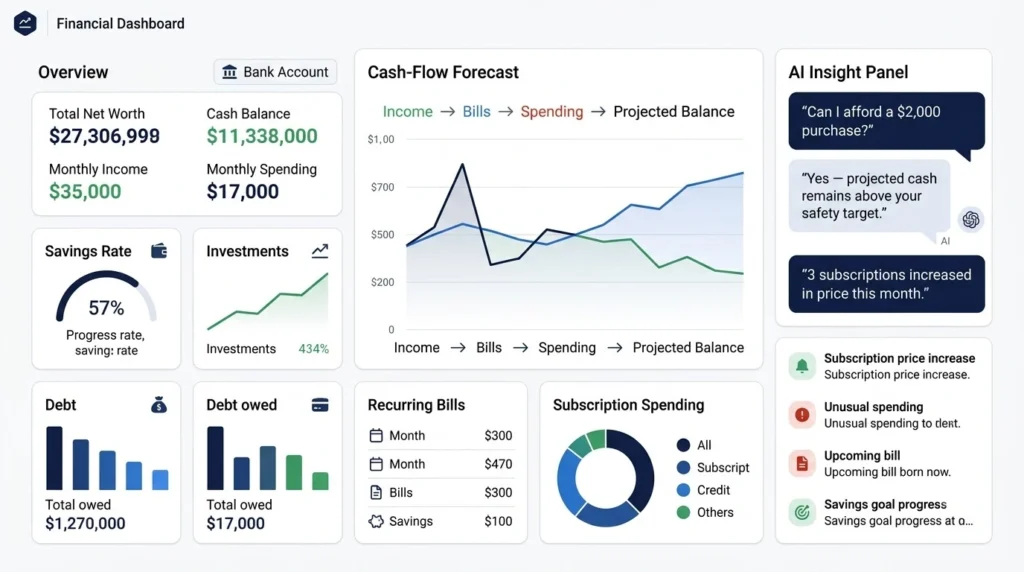
- Natural-language financial queries — asking “why did spending rise this month” or “can I afford a $2,000 purchase” and getting a plain-language answer instead of building a spreadsheet.
- Cash-flow forecasting — projecting future balances from income, bills, and recurring payments, which matters most for freelancers and small-business owners tracking tax reserves or payroll timing.
- Goal-based planning — modeling savings targets for an emergency fund, a home deposit, or debt payoff, with the better tools adjusting recommendations when real spending diverges from the plan.
- Subscription and bill monitoring — flagging recurring charges, price increases, and duplicate payments, especially useful for anyone running several software subscriptions.
- Investment and net-worth aggregation — consolidating bank, brokerage, retirement, and loan data into one dashboard for a full financial picture.
- Tax and expense preparation support — organizing receipts and flagging potentially deductible expenses for the self-employed, though this should be treated as preparation help, not a substitute for a qualified accountant.
Comparing the Top Apps
| App | Best For | Strengths | Watch Out For |
|---|---|---|---|
| Monarch Money | Broad household financial visibility | Automated categorization, net-worth tracking, goals, natural-language assistant | Paid, comprehensive product — may be more than you need for simple budgeting alone |
| Copilot Money | Apple users wanting fast, polished tracking | ML categorization, recurring-transaction detection, clean spending summaries | More platform-specific than web-first competitors; confirm bank connectivity for your country |
| YNAB | Disciplined, behavior-change budgeting | Zero-based budgeting method, goal tracking, spending alerts | More manual and method-driven than fully automated tools; lighter on investment aggregation |
| Cleo | Conversational, approachable coaching | Chat-based budgeting, savings prompts, beginner-friendly tone | Better fit for individual budgeting than complex household or small-business finance |
Independent 2026 app comparisons consistently place Monarch, Copilot, and YNAB among the leading budgeting and planning tools, with Cleo positioned more as a conversational assistant for younger or first-time budgeters. Beyond these four, worth knowing about depending on your need: Quicken Simplifi for traditional budgeting, Rocket Money for subscription management specifically, Wealthfront or Betterment for investment-focused accounts, and Tiller Money for a spreadsheet-based approach.
Before You Connect Your Bank Account
This deserves real attention, not a rushed checkbox during signup. The UK’s FCA expects firms using AI in financial services to apply existing obligations around fair value, clear communication, and accountability — the same standards that apply to any regulated financial product, whether or not the interface is a chatbot. Before connecting any account:
- Connect only what the tool actually needs — a subscription tracker doesn’t need access to your retirement account.
- Check the data-sharing and retention policy, specifically whether your data is sold or used to train models beyond your own account.
- Enable multi-factor authentication on both the finance app and the accounts it connects to.
- Confirm you can export and delete your data before you need to, not after.
- Know the boundary between education and advice. A tool that explains a concept is different from one making a personalized recommendation — the second may fall into regulated territory, and it’s worth knowing which one you’re actually using.
Building a Stack, Not Just Picking One App
For a small-business owner or anyone managing both personal and business money, the realistic answer usually isn’t “which single app wins” — it’s a stack: a business accounting platform as the system of record for books and tax filings, a personal-finance dashboard like the ones above for household visibility, and a regulated investment or advisory service for actual portfolio decisions. Trying to force one app to do all three jobs usually means it does none of them particularly well.
Common Mistakes People Make
- Letting AI move money without review. Categorization and forecasting are safe to automate; transfers, debt payments, and investment moves still deserve a human look before they execute.
- Connecting every account on day one. Start with what you’re actually trying to solve — spending visibility, subscription cleanup, debt payoff — and expand from there.
- Treating a budgeting app’s tax help as a substitute for an accountant. These tools organize and flag; they don’t replace a professional for anything beyond routine self-employed expense tracking.
- Mixing business and personal finances in one dashboard without separation. Even a great aggregation tool can’t fix messy books if personal and business spending were never separated in the first place.
also checkout – great AI Bookkeeping Software for Startups and Small Businesses: The 2026 Guide
FAQs
What are the best AI personal finance management tools in 2026? It depends on what you need: Monarch for broad household financial visibility, Copilot for polished automated tracking (especially on Apple devices), YNAB for a disciplined zero-based budgeting method, and Cleo for a conversational, beginner-friendly experience.
Can AI automatically manage my budget and savings? It can categorize transactions, forecast balances, suggest savings targets, and send alerts — but you should still approve any transfer or automated money movement yourself rather than letting the AI act unsupervised.
Is it safe to connect my bank account to an AI finance app? It depends on the provider’s security practices, data-sharing policy, and authentication options. Connect only the accounts necessary for what you’re trying to accomplish, enable multi-factor authentication, and check whether you can export or delete your data before you need to.
Can AI replace a financial adviser or accountant? Not for anything beyond routine tasks. AI is well-suited to automating categorization, forecasting, and reporting, but complex tax situations, investment decisions, and fiduciary matters still call for a regulated professional.