
Zapier vs. Make vs. AI Automation Platforms: Which One Should You Use in 2026?
When comparing Zapier vs Make vs AI Automation Platforms in 2026, Zapier is the better call for most small businesses…Zapier is the better call for most small businesses and agencies that want the widest app coverage and the fastest setup, while Make wins on complex, branching workflows at a lower cost once you’re past its steeper learning curve. If what you actually need is autonomous AI agents or enterprise-grade AI governance rather than app-to-app automation, newer platforms like n8n, Turbotic, and Airia are worth a look before you commit to either.
The choice between Zapier vs Make vs AI Automation Platforms depends on your automation goals. Zapier works best for simple business workflows, Make is better for advanced automation logic, while AI automation platforms focus on autonomous AI agents and intelligent decision-making.
What’s Actually Different About Automation in 2026
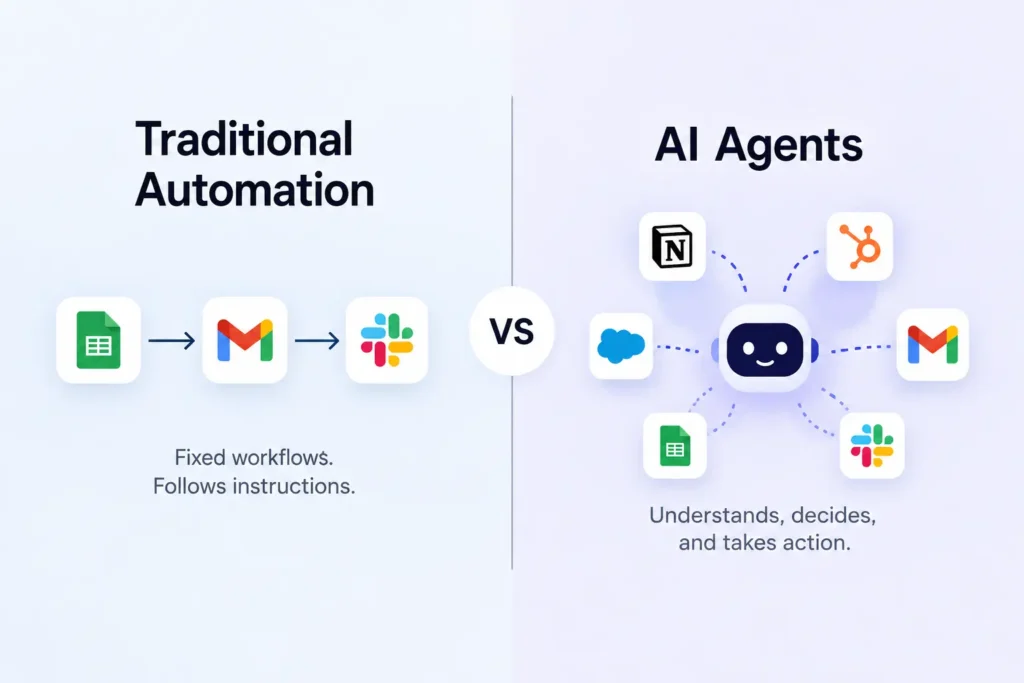
For most of the last decade, “automation” meant connecting App A to App B on a fixed trigger. The 2026 shift is from that model to AI agents that act across your stack with some independence — drafting a reply, deciding whether a lead is qualified, or fixing a workflow that broke when an upstream API changed, instead of just moving data along a predetermined path. Zapier and Make are both racing to add that layer on top of their existing automation engines; a newer set of platforms was built AI-native from the start.
Table of Contents
Zapier vs. Make vs. AI Automation Platforms at a Glance
| Factor | Zapier | Make |
|---|---|---|
| Integrations | 7,000–9,000+ officially maintained | 3,000+, with many community-built |
| Workflow style | Linear “Zaps” with Paths, filters, and Canvas | Visual graph canvas with routers, iterators, aggregators |
| Pricing model | Per successful task | Per operation (credit-based) |
| Starting price | Free tier; paid from ~$20/mo | Free tier; paid from ~$9–12/mo depending on billing terms |
| AI features | Copilot (build Zaps from plain English), AI Actions, MCP/SDK for agents | AI Agents, an MCP server, 350+ AI-specific app integrations |
| Best for | Fast setup, broad app coverage, non-technical teams | Complex branching logic, cost efficiency at high operation volume |
Zapier — Best Choice in Zapier vs Make vs AI Automation Platforms for Speed and Simplicity
Zapier’s real advantage is coverage: if a tool has any kind of API, there’s a good chance Zapier already has an officially maintained connector for it, which matters most for niche or industry-specific software that smaller platforms haven’t built integrations for yet. Its linear “Zap” builder, plus newer additions like Canvas for visual mapping and Copilot for building Zaps from a plain-English description, make it the fastest platform to get a non-technical team from zero to a working automation. The tradeoff shows up in complex, multi-branch logic — Zapier can do it with Paths and filters, but Make’s canvas handles it more natively.
Make — Best for Complex Logic and Cost Efficiency at Scale
Make’s graph-based canvas is built for exactly the workflows that feel cramped in Zapier: multi-path routing, iterators looping over data sets, and aggregators combining results back together, all visible on one screen. Its credit-based pricing can work out cheaper than Zapier’s per-task model at high volume, especially in workflows where a filter step rejects most incoming records before they hit the expensive parts of the flow — you’re only charged operations for what actually runs. The real cost is a learning curve steep enough that Make’s own support team recommends its training courses before teams build production workflows.
When Zapier or Make Isn’t Enough: AI-First Platforms
If the job is less “connect these apps” and more “let an AI agent handle this end to end,” a newer set of platforms is built around that instead of bolting it onto an existing automation engine.
- n8n — Open-source and self-hostable, with deep native LangChain support and code nodes for JavaScript or Python. The right pick for engineering-led teams that want full data sovereignty and are comfortable with a steeper technical bar than Zapier or Make. Self-hosting is free; n8n Cloud starts around $20/month.
- Turbotic — A Swedish automation company (founded 2020, originally in RPA) that launched a conversational, natural-language automation builder in late 2025. Its pitch is self-healing workflows: when an upstream app changes its API or UI, Turbotic is built to detect and patch the break rather than silently failing. It’s aimed at teams without a dedicated automation engineering staff, with SME and enterprise customers.
- Airia — An enterprise AI governance platform (founded 2024, headquartered in Atlanta) built by AirWatch’s former co-founder, combining agent orchestration with compliance reporting mapped to frameworks like the EU AI Act, NIST AI RMF, and ISO 42001. This is the tool for a security or compliance team that needs an inventory of every AI agent running in the business, not a general workflow builder. It has a genuine free tier (10 agents, 100 executions/month), with paid plans from $50/month for individuals and $250/month for teams.
- Lindy — Pre-built AI agents for specific jobs like inbox monitoring, scheduling, and meeting notes, where the goal is a fast, working agent rather than a fully custom orchestration layer. Paid plans start around $50/month.
How to Choose: A Decision Framework
- Start with what’s actually breaking down today — a specific manual process, not “we need automation” in the abstract.
- If it’s app-to-app data movement with light logic, default to Zapier; the setup speed and integration coverage will save more time than they cost.
- If the workflow has real branching — multiple conditions, loops, or data transformation — evaluate Make before you build it in Zapier with a pile of extra Paths steps.
- If you need an AI agent to make judgment calls autonomously (triage, drafting, decisions) rather than move data on fixed rules, look at n8n, Turbotic, or Lindy depending on your technical comfort level.
- If your blocker is governance, not capability — you already have AI agents running and need visibility, audit trails, and compliance reporting — that’s Airia’s job, not a workflow builder’s.
- Price out your actual expected volume before committing, since tasks, operations, and executions are counted differently across platforms and the “cheaper” tool depends entirely on your workflow shape.
What This Actually Costs in Practice
The three major pricing models count usage differently, and that difference matters more than the sticker price:
- Zapier charges per successful task — one action completed in a Zap. Triggers and filters are typically free; you pay for what the workflow actually does.
- Make charges per operation, and operations include triggers, filters, routers, and other internal steps, not just the final action. A workflow with a lot of branching logic can rack up operations quickly, but a well-designed filter that rejects most records early keeps costs down.
- n8n charges per workflow execution on its Cloud plan, or nothing at all if you self-host — at the cost of running and securing your own infrastructure.
There’s no universally cheaper option here; the same workflow can cost more on Make than Zapier or vice versa depending on how many steps it touches and how much branching it does. Map your actual workflow before comparing sticker prices.
Common Mistakes Teams Make Choosing Between These
- Picking Zapier for a workflow that’s fundamentally a data pipeline. Heavy branching and transformation logic gets clunky fast in a linear tool, no matter how many Paths you add.
- Picking Make without budgeting time for the learning curve. The visual canvas is powerful, but teams that skip training tend to build scenarios that are hard to debug later.
- Adding an AI agent platform before governance is in place. An ungoverned agent writing to your CRM or sending customer emails autonomously is a real risk — Airia and similar tools exist because “it works in testing” isn’t the same as “it’s safe to run unsupervised.”
- Comparing list prices instead of actual workflow cost. Tasks, operations, and executions aren’t the same unit — run the math on your specific volume before deciding a platform is cheaper.
FAQs
Is Zapier or Make better for small businesses in 2026?
Zapier is the faster starting point for most small businesses — broader integration coverage and a simpler builder mean less setup time. Make is worth the switch once your workflows involve real branching logic or you’re running enough volume that its credit-based pricing comes out cheaper, but budget time for the learning curve.
How do Zapier’s tasks, Make’s operations, and n8n’s executions differ in pricing?
Zapier counts successful action tasks, with triggers and filters typically free. Make counts operations at the module level, meaning triggers, filters, and routers all consume credits alongside the final action. n8n charges per workflow execution on its Cloud plan, or nothing if you self-host, in exchange for taking on your own infrastructure and security.
Can AI-first automation platforms replace traditional RPA tools?
For many use cases, yes — platforms like Turbotic are built to replace rule-based RPA with natural-language workflow creation and self-healing automation that adapts when an upstream app changes. The tradeoff is generally less granular, step-by-step control than a dedicated RPA tool offers, in exchange for faster build times and less maintenance overhead.
Is self-hosting automation (like n8n) worth it for compliance and cost?
It can be, particularly for regulated industries that need full data sovereignty or teams running high enough volume that per-execution cloud pricing adds up. The real cost isn’t the software — it’s the ongoing infrastructure, security, and operations work self-hosting requires, which is worth weighing honestly against what a managed cloud plan costs at your actual scale.